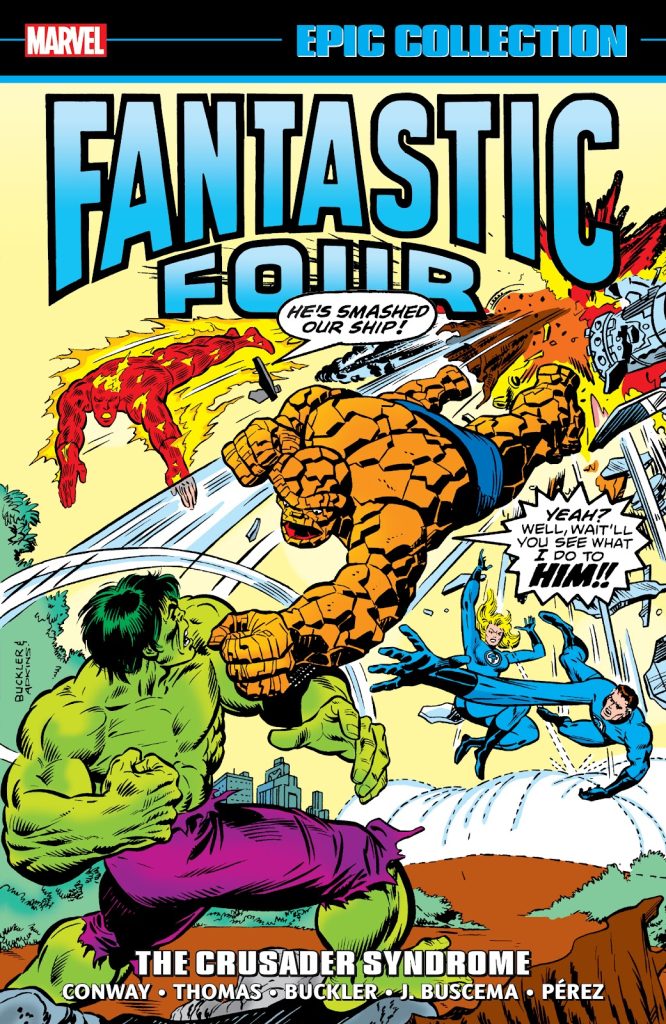

Review by Karl Verhoven
Back in 1974 Gerry Conway had good ideas for disrupting the status quo of the Fantastic Four family. In Annihilus Revealed he instituted friction between Reed and Sue Richards, previously the personification of marital happiness at Marvel, and stretches that further here in the opening story of Sue apparently deciding the Sub-Mariner is a better bet for a life partner. At the time Conway was a young writer, and the lack of emotional experience is evident. His drama is polished, but the feelings prompting it are unconvincing. “If only I knew what was right”, wails Sue, “Is it enough that he loves me?”
If that’s suspect, aggressive feminist Thundra meeting her male counterpart Mahkizmo is laughable in places. Conway’s best in this collection is the wedding of former FF member Crystal and Quicksilver, where emotions are well handled, while conceiving a viable threat to be dealt with in Steve Englehart’s conclusion starring the Avengers.
The best of four Giant-Size issues reprinted is Len Wein and Chris Claremont introducing Multiple Man, but most remaining content is written by Roy Thomas. As per his previous work on the FF, it’s patchy, the ideas generally strong, but the execution not always the best. The title strip exemplifies this, introducing the mystery of returned 1950s hero Marvel Boy, now calling himself the Crusader, amid a plot including social commentary, but his eventual defeat is all too convenient.
At face value the art is very serviceable from Rich Buckler generating the excitement of FF great Jack Kirby (sample page). However, online research has determined that’s because panel after panel is copied from Kirby’s work. It’s not the sort of behaviour expected from an artist then several years into a professional career. John Buscema’s contributions are sporadic, but extremely polished, while on later pages George Pérez is an artist then coming into his prime.
Thomas overwrites considerably, but should be credited for attempting to remove Invisible Woman from her past by conceiving more inventive ways to use her powers, although she fails to shine when featured in his best work. Collaborating with Len Wein, Thomas has the Silver Surfer blackmailed by Doctor Doom into attacking the FF. Their gloating Doom is a joy to read, and the solution is well worked. Better still are the four chapters of alternate worlds beginning with other-dimensional barbarian tyrant Arkon hunting down Ben Grimm. Thomas spotlighting a world where things turned out very differently for the Fantastic Four perhaps prompted the idea of What If…?, which began a long run the following year. Mysteries abound, and despite four chapters being unusual for the era, the pace never lets up.
In hardcover these stories can be found over Marvel Masterworks: Fantastic Four Volume 14, Volume 15 and Volume 16, while Thomas’ work alone features in Fantastic Four: Crusaders & Titans. In black and white look for Essential Fantastic Four Vol. 7, with the later inclusions spilling into Vol. 8.