Review by Woodrow Phoenix
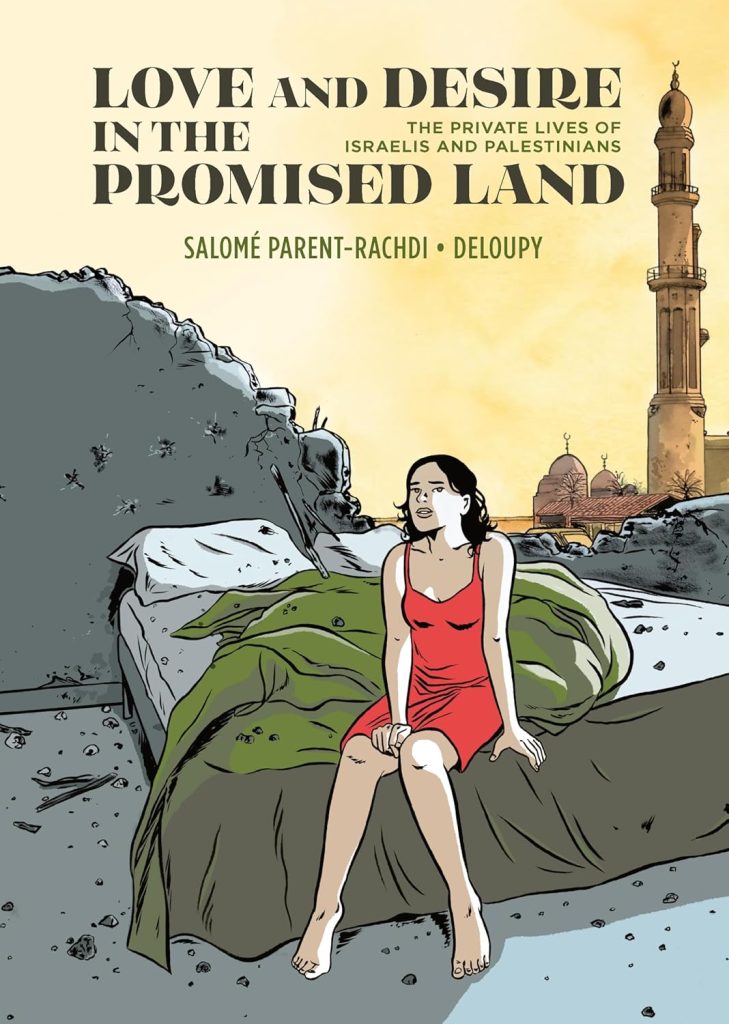
Love and Desire in the Promised Land: The Private Lives of Israelis and Palestinians fits somewhere between reportage and biography in its mission to uncover the complex lives of Arabs and Jews in mixed relationships. Salomé Parent-Rachdi, a French journalist based in Israel and Palestine for three years, conducted interviews in Tel Aviv, Jaffa, Jerusalem, Ramallah, and Nablus. “It’s a good way to talk about the conflict from a perspective you don’t normally take … it’s also the perfect pretext to talk about the groups who live on that little piece of land: Jews, Muslims, Christians, non-religious people. Russian speakers. Ashkenazi Jews, Sephardic Jews… What interests me is when desire pushes toward the ultimate transgression: breaking your own people’s rules to give yourself over to another, or to free yourself.”
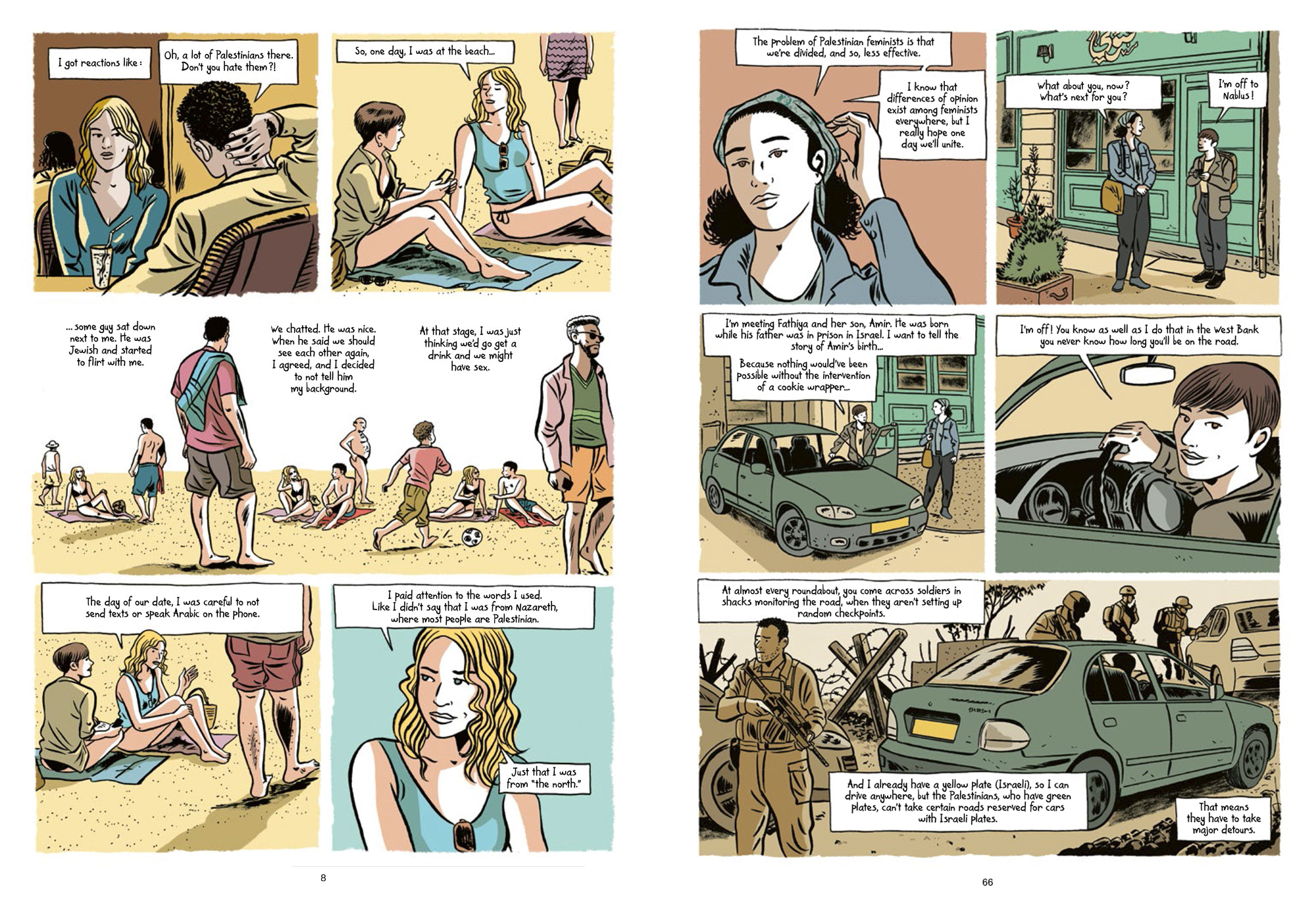
Artist Zac Deloupy draws the journeys she makes to meet her interviewees through checkpoints, inspections, security turnstiles, permit stamps and more checkpoints. His straightforwardly descriptive images are very good at giving a flavour of the people she meets and their stories, including an Arab woman whose blonde hair and blue eyes disguise her Palestinian roots; a famous Jewish actor and an Arab TV news presenter whose marriage makes them a media ‘power couple’; a young Muslim man who hides his gay identity from his community while he has sex with self-hating Jewish men who are hiding theirs; a Palestinian woman in a lesbian relationship with a much younger, significantly less self-aware Israeli soldier, and many others.
They all share a mixture of repressed anger and guilt underlying choices that come with unequal power relations between an upper class and an under class. It’s coupled with the pressure of going against every cultural norm proscribing how men and women should behave, with no room to maneuver for anyone who deviates. It’s hard to tell who has more to lose. “Here, going out with Jewish men and women when you’re an Arab, that implies that you have connections with Hebrew,” says Samira, a Palestinian film director. “The language you speak is the language of power. After that, it’s impossible to be equals and avoid domination.”
The interviews and most art was completed before October 7, 2023, when what was already a brutally inhuman territory careened toward a devastated warzone. The ever-present threat of violent punishment for the political and religious transgressions of the couples shown here is more disturbing in the light of what has happened since. With the erasure of Palestinian life in Gaza near complete and the extension of the occupation project to neighbouring Lebanon, Parent-Rachdi and Deloupy are well aware of how that changes what we read, providing a foreword and an epilogue updating us on where everyone in this book has ended up since the genocidal assault began.
Does it help? Not really. Despite the skill of Deloupy’s drawing, Parent-Rachdi’s ability to get fascinating details out of her interview subjects, and Jenna Allen’s excellently fluid translation, it is not news to anyone that Israelis and Palestinians are both feeling beings. Israelis don’t need rehabilitation for only being a nation of 60% monsters instead of 100%. Love and Desire in the Promised Land won’t change your mind in either direction, but it does fill in a few knowledge gaps.