Review by Frank Plowright
The world has turned upside down. Black is white, and self-serving politicians refuse to call out atrocities being committed by Israel in Gaza, while news reporting rarely challenges the Israeli assumption that it’s perfectly acceptable to kill all occupants of a building because someone associated with Hamas has allegedly been tracked there. Hamas is an appalling, ruthless organisation unconcerned with human life, but when did it become acceptable to murder any amount of civilians on the off chance of killing one of their members? Welcome to Gaza. Welcome to Hell.
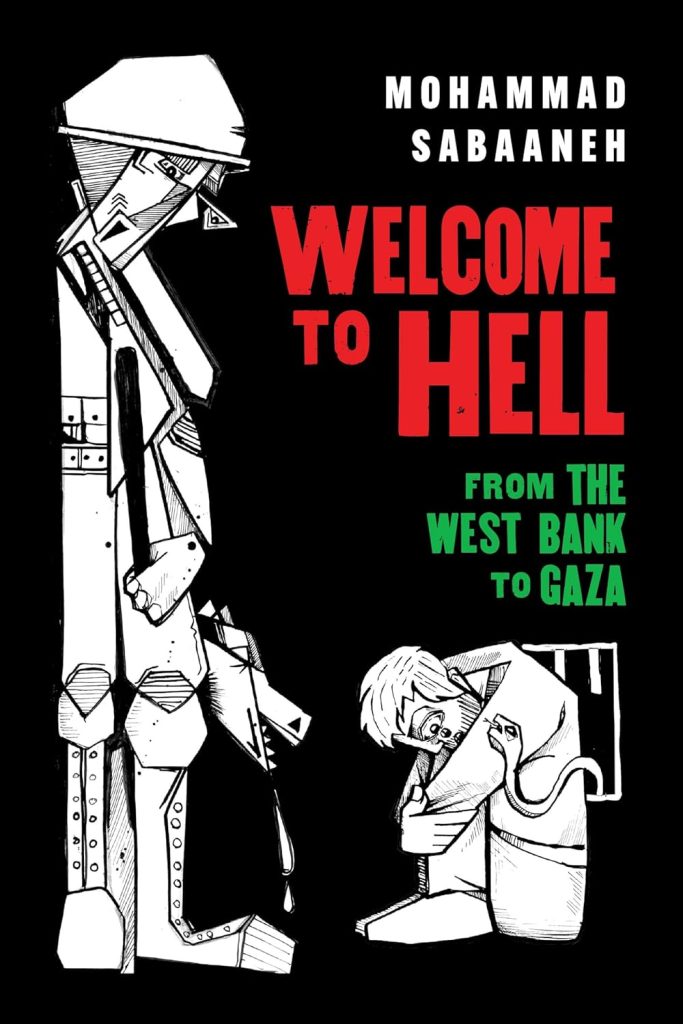
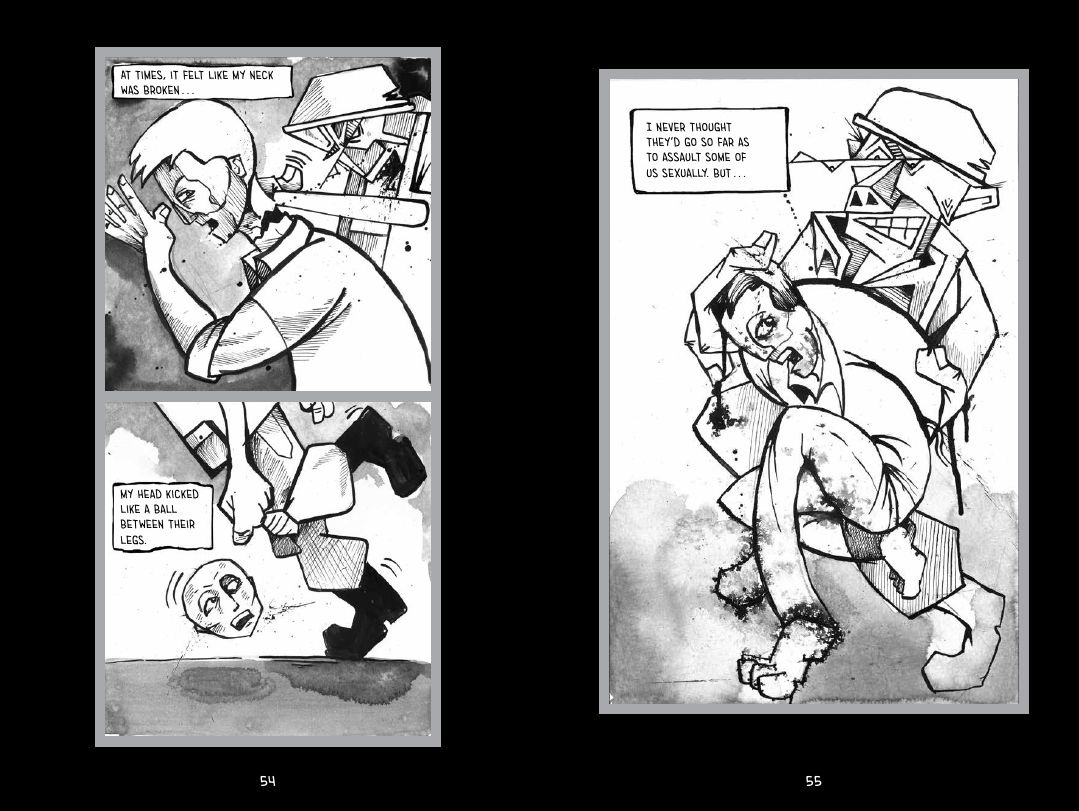
Mohammad Sabaaneh is a journalistic cartoonist who’s published collections of his work, and begins Welcome to Hell by relating his own experience and that of his brother as they’re randomly beaten by occupying Israeli troops for no given reason as they travel home from Europe. Adel is detained and beaten for longer, after which Sabaaneh moves forward by presenting what life is like for Palestinians in Israeli prisons.
Because the topic is so contemporary and because the world largely turns a blind eye to Gaza, the hope would be that Sabaaneh’s reportage is consise and hard-hitting, but it’s not. It’s an endlessly frustrating parade of missed opportunities drawn in a style that never settles into consistency.
It may be attempting to convey the disorientation of Palestinians in Israeli captivity, designed to be confusing and leave questions unanswered. For starters, whose experiences are being shown? Is Thamer a generic representative undergoing the accumulated experiences of many or a specific individual? In the face of the reprehensible dehumanising treatment detailed that may seem irrelevant, and an afterword detailing sources would suffice, but testimony needs to be attributed. Some context is also needed. Fellow prisoners arrive and are commented on, but in vague terms. These people aren’t anyone we come to know, just a procession of anonymity. The same applies to key sequences such as Thamer’s trial, which is shown starting in unacceptable fashion for what’s held up as an unbiased process, but truncated and not mentioned again. Yet, there’s room for several pages of Thamer forestalling hunger by imagining a meal at home with his family.
Even allowing for an illustrative background where a single image making a point is all-important, Sabaaneh’s art doesn’t serve events well. Scratchy elusive figures give way to more detailed illustrations, panels are placed within large black surrounding areas and when there’s a chance to make a point in a single powerful illustration it’s not taken.
What happens in Israeli jails is barbarous, and Welcome to Hell’s most powerful moments are when simply noting everyday transgressions such as guards stamping on food before it’s given to near starving prisoners, or the final indignity of not being freed without a returning a never supplied coat.
Welcome to Hell is so disappointing for being an opportunity to shine a light on abhorrent behaviour, and while rightful anger is present, it seems more concerned with form over content.