
Review by Ian Keogh
To most in the world he occupies, Junkyard Joe is a cartoon character seen in a daily newspaper strip, but to Muddy Davis, creator of that strip, he’s something else altogether.
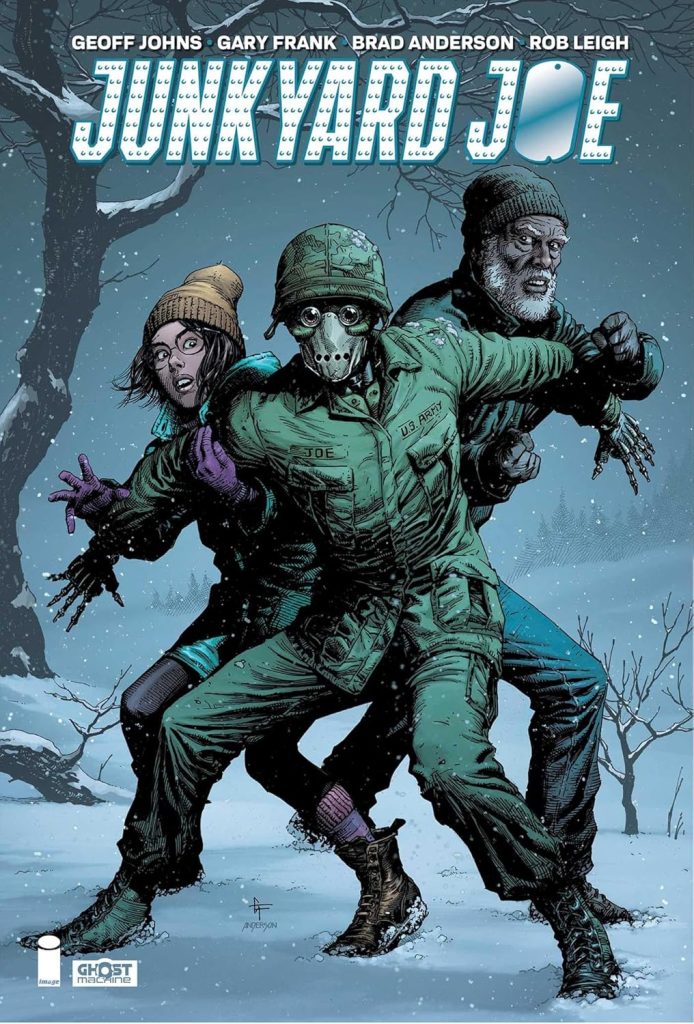
Joe is first seen in 1972 in wartime Vietnam, with latex features covering a robotic body assigned to a platoon of American soldiers. The covering doesn’t survive a first attack, revealing the metal beneath. Muddy is the only soldier thereafter to attempt contact with the creation he names Joe, finding Joe’s inability to speak a useful confessional tool.
Having a protagonist who not only doesn’t talk, but also has no narrative captions is a brave move for a writer, but Geoff Johns is allied with Gary Frank as artist, and he has the nuance required to convey what’s happening. Joe is actually learning from Muddy, taking on his ethical values, and that leads to a surprise when he’s last seen in a chapter exclusively set in Vietnam. It’s a steep learning curve and cameos from Richard Nixon and Hawkeye Pierce are icing on the cake. Frank’s adaptability extends beyond likenesses, though, as he later displays a neat turn as a charming cartoonist.
Although Junkyard Joe’s seen in the Geiger stories, his solo outing takes place in a world still recognisable as our own. Beyond the opening chapter Muddy is seen as an old man just retired in a remote Indiana town and mourning the passing of his recently dead wife. A family have moved into the empty house across the road. The story is titled after Joe, so it’s no spoiler to reveal he also turns up in Indiana. The family are needed as a parallel theme of escaping, while sensitive teenage daughter Emily becomes a primary character. A little too much time, though, is spent on their settling in problems when Muddy, Joe and what’s coming after him are far more interesting even if just handling domestic chores.
Whatever you might expect from a robot created to fight in Vietnam, Johns and Frank are likely to confound those presumptions. Johns’ work for DC could feature gratuitously unpleasant scenes, a definite weakness from a superior superhero writer, but despite villains, violence and warfare this is a very human and sensitive story all the more remarkable for the main character remaining silent. It’s written to a feelgood cinematic template, but the presence of a silent robot designed as a killing machine ensures Junkyard Joe never strays too far into sentimentality. Both Johns and Frank have sparkling back catalogues, but this ranks among their highlights.
Word of mouth has spread a reputation, and in 2024 an oversized hardcover Deluxe Edition was published.