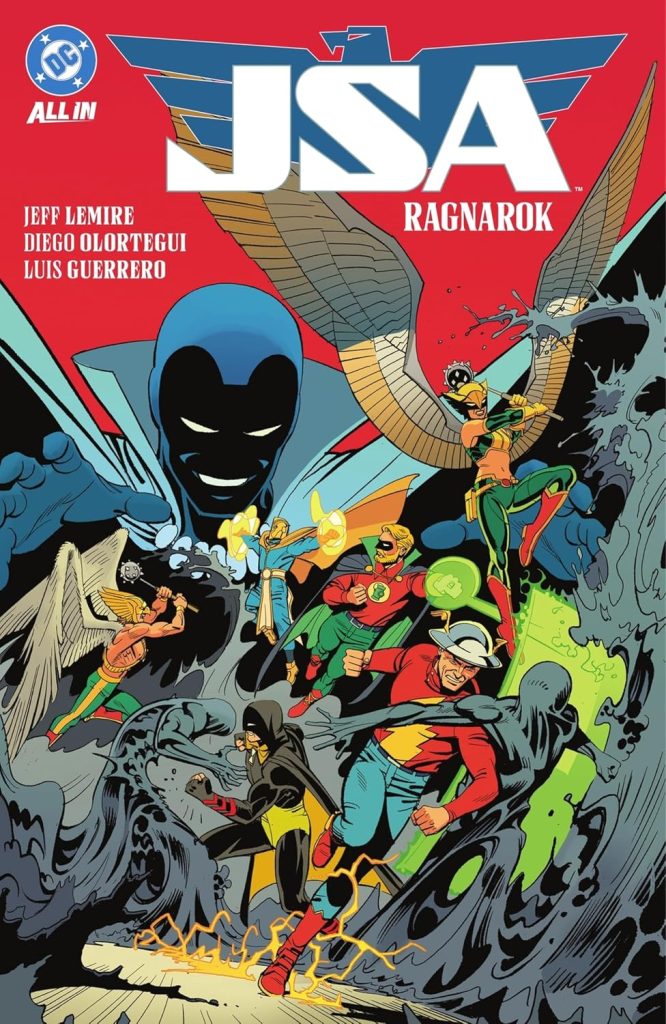

Review by Karl Verhoven
The Justice Society is DC’s oldest super team, a legacy organisation serving as the inspiration for all who followed. Infinity Inc. vs. the Justice Society, though, showed a team riven with disagreements, manipulated by the Injustice Society, and a member down in the final pages. Some of the team suspect, but haven’t yet proved, that one among them is a traitor. They’re right, and readers know Obsidian has been replaced by a disguised Johnny Sorrow.
Ragnarok opens with some team members still missing or out of action, and a memorial.
Over the twelve chapters of this and the previous collection it seems as if Jeff Lemire is trying to feature anything he ever liked about the JSA. The legacy aspect of heroes training their successors is magnified, there’s a trip back to the team’s earliest days in the 1940s, objects associated with previous stories play a part, and there’s a determination to pack the cast, which is a drawback. Starman, though, is mysteriously missing. Including such a massive amount of characters and giving them all a story leaves large gaps between catching up with them, some absent for entire chapters. Timescales are also fudged to accommodate this, so the tension is artificially maintained. That also applies to the villains, and the added problem about them is the lack of a convincing reason why they’d want to follow a person whose objective is pretty well turning over control of the planet to demons. “When it’s all over (they) promised me Europe” might have convinced a 1970s audience, but falls flat here.
Primary artist Diego Orlotegui is certainly a sympathetic collaborator, unafraid of defining multiple characters whose feelings are apparent and who look good in action, There have been subtle alterations to costume designs, all improvements, and a heroic stature is maintained throughout. Roberto De La Torre and Gavin Guidry also impress with their chapters, and their contributions mesh well for a continuous story.
A new Kid Eternity was introduced in the previous volume and while their story is dragged out, it eventually results in a decent pay-off, although as part of the cost is the death of a long-running character, it’s not going to please everyone. Lemire has also introduced insecurities among the younger JSA members, and while a fall and rise arc is predictable, indeed probably what most readers want, it’s well played out and ends with a foreboding prologue featuring a JSA member otherwise unseen.
What’s a stirring twelve chapter story reinforcing what the JSA is will ultimately stand or fall for individual readers on how beloved the discarded character was to them. Lemire’s JSA continues with Year One.