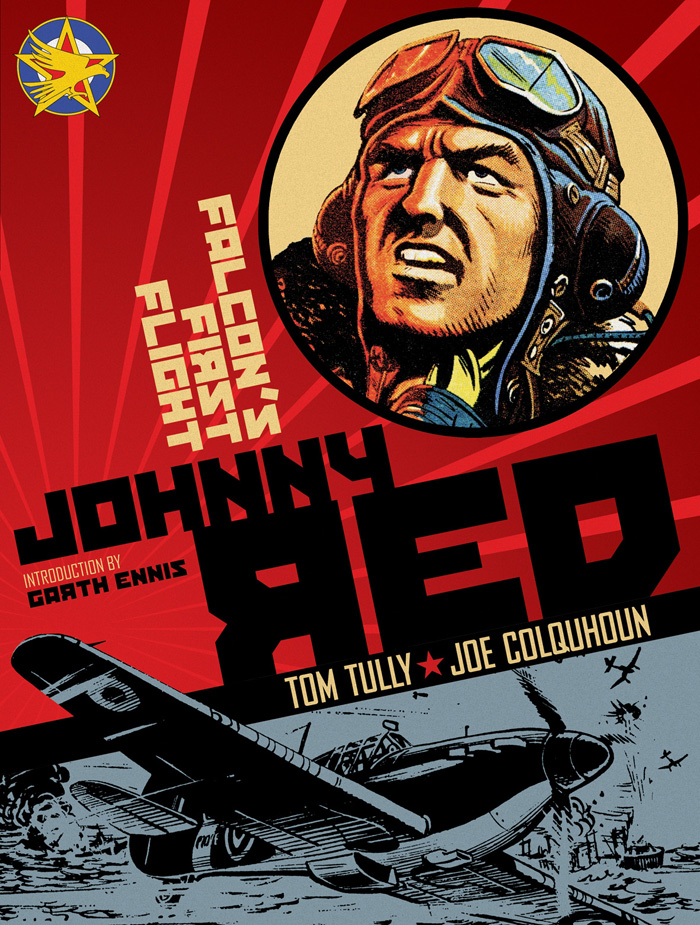

Review by Ian Keogh
Even those who thrilled to Johnny Red’s serialised adventures back in the 1970s and 1980s may not have realised the story of a British pilot who ended up in Russia was based on fact, as revealed in an introductory article by Jeremy Briggs.
Tom Tully transposes those real events onto Johnny Redburn, just nineteen when he takes control of a Hurricane fighter plane during a desperate battle in the Arctic sea, but as he didn’t have permission, rather than ditching after his success, he flies on to land in Russia. He arrives at a remote base written off by Soviet commanders, with the residents as likely to die from their own side’s shells as enemy attacks, and completely demoralised. Johnny’s arrival revives some spirit.
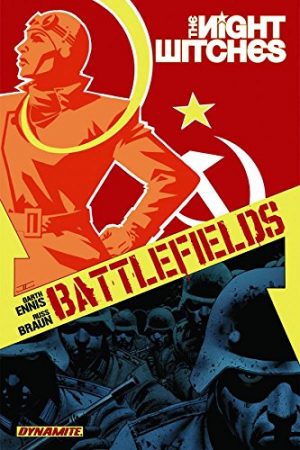
There’s much to admire about Johnny Red from the earliest strips. An introduction from Garth Ennis highlights how different Johnny’s working class background was from the standard wartime hero presented in comics. Before Battle, the weekly title carrying Johnny’s adventures, readers were given wartime heroes they were supposed to look up to rather than people they could identify as one of their own. After much work by Ennis, it’s no longer as startling, but worth mentioning. Also notable is Johnny’s no-nonsense attitude, while Tully introduces credible dilemmas, although sometimes melodramatically staged, particularly Johnny occasionally becoming blind.
Joe Colquhoun draws all the strips in this collection, and it’s a feature he grows into. His signature detail and precise inking is apparent from the beginning, but it’s really only when the stories evolve to encompass something more than aviation scenes that he comes into his own. He builds a regular cast, packs every panel with detail. and the weapons and vehicles show a depth of research in creating a convincing environment. Colquhoun’s also fantastic at realistic debris when boats, tanks or planes are destroyed.
Tully writes to the British boys’ comics formula of each three page episode starting by resolving a cliffhanger then using the 25 or so panels to build to the next cliffhanger. However, within that the excitement still transmits. Johnny Red is well researched, the bear-like Yakob is a distinctive strongman and Tully’s most hateful creation parrots Soviet ideology with no concern for human life. There’s an initial chronology from 1941 into 1942 and the siege of Leningrad where Tully makes good use of the appalling conditions before taking a looser approach to time.
The brief Tully fulfilled back in the day never incorporated the idea of collections, and the presumption was that a gap of several months of weekly episodes before reworking an idea was enough. It leads to a few too many cliffhangers too conveniently resolved. However, read any dozen episodes and Johnny Red still provides thrilling aerial action exposing the horrors of war in Russian winter in brilliantly drawn three page episodes.