Review by Lewis Savarese
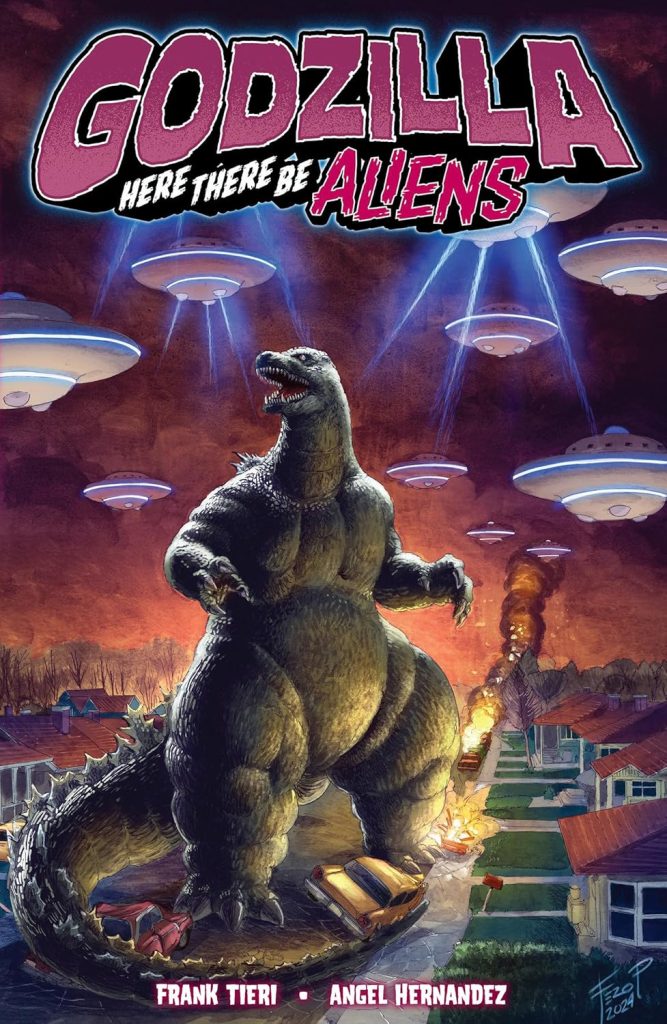
For the finale of his Here There Be trilogy, Frank Tieri resumes the King of the Monsters’ romp through recorded history in the 1950s with Godzilla: Here There Be Aliens. Inaki Miranda, artist for the two preceding volumes, doesn’t get the chance to usher Godzilla into the 20th century, but Angel Hernandez is a suitable replacement. Here There Be Aliens is a homage to the alien invasion films of the 1950s without the Cold War anxieties or modern day equivalents that underpin the genre. As Tieri’s trilogy draws to a close, the thesis that emerges from his fusion of Godzilla IP and pop history can only be described as “Godzilla Meets the Great Man Theory of History.”
In 1954, Agent Bob Jones is the sole member of Project Colossus, a United States Department of Defense program designed to prove the existence of kaiju and assess their threat to national security. When Jones presents his findings to his superior Director Stone and various agents during a briefing he is laughed out of the room, only to be vindicated later that night when Godzilla surfaces in Japan. Men in black swiftly abduct Jones at the behest of Dr. Kyoto, a government official who leads the real kaiju program located at Area 51.
What transpires next is the age-old battle of exposition versus action, with a strong showing from the exposition contingent. Like journalist Mortimer Lane from Godzilla: Here There be Dragons II – Sons of Giants, Agent Jones is the audience surrogate who exists to receive a constant barrage of exposition from Dr. Kyoto. Kyoto explains to Jones why the cliffhanger from the previous volume in which the Xiliens were primed to invade Earth in 1804 never materialized: a war broke out between them and the Simians that lasted 150 years. Having recently won the war, the Xiliens focused their attention on Earth once again. Godzilla sensed the imminent invasion and made landfall in Japan followed by kaiju activity across the globe.
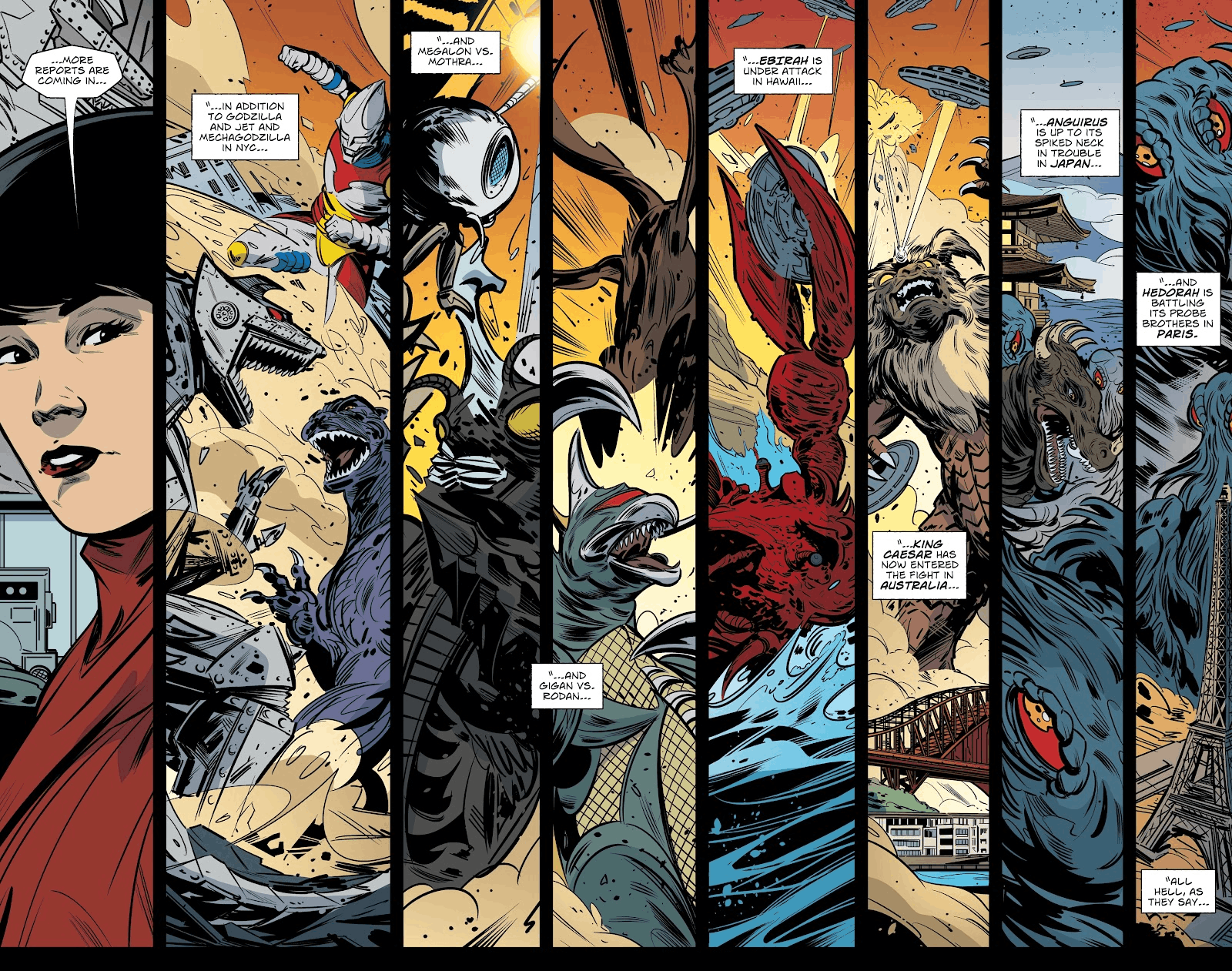
Unlike the previous entries, here most of the action happens in real-time, but Tieri still struggles to balance multiple narrative threads. We spend an inordinate amount of time with the milquetoast Agent Jones who, for a kaiju-believer, reacts to everything Dr. Kyoto says with incredulity. When the perspective shifts to the Xiliens their commander spouts trite directives such as “We are ready for phase four” instead of anything meaningful. Hernandez’s clean lines capture the mid-century milieu and his kaiju beatdowns evoke the best of the Showa Era, even though Tieri’s drive-in theatre sensibilities fall flat. Tieri clearly subscribes to the school of thought that interprets B-movies as hokey products of a bygone era. Noticeably absent from Here There Be Aliens is the mention of nuclear weapons which factored into many 1950s sci-fi films, including most obviously 1954’s Godzilla. It’s a missed thematic opportunity considering the Doomsday Clock is closer to midnight than ever before.
Alas, Tieri is content with smashing action figures together on the sitting room floor, as Dr. Kyoto exclaims “May he who has the biggest monster toys win.” Your favourite kaiju probably appears for a panel or two fighting against or alongside your second favourite. Tieri does allow the kaiju to stand shoulder to shoulder with history’s ‘Great Men’ represented here as the Sons of Giants, a kaiju-worshipping secret society. President Abraham Lincoln, Archduke Franz Ferdinand, and even American mobster Bugsy Siegel dedicated their lives to protecting the kaiju who in turn protected Earth. Ultimately reinforcing an outdated historical theory that venerates male leaders above all else, seals a vacuous Godzilla graphic novel.