
Review by Frank Plowright
In the mid-1990s Jim Lee could do no wrong. Not since Jack Kirby in the 1960s had there been the same combination of writer, artist, conceptual mind, talent and speed. He blazed through Marvel, most prominently on X-Men, and when it came to creating projects for his own WildStorm imprint his finger was on the pulse of the zeitgeist and he was a great spotter of talent. A rush of associated titles connected to a single event contributed to a bigger picture, and where this Lee proved far more talented than Kirby was via marketing. He knew how to sell the artwork, supplied alternate covers, and rushed his material into paperbacks and kept them in print.
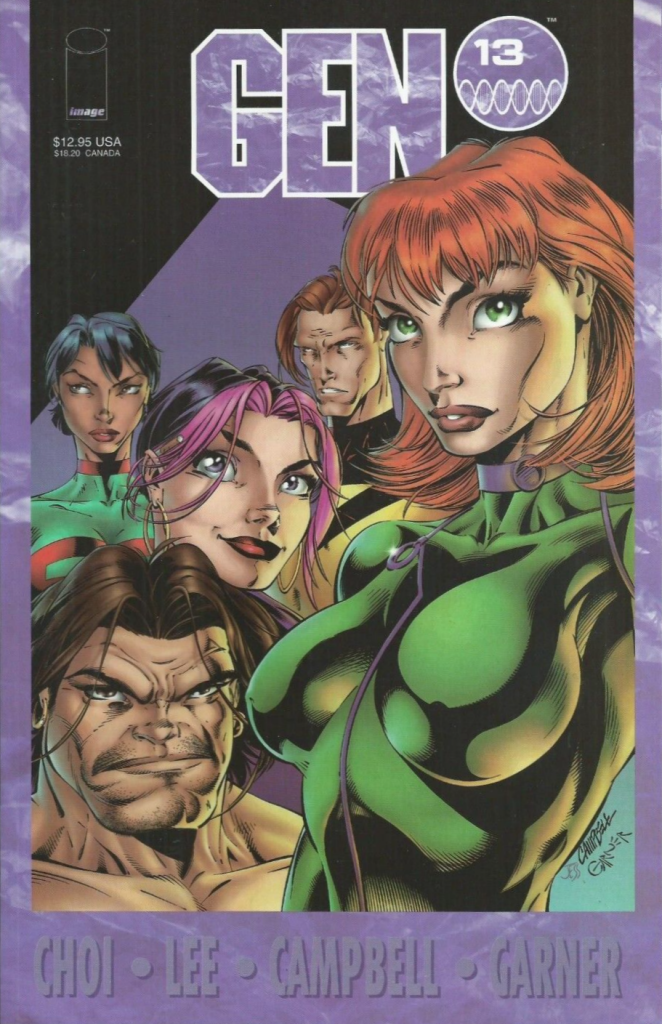
Gen 13 was his final big launch, a group of teens with super powers finding their way in a hostile world. The teenage aspect instantly invites comparisons with X-Men, as does their being guided by another hand, although in this case its veteran spymaster Ivana Baiul who’s far more manipulative than Professor X. Burnout, Fairchild, Freefall, Grunge and Rainmaker are all descended from IO operatives who were experimented on to give them super powers, and have powers themselves. Lee, co-writing with Brandon Choi, ensures these are realistic teens of the 1990s, largely rebellious, experimental and unsatisfied, instantly removing them from the compliant teen superteams of old.
At this stage in his career artist J. Scott Campbell exemplifies the term style over substance, able to produce dynamic looking pages in a superficially attractive style, but with a woeful sense of anatomy and proportions. Women are objectified throughout. He’s a quick learner, though, and chapter by chapter there’s improvement to the art. He never entirely masters anatomy, but his people gradually coalesce into a consistent style. Like Lee’s own art, it’s fussy with detail on costumes and tech, but Campbell’s backgrounds are largely filled by colour.
The five chapters introduce the team, establish what they can do, spotlight the people wanting to exploit them and muddy the waters by guest-starring the now long forgotten Pitt. By the end they’ve learned some hard truths and are ready for their next stage in Starting Over.
To readers exposed to Gen 13 at an early age the dynamism will still resonate, and they’re now at the ideal age to have those memories reactivated by this material being reissued in hardcover as part of Starting Over: The Deluxe Edition. However, anyone older will despair at the lack of structure, and today’s superhero readers will find it very much of its time.
Before this edition, the same content was issued over several printings of Gen 13: The Collected Edition, and the material’s also available in black and white as part of Gen 13 Archives.