Review by Frank Plowright
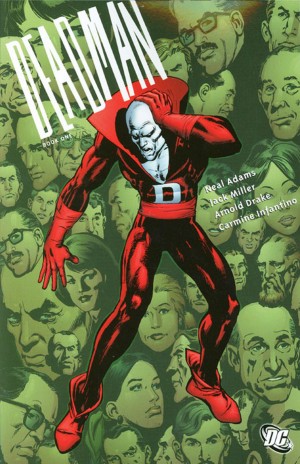
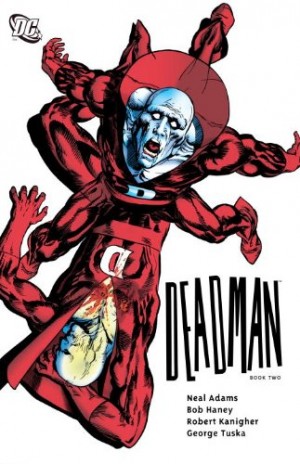
Issuing Deadman’s appearances chronologically from the 1960s to the 1990s in a series of five books awkwardly forces together material taking vastly different approaches to the character. It’s very apparent over the two main stories in this final collection.
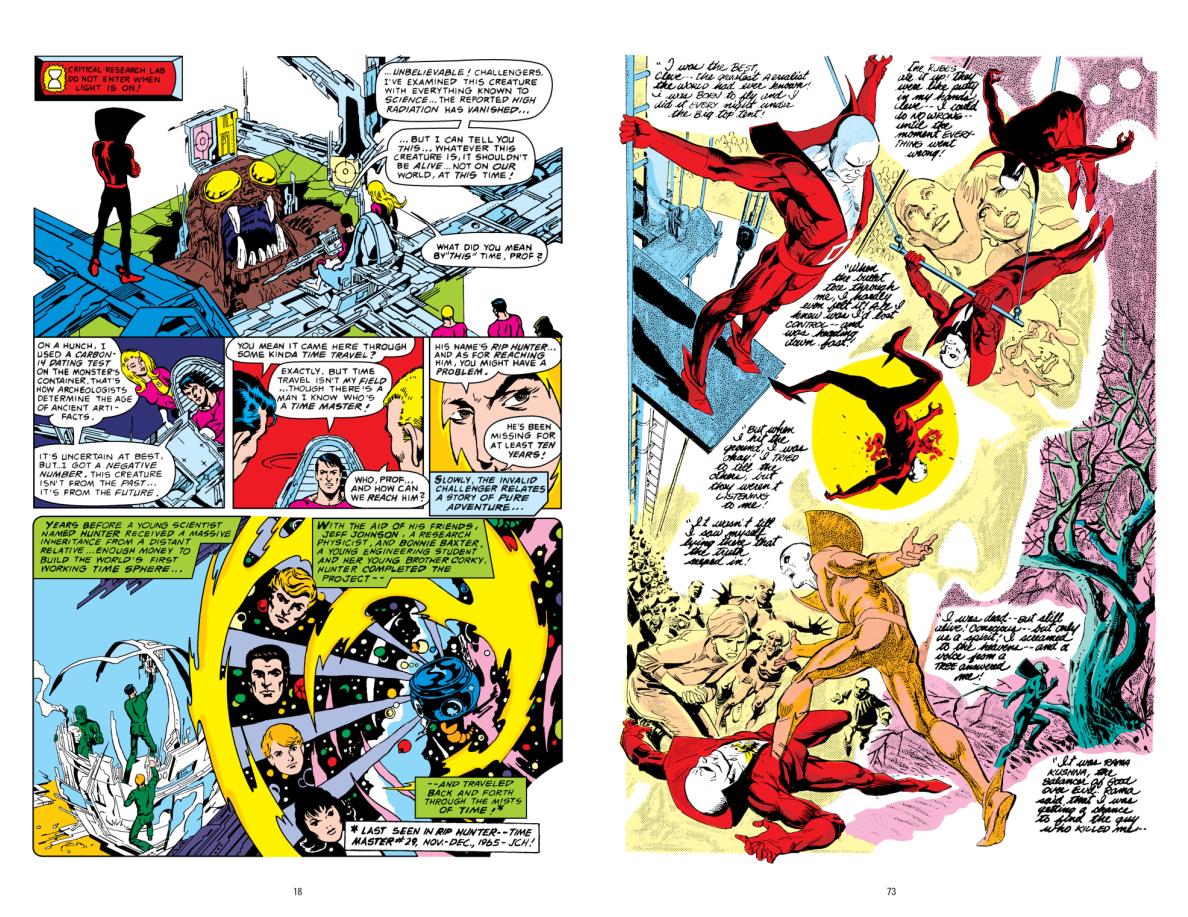
It opens with the last three chapters of a continued story under the Challengers of the Unknown title. Deadman has obviously been hanging around before it picks up, but as he’s a ghost the Challengers are unaware of his presence. In the late 1970s Gerry Conway used the Challengers series as a home for assorted characters without their own title, so Swamp Thing and Rip Hunter also feature in an increasingly convoluted story looking better than it is due to Keith Giffen’s experimental art.
Giffen doesn’t start well, with poor figures and layouts, but within a few pages he’s settled into a style seemingly influenced by European SF comics of the era. It’s detailed and imaginative, with the designs good on both monsters and futuristic societies. Deadman’s part is largely to discover what’s going on in the future by possessing body after body and accessing memories. The rapid ending indicates a story intended to run longer having to be wrapped up in a couple of pages.
Far better are the four chapters from 1986 by Andy Helfer, featuring the peerless art of José Luis García-López. Helfer once again opens the door to Boston Brand’s past as a murdered circus aerialist saved from death by a mystical presence and returned to Earth to locate his killer (as seen in Book One). It opens in the middle of events, with Deadman in the one place he can still pass as human in his own body, which is Helfer’s way of stating he’s revising all continuity since Book Two. Deadman’s not happy in his situation, which then escalates, as he’s assassinated a second time in the same circumstances when possessing his brother’s body during a circus act. The spiritual conundrum is only one of them being able to pass on to eternal rest.
García-López presents a masterclass in how to tell a story. Immaculate technique combined with imaginative page design results in a collection worth buying to swoon at the art alone.
There’s a problem with Helfer’s plot being dependent on people dropping cryptic comments to Deadman about impending danger rather than spelling out the circumstances, but once underway it’s also imaginative. It tinkers intelligently with Deadman’s origin, provides a backstory and purpose for Batman foe Sensei and his League of Assassins, features creative methods of limiting Deadman, and dangles the temptation of trouble in paradise. It’s good, but massively elevated by the art.
Having ended one aspect of Deadman’s continuity, Helfer then returns to his origin, presenting in it in a more cohesive fashion via viewing surrounding events at the same time as a still living Brand perfects his aerial act. It lacks the mystery that subsequently sustained the original series, but telling the origin from a different viewpoint and having it contextualised by the previous material drawn by García-López results in a better story than might have been assumed when read as an individual comic. Kevin Maguire’s clear art is excellent, and it’s a rare collection featuring someone even better.
It’s probably necessary to be invested in Deadman as a character to take the most from Book Five, but anyone can appreciate the art.