Review by Frank Plowright
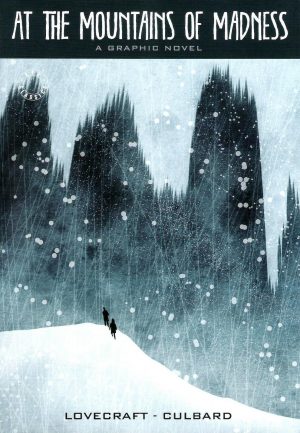
H.P. Lovecraft’s atmospheric horror stories, originally pulp material, have a reputation that grows generation by generation, yet At the Mountains of Madness was originally rejected by publishers. It’s one of Lovecraft’s few novel length creations, and as such offers greater immersion and tension than his short stories. Perhaps in Japan it’s not been as frequently adapted, but there’s no shortage of English language graphic novels, with four since 2010 alone. What this version has going for it, though, is the stunningly dense art of Gou Tanabe, which resulted in award nominations for the 2019 smaller paperback editions, yet can be far better appreciated at the larger size of this Deluxe format.
Tanabe is a master craftsman whose panel and page compositions are invariably thoughtful and precise, and his actual art delicate, expressive and subordinate to telling a story. Yet, pin-up spreads supply emphasis and period detail is entirely credible, and probably researched in depth. The sheer detail of the sample art featuring a boat kitted out for an Antarctic expedition shows far greater effort than most artists would provide, yet it’s merely the background for a scene-setting conversation. When later in the story he provides the excitement of storms in the Antarctic, astonishing ancient civilisations, and seventy pages of myth creation Tanabe’s magnificent.
The plot concerns a trip in the late 1920s to Antarctica, then for the most part unexplored and believed to be largely bereft of life, yet an advance party has been slaughtered. After establishing that we flash back to Professor Dyer and his assistant Danforth first meeting those who will die and how their exploration unfolds from there to the discovery of ancient horrors. It’s a long, segmented journey sustained by suspense about the unknown, but unlike some other Lovecraft material this isn’t mostly tease with only a brief pay-off. Instead the myth creation is fundamental to the shared world of his other works.
A feature of Tanabe’s adaptations is attempting to keep as much dialogue as possible from the original story, no matter the restrictions it imposes on his art, nor how long it extends the book, and it’s the faithful approach he takes here. As Lovecraft can over-write, respecting his text isn’t always the best idea for comic adaptations, but Tanabe is aware of this, so structures the story to pace longer descriptive sections via illustration, breaking them down smoothly.
Reputation notwithstanding, Lovecraft’s singular form of horror isn’t to all tastes, but if any graphic novel can convert the sceptics it’s this one.