Review by Win Wiacek
Floyd Gottfredson started out as just another warm body in the Disney animation factory. Happily, he slipped sideways into graphic narrative and evolved into a pioneer of pictorial storytelling. Gottfredson’s Mickey Mouse entertained millions – if not billions – of eagerly enthralled newspaper readers and shaped the very way comics worked. Via some of the earliest adventure continuities in comics history he took a wildly anarchic animated rodent from slapstick beginnings and transformed a feisty everyman/mouse underdog into a crimebuster, detective, explorer, lover, aviator and cowboy.
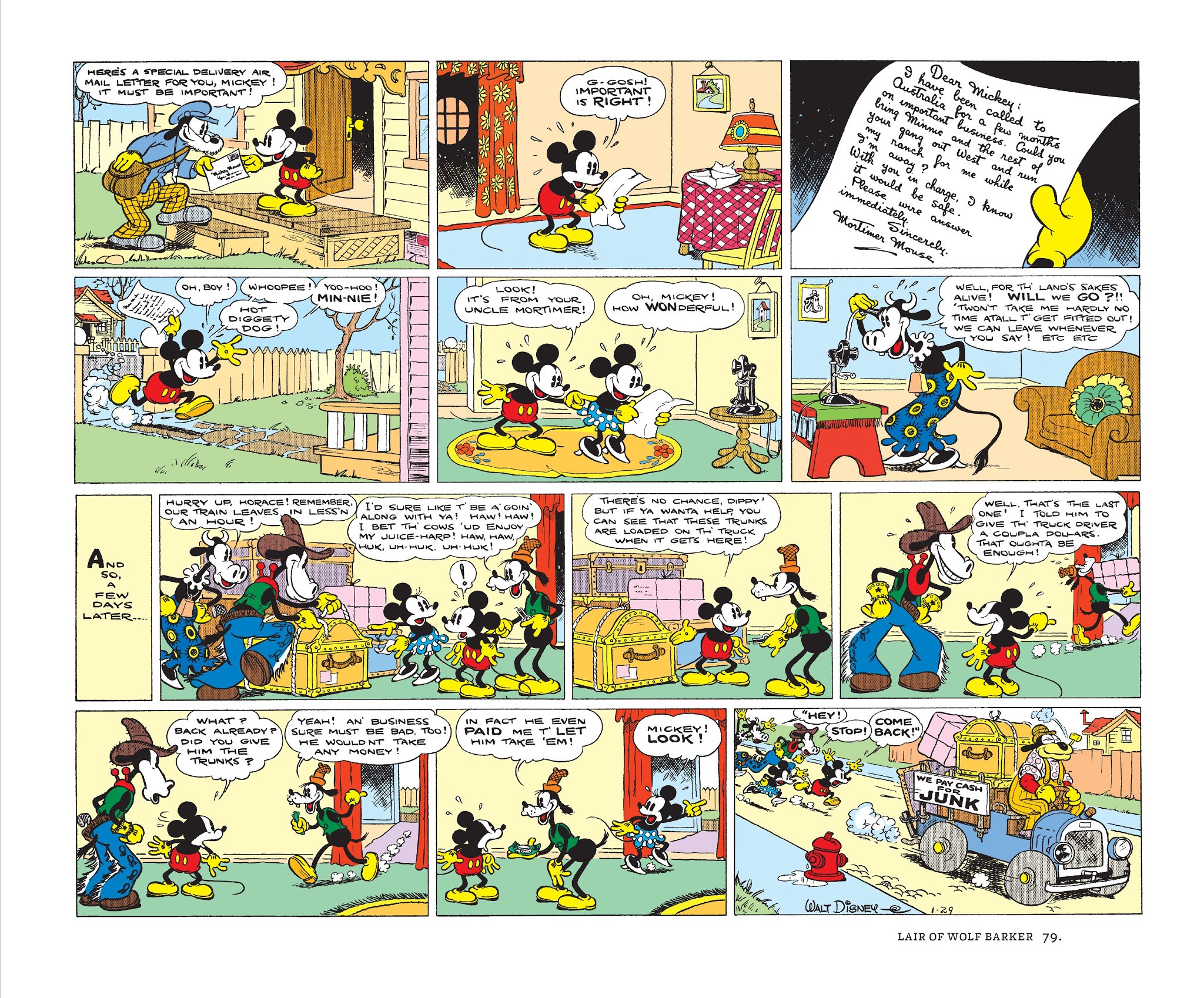
His first effort saw print on May 5th 1930 (his 25th birthday) and Floyd just kept going for fifty years. On January 17th 1932, Gottfredson crafted the first colour Sunday page, which he also handled until retirement. At first he did everything, but in 1934 Gottfredson relinquished scripting, preferring plotting and illustrating the adventures to playing about with dialogue. Thereafter, collaborating wordsmiths included Ted Osborne, Merrill De Maris, Dick Shaw, Bill Walsh, Roy Williams and Del Connell. At the start and in the manner of film studio systems, Floyd briefly used inkers, but by 1943 had taken on full art chores.
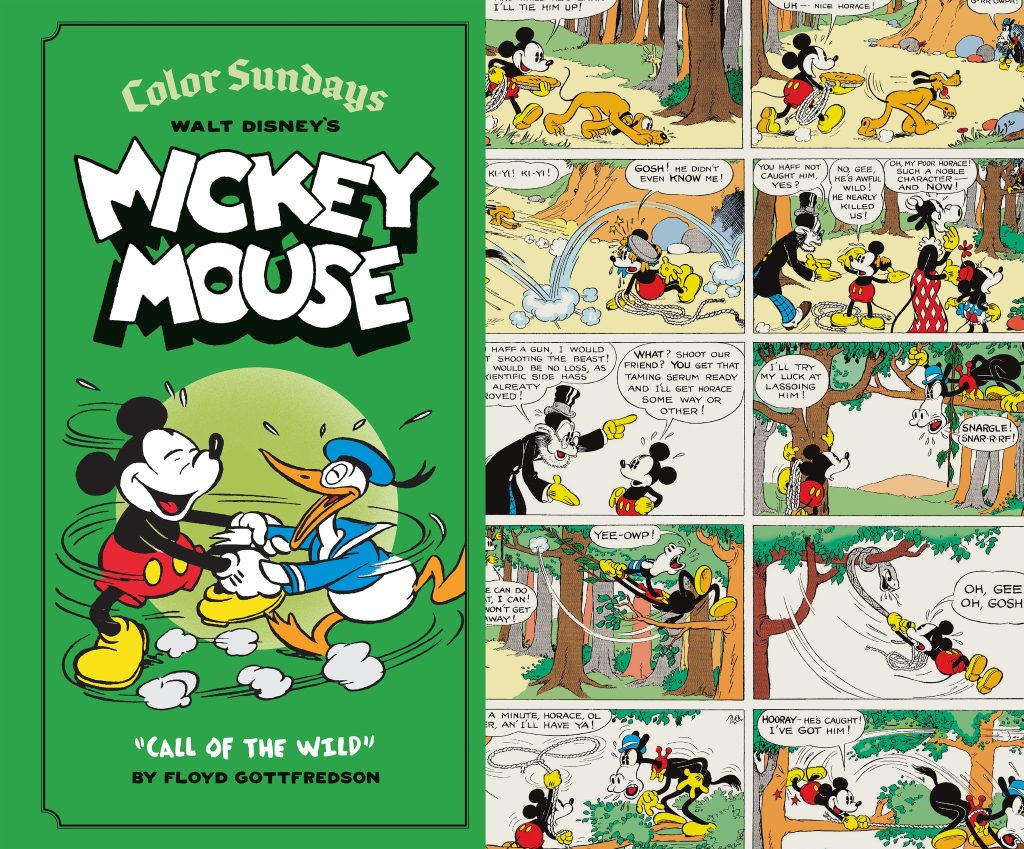
This superb archival compendium – part of a magnificently ambitious series collecting the creator’s entire canon – re-presents the initial colour sequences, jam-packed with thrills, spills and chills, whacky races, fantastic fights and a glorious superabundance of rapid-fire sight-gags and verbal by-play. The manner by which Mickey became a syndicated star is covered in various articles at the front and back of this sturdy book devised and edited by truly dedicated, clearly devoted fan David Gerstein who also provides an introduction. The tome is stuffed with lost treats such as a try-out sketch (of the Wolf Barker storyline) by Carl Barks from 1935 when he joined Disney Studios.
At the start – just like the daily continuity – the strip was treated like an animated feature, with diverse hands working under a “director” and each day seen as a full gag with set-up, delivery and a punchline, usually all in service to an umbrella story or theme. Such was the format Gottfredson inherited from Walt Disney for his first full yarn, and here generally unconnected gag strips spanning January 10th to July 24th 1932 were by Earl Duval (story and pencils) and Gottfredson until they switched. The result was a barrage of fast-paced and funny anthropomorphic animal antics starring Mickey, Minnie Mouse, Horace Horsecollar, Clarabelle Cow, plus prototype pet Pluto dodging dogcatchers, visiting circuses and funfairs, fighting fires, skating, joyriding, farming, fishing, gardening, cooking, quarrelling, messing with model planes and trying to make money. As the weekly funfest progressed, Pluto’s part grew exponentially leading to the first extended storyline.
Running from July 31st to September 4th 1932 ‘Dan the Dogcatcher’ saw Gottfredson introduce future returning foe Peg-Leg Pete as an unscrupulously uncivil civil servant seeking to put Pluto in the pound at any cost. Gottfredson returns to gag strips, but the seeds are sown and thereafter a run of gag strips separated compelling serials.
Gottfredson’s influence on not just Disney’s canon but sequential graphic narrative itself is inestimable: he was among the first to produce long continuities and “straight” adventures, pioneered team-ups and invented some of the art form’s first super-villains.
Like all Disney creators, Gottfredson worked in utter anonymity. However, in the 1960s his identity was revealed and the roaring appreciation of previously unsuspected hordes of devotees led to interviews, overviews and public appearances, leading to subsequent reprinting in books, comics and albums which now all carried a credit for the quiet, reserved master. More genius follows in Robin Hood Rides Again.