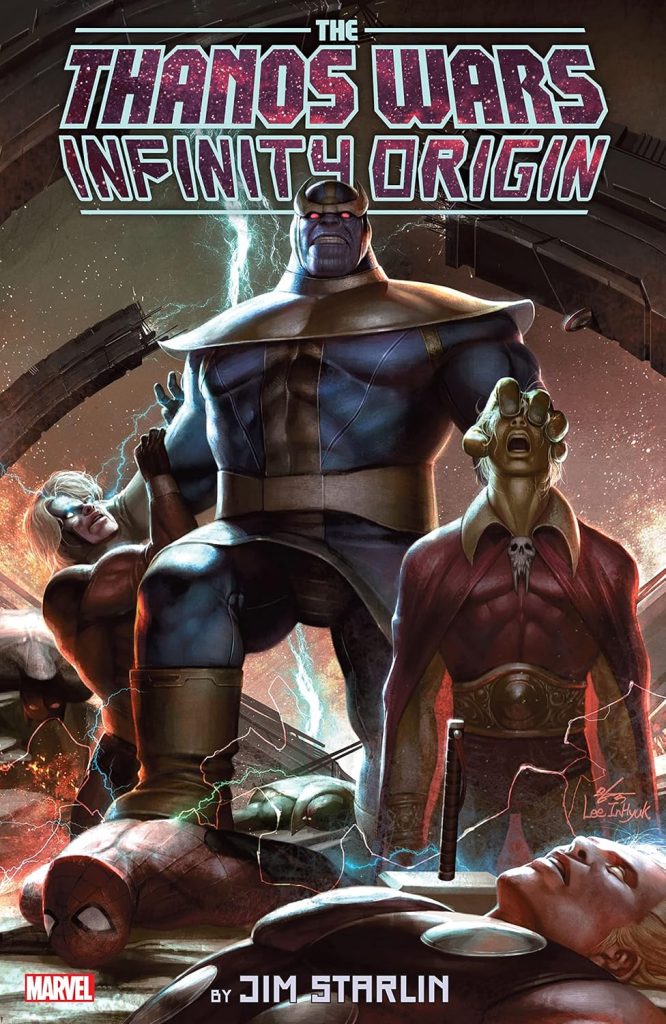
Review by Frank Plowright
For all his subsequent stature as a grand galactic villain, Thanos was introduced as almost as a throwaway threat as Iron Man teamed with Drax the Destroyer to battle a couple of interstellar goons calling themselves the Blood Brothers. Just as Thanos grew in stature, so did Jim Starlin as a creator, and his progress is evident in the material collected here, which encompasses most of his Marvel output during the mid-1970s.
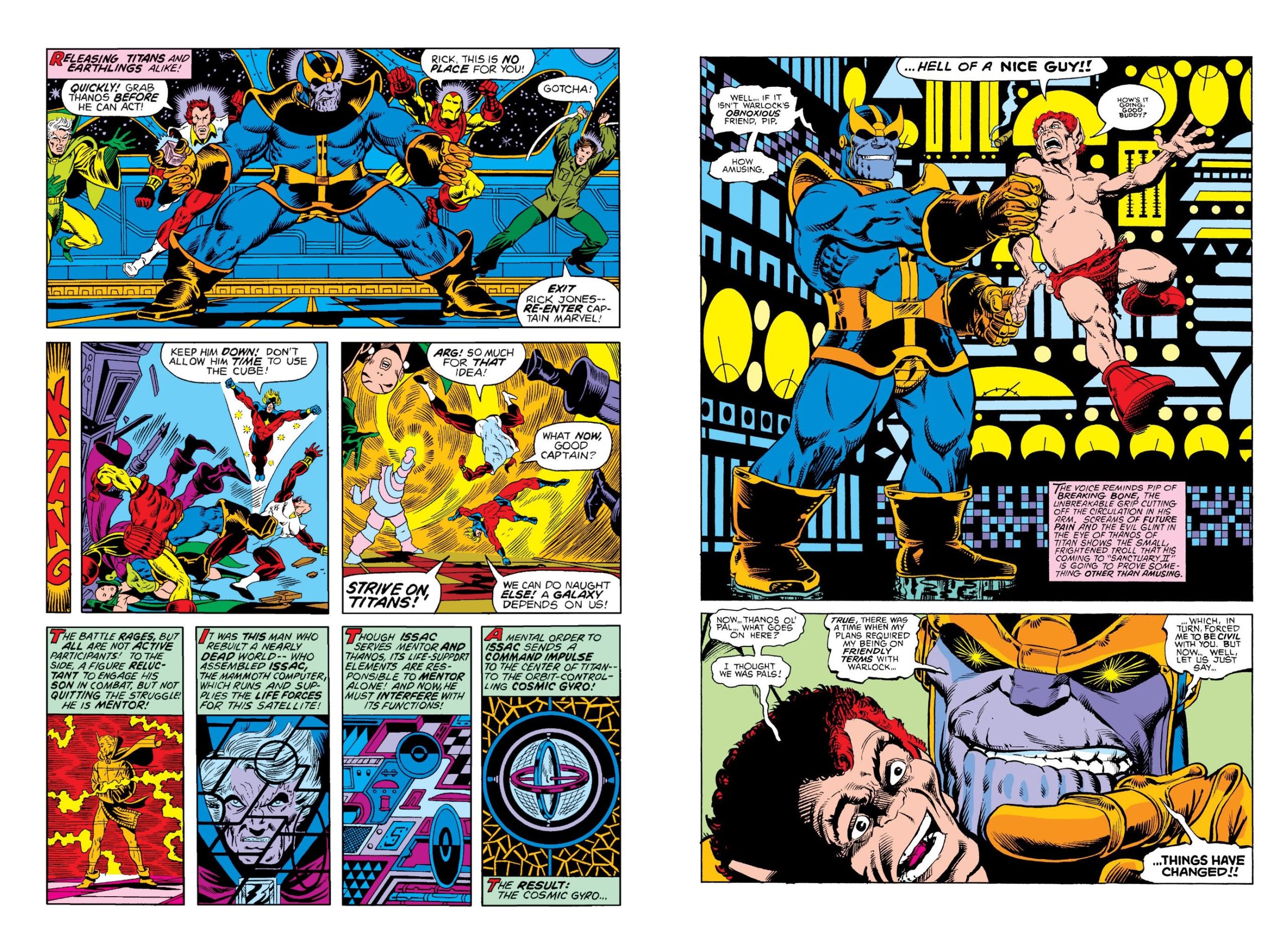
Thanos would perhaps consider himself above such casual definitions, but surely the ultimate villain is someone whose stated aim is to destroy the universe. Because Thanos is a villain, almost all the content here is from the viewpoint of Captain Marvel and Warlock, with Thanos largely arranging for others to carry out his dirty work in plaguing them. It’s only toward the end of their cycles that they confront him personally. It’s much the way that The Avengers movies were set up, and it’s no coincidence that the team are involved in what seemed at the time to be a definitive demise for Thanos.
When originally published in the mid-1970s both Starlin’s Captain Marvel and Warlock were considered left field and ambitious, but didn’t greatly resonate with the bulk of fans, which is rather ironic considering how many times those stories have been repackaged since. Starlin resurrected and remodelled characters whose first runs had been cancelled, a relative rarity at Marvel in the early 1970s, concentrated on space opera rather than superheroics in New York, and introduced themes well beyond the usual Marvel comics of the era. Not least, both Captain Marvel and Warlock die, and in Mar-Vell’s case it’s one of the few permanent superhero deaths.
The Captain Marvel material is enthusiastic and energetic, with Starlin the artist becoming ever more imaginative, but his learning on the job hasn’t aged well. Uneven pacing is a particular problem as his imagination battles against his capabilities, and it’s only the final chapters when Thanos appears that Starlin hits his happy spot. Dialogue is often by Mike Friedrich or Steve Englehart.
We’re given Starlin’s entire output for both heroes, which serves Warlock far better, as his longer run only really involves Thanos toward the end. By the time Starlin acquired Warlock he’d become the complete storyteller, narrative and visual, and serves up a stunningly creative spin across religion, destiny and depression, as Warlock comes to realise his future’s crocked no matter what he does.
The Death of Captain Marvel was originally issued as the first of Marvel’s graphic novels. It barely features Thanos, but fits thematically with the remainder of the content, and is thoughtful and reflective if not as well drawn as the earlier material. There’s also a Spider-Man team-up with Warlock by Bill Mantlo and John Byrne, possibly again included for the sake of completeness, but there’s no Starlin or Thanos. Overall, the Warlock material stands the test of time, remaining fresh, innovative and unpredictable, but much else has dated.
As noted, these stories have seen plenty of previous printings, and if this oversized hardcover is beyond your price range, likely given the price for used copies as of writing, The Life and Death of Captain Marvel and Warlock: The Complete Collection by Jim Starlin are the paperbacks to look for.