Review by Frank Plowright
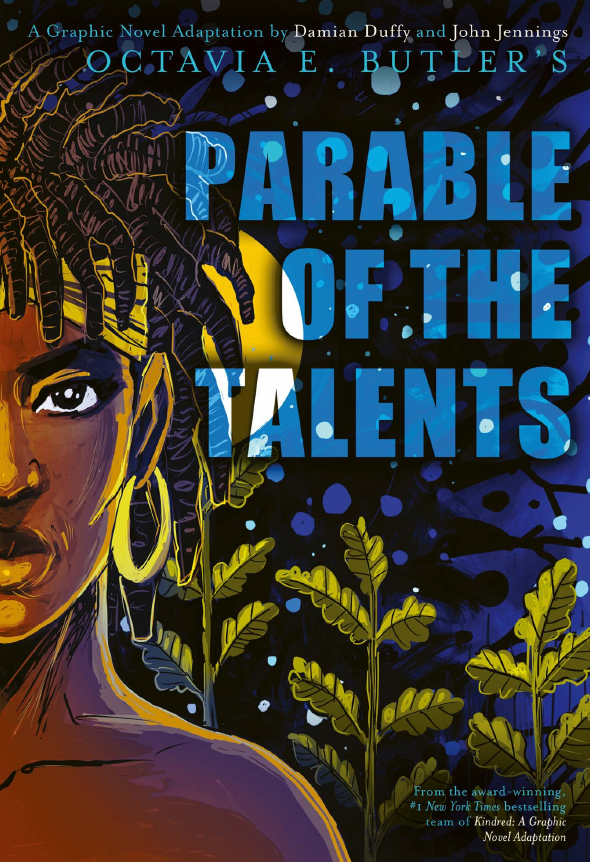
Parable of the Talents is the third of Octavia E. Butler’s novels to be adapted by Damian Duffy and John Jennings, and a sequel to Parable of the Sower.
That concerned Lauren, fifteen as events began and living in a post-apocalyptic USA where society has fractured. Dispensing with a belief in the God whose word her father preached, she conceives a more personal and ecological set of religious beliefs with the fundamental destiny of eventually leaving Earth. She names the belief Earthseed. When last seen she’d become a community leader.
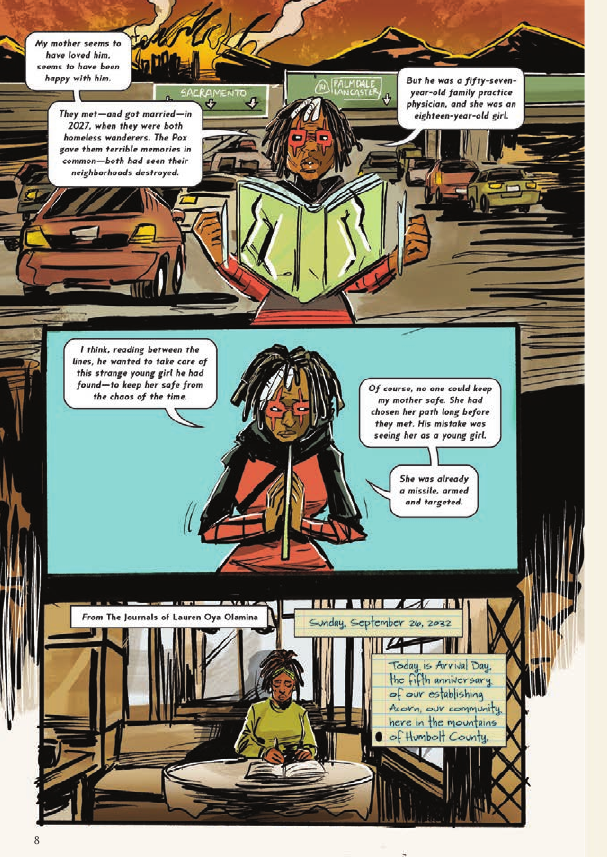
Butler’s not interested in taking the obvious route of a direct sequel. Parable of the Talents opens with the technology of what seems a more stable future, and Lauren’s daughter Asha explaining a conflicted relationship with her now dead mother, but hoping to understand her better from her writings. These and the associated journals of Lauren’s husband Taylor Bankole, a doctor and far older, form the bulk of the book, accompanied by Asha’s portentous comments and occasional verses of Earthseed scripture. Parable of the Sower eventually concerned optimism, while Parable of the Talents is eventually damning of Christian fundamentalism.
What’s immediately notable is Jennings taking a different approach with the art. His style remains the same loose rendering of people and events, but now seen far more frequently from distance rather than in close-up. It opens up a world previously closed and immediately presents as more attractive. This is both in the journal entries of the past and the technological present, both considerably in the future when the novel was written.
Lauren’s community Acorn is one of learning and peaceful co-operation, but Lauren also has an expansionist agenda and a practical view of the world as it is. She does what she can to improve lives, but remains democratic, yet Acorn is demonised as a cult from outside. As previously, Duffy adapts sensitively, supplying the needed nuance and ensuring the graphic novel is as compelling as the original work.
Halfway through Butler switches her story from one of hope for a better world to a grim reflection of real world horrors where power is unfettered and the name of God is justified in the undertaking of all sorts of atrocities. It’s a catalogue of desperate acts of resistance learned by Asha by a distance of years as her experiences from a young child become more relevant. Jennings delivers the brutal violence explicitly, but sexual abuse is more delicately dealt with.
For all the warnings being given about how society could develop, Butler always provides a cracking story with rich characters and mysteries sustained throughout. Thoughtful moments draw on cruel memories, and Asha’s personality reflects her mother’s spirit. That spirit is most evident in Lauren’s ability to make difficult decisions in the name of practicality, and while driving wedges she lives to see her ultimate purpose.
There’s no question of Parable of the Talents being a very readable novel with something to say about humanity, as relevant now as it was glimpsing into the future in 1998. Duffy’s adaptation is solid, but it’s the decision by Jennings to alter his style of art that makes this a far better graphic novel than the two previous Butler adaptations he’d been involved with.