Review by Ian Keogh
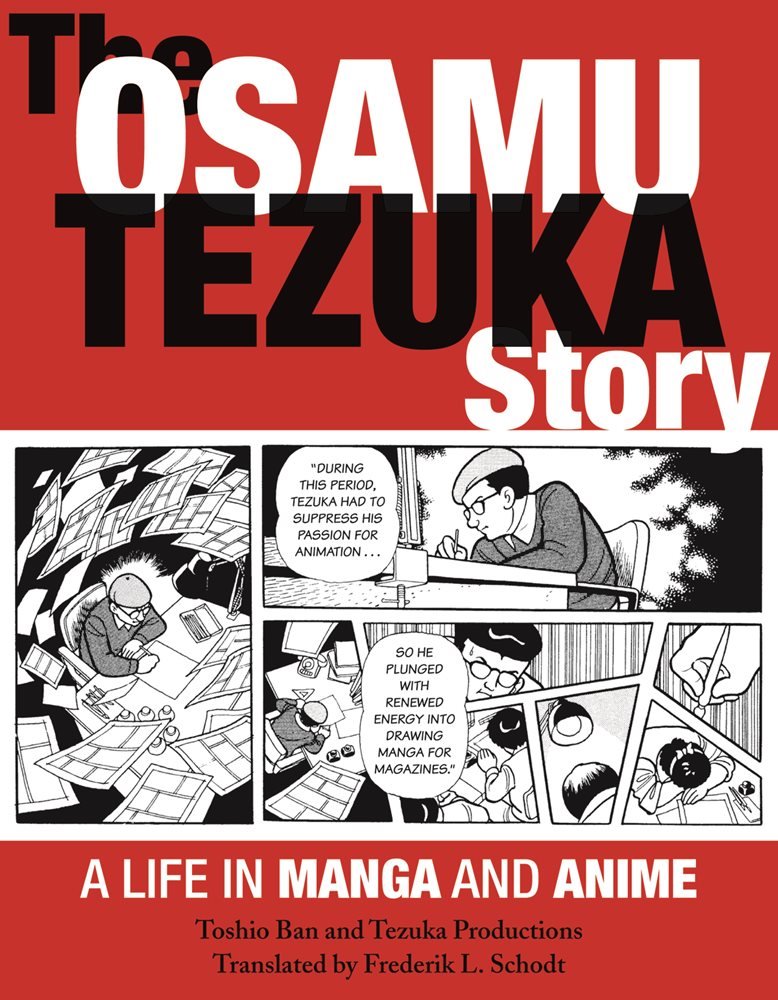
Published three years after The God of Manga’s death in 1989, The Osamu Tezuka Story is the gold standard for graphic novel biographies of comic creators if you’re primarily interested in their career and little beyond.
The entire page count of similar projects just about covers Tezuka’s school days, and while quality isn’t always equated with quantity, in this case it is. While Tezuka’s autobiographical writing is frequently quoted, instead of relying exclusively on printed sources, biographer and excellent cartoonist Toshio Ban carries out his own research. Dozens were consulted, including those who were at primary school with Tezuka. Ban himself is well placed, being highly ranked at Tezuka’s studio during the 1980s, and this isn’t just a biography, but the story of post-World War II comics in Japan. Furthermore Ban shows how Tezuka’s life experiences fed into the comics he created, an early example being a 1947 visit to a poor district of Tokyo still suffering wartime deprivations. Orphans seen begging in the streets much later resulted in Dororo, one of Tezuka’s most enduring series.
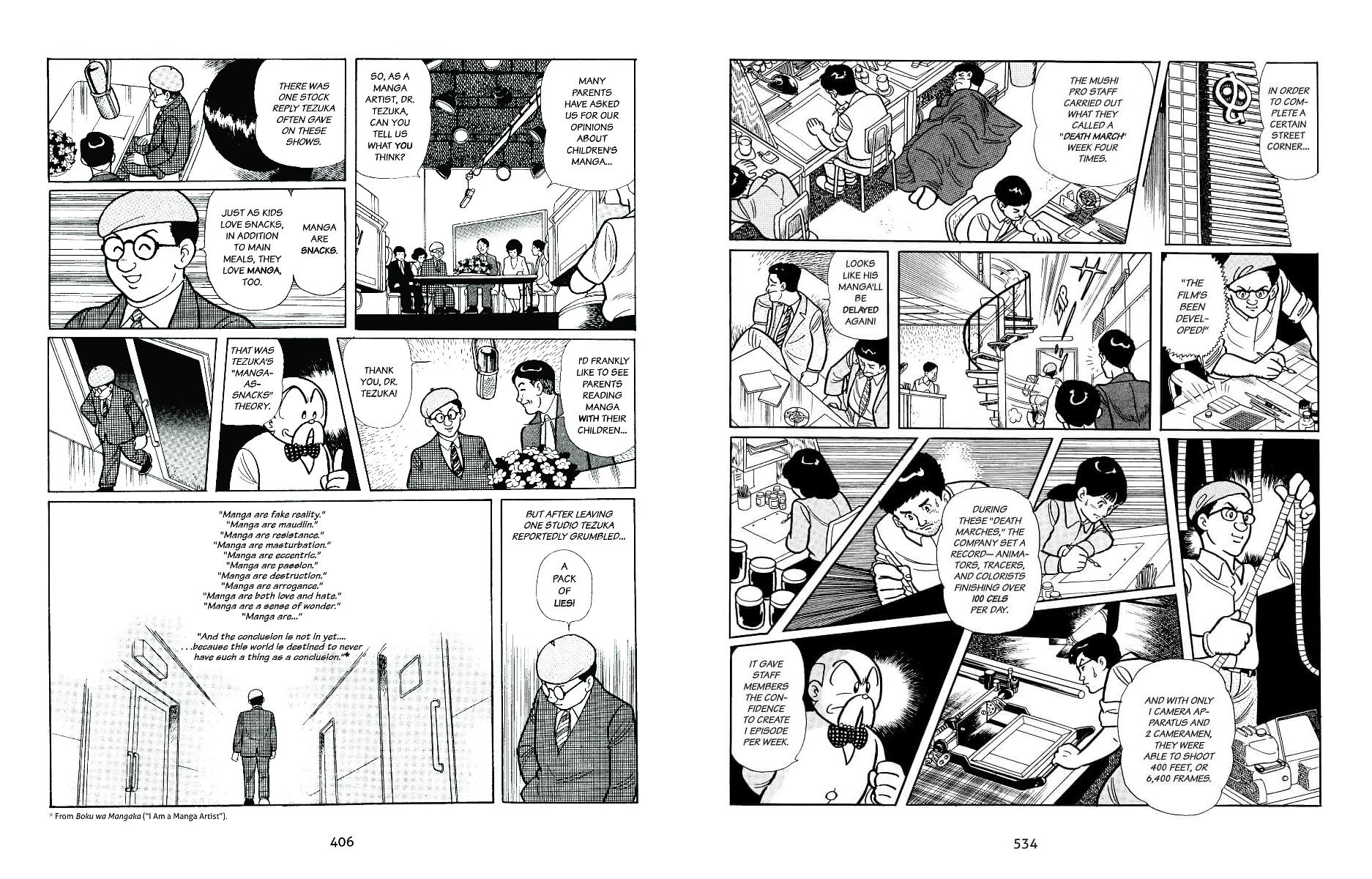
Throughout his career Tezuka was known for an astonishing work rate and phenomenal application, established in his late teens. Tezuka qualified as a doctor and is addressed as such throughout. For most medical studies would be work enough, but he was also involved in a theatre company, contributed regularly to several publications and still found time to practice piano to a prize-winning standard. From the theatre projects Tezuka conceived a repertory company of characters for his comics, and from them Shunsaku Ban (or Moustachio) narrates the biography.
Ban’s contextualises Tezuka within the framework of Japanese comics and animation at any given point. Almost from the start of his career Tezuka produced long form stories requiring serialisation, which was an innovation in the late 1940s. Single panel examples of his series are shown throughout, but detailed information about individual projects is restricted to a few examples of animation.
Beyond childhood interests, working practices and ambitions you won’t come to know much about Tezuka as a person, his views or his troubles, and there’s little information about family or upbringing. Featuring overseas trips toward the end is a rare deviation from work. The compensation is the wealth of anecdotes. There’s no concealing Tezuka’s eccentricity – it’s estimated he watched Bambi over eighty times – while an insight into the manga market is competing editors camping in Tezuka’s studios taking serialised pages as he drew them. The power balance then shifted to artists almost being abducted and confined to hotel rooms by editors. It’s estimated that Tezuka drew an average of 363 pages per month in 1974.
When finally achieving his ambition to start an animation studio Tezuka’s already insane work rate multiplied, yet he innovated to create a sustainable business for ten years. However, as with other negativity, it’s noted that the studio collapsed leaving Tezuka in debt, but without explaining why. Even assuming Tezuka to be a workaholic, neither is there any explanation as to why he constantly put himself under such pressure to create comics when his stature surely ensured he could negotiate a more reasonable schedule. What’s shown of the 1970s and 1980s is constant and totally unreasonable pressure to create, spread to those working in his studio.
Fredrick L. Schodt’s excellent translation of a monumental biography should be noted. Ultimately, Tezuka left a prodigious body of acclaimed work, and this is magnificent in explaining the creation, but one wonders if he regretted how little time that seems to have left for his family.