Review by Frank Plowright
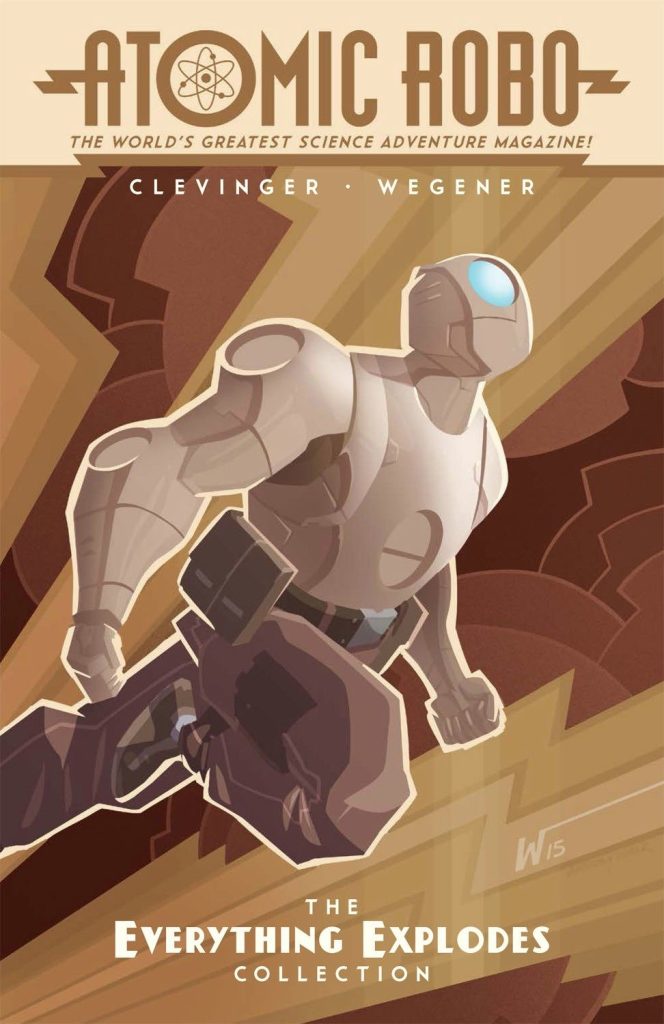
Atomic Robo was created in 1923 by maverick scientist Nikolai Tesla, who in this world disappeared before World War II, but his creation lives on to the present day, established as identifying as male. He’s a smart and often funny being, largely impervious to most threats, and while there’s an overall progression, Brian Clevinger’s form of storytelling is to concentrate on adventures from the past with only a few glimpses at the present day. The collection combines the first three Atomic Robo trades with the title originating in a great line originally delivered in The Shadow From Beyond Time in which Atomic Robo quotes his creator noting a universal constant is that everything explodes.
Both Clevinger and artist Scott Wegener begin strongly influenced by Hellboy, with the series opening, in paperback as The Fightin’ Scientists of Tesladyne, dealing with a Nazi genius whose creations plague Atomic Robo during all World War II adventures. Subsequent collection The Dogs of War is set entirely during wartime, and Clavinger rapidly introduces charismatic supporting characters for whichever era is seen. British wartime spy the Sparrow would later have solo adventures, James Milligan, given some fantastic Scottish dialogue, is based on Wegener’s grandfather, and in more recent times there’s a running joke about Tesladyne employee Jenkins’ capacity for violence.
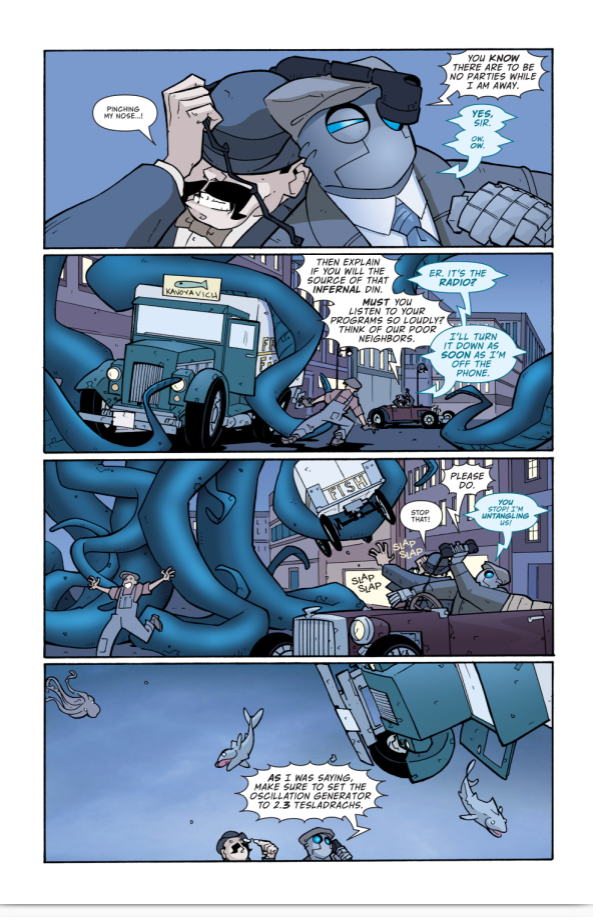
Wegener may initially be influenced by Mike Mignola, but rapidly moves away into his own distinctive cartooning losing the contrast of light and shade to develop a brighter look more in keeping with the feature’s general tone. He’s strong from the start, telling the story clearly and maximising the impact of a squidgy multi-dimensional monster, a walking pyramid, and beautifully designed retro-technology. Atomic Robo’s design is also noteworthy, clean, functional and adaptable, and rather than towering over allies, he’s a squat and bulky presence. Other artists contribute short stories, and all are good, but it’s Wegener who defines the series.
Energy and enthusiasm more than overcome a few rough edges at the start and Clavinger develops Atomic Robo’s personality into a likeable quick-witted character whose array of strengths can render him overconfident. Clavinger deliberately keeps the mechanics of Atomic Robo vague, as intimate knowledge of schematics is irrelevant to the fast-paced and consistently inventive plots. These also become ever more complicated, with the multi-dimensional threat of the final story requiring some explaining. It’s done in the manner of the fantastic charmingly passed off as ordinary.
You could buy three paperbacks or their latterly released individual hardcover editions, or you could immerse yourself in a full feast with this combination. The following three volumes are combined in The Crystals Are Integral Collection.