Review by Karl Verhoven
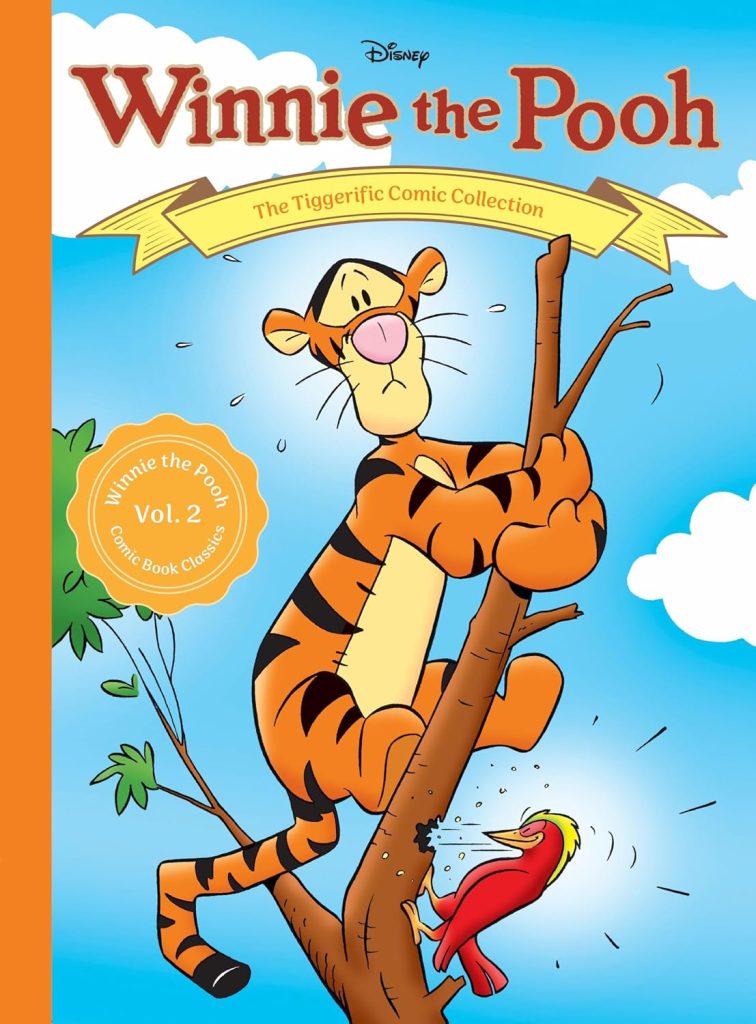
A second collection of Winnie the Pooh comics follows the same formula as the first, once again starting with a film adaptation, moving to strips culled from 1970s and 1980s US comics, and then casting the net further afield to European material never previously seen in English.
The opening and longest story adapts 2000’s The Tigger Movie, Jim Fanning and David Gerstein reverting Barbara Bazaldua’s French script back to English. The cartooning of José Antonio González matches the movie’s energy, introducing Tigger’s irrepressible personality as he bounces about on his tail circulating among the other residents of Hundred Acre Wood, his accidental destruction causing problems. The thrust of the plot is Tigger wanting to find his family, with the message of his true family over-emphasised for adults, but generating enough imaginative comedy and the occasional sad scene for children.
Although enthusiastically introduced by Gerstein, the strips from the late 1970s and early 1980s aren’t gold standard. They’re well drawn, but very few are dependent on the core personalities of the familiar cast. Strips about a race, being lost in caves or searching for the treasure at the end of the rainbow could substitute other cartoon characters to no discernible difference. Further diluting them is so many featuring characters not from A. A. Milne’s original stories. Milne may have created Sir Brian the knight, but it was for a poem, and he and his dragon fit poorly in the Hundred Acre Wood. This is highlighted by those stories being followed by Thomas Michelsen’s ‘Woolie or Won’t He?’. Michelsen understands both the cast and Milne’s whimsical storytelling in a tale based on Pooh’s greed in wanting an extra birthday by pretending to be his brother. “You’re forgetting dear old… er… Woolie the Pooh”, bumbles Winnie, “I’ve told you about him many times… er… Haven’t I?” It’s charmingly set-up and concluded.
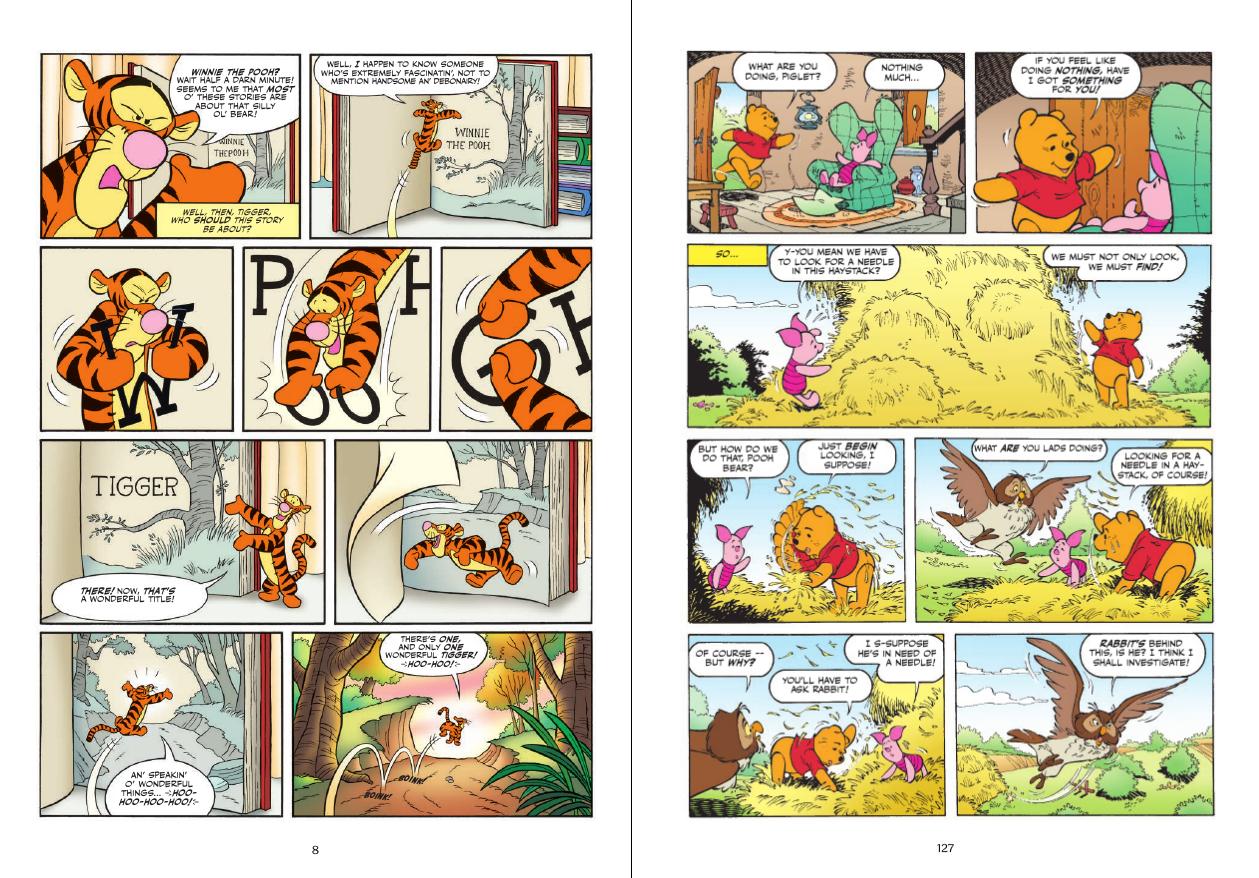
As in The Hundred Acre Wood Collection, Fanning’s stories also show better understanding, being well-plotted, consistently engaging and funny, with his best concerning finding a needle in a haystack. Carlos Grangel’s expressive cartooning seals a real gem. Fanning notes in the section introduction that as all the cast are fundamentally decent, the easiest way to introduce conflict is via Rabbit’s fussiness, and Rabbit features strongly in three of Fanning’s four contributions.
The collection ends as it began, with Tigger, this time with Fernando Güell story and art. The idea of his wanting to commune with the birds is rather random, but leads to a plot about balloons well sold by Güell’s lively art.
It would seem the idea of these collections is to be as representative as possible, and art from Pete Alvarado, John Carey and Sparky Moore is certainly worth seeing, but the US material is the weakest overall. Almost without exception, though, the stories originally published in Europe are far better, and this is a stronger selection than its predecessor.