Review by Karl Verhoven
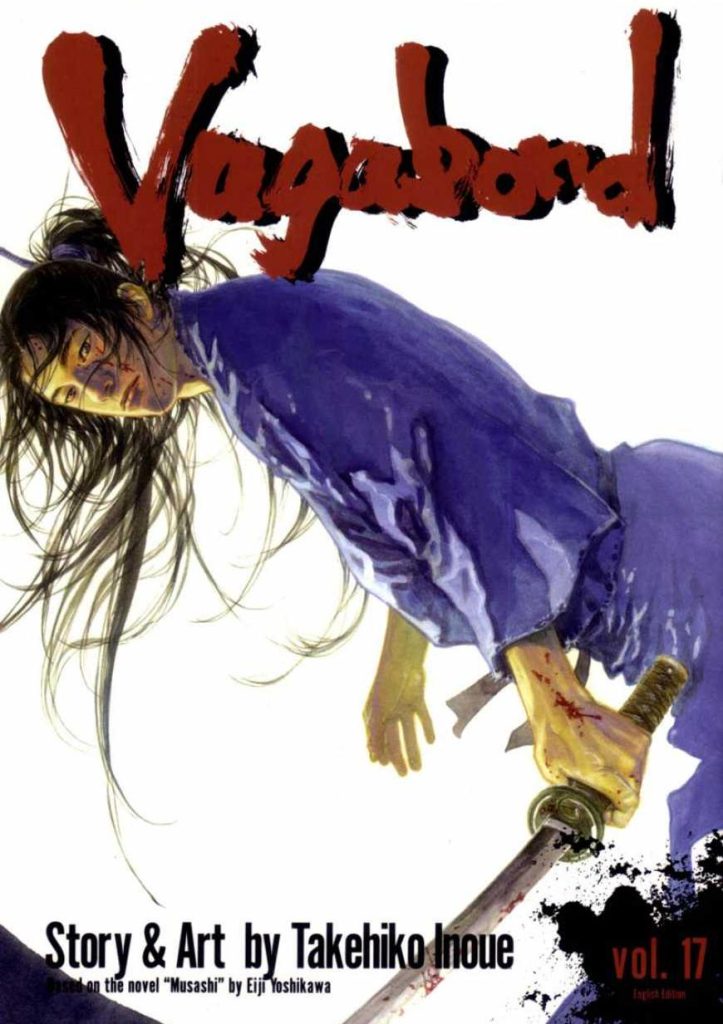
The past three volumes have been building up the deaf Kojirō’s youth, which continues here as he faces his first proper swordfight. We’ve already seen his determination and the skill developed via solitary practice, but the combat continuing from Vol. 16 is the first proper insight into his personality. He’s been referred to as a tiger, but is that the case?
Because the story’s switched to Kojirō it might have been forgotten that earlier in the series Takehiko Inoue devoted long sequences to a single swordfight, and that’s what he does in a book split equally between combat and contemplation. Kojirō has been confronted by three swordsmen on their way to war and each see the other as prey, yet the visitors have enough honour to confront Kojirō individually.
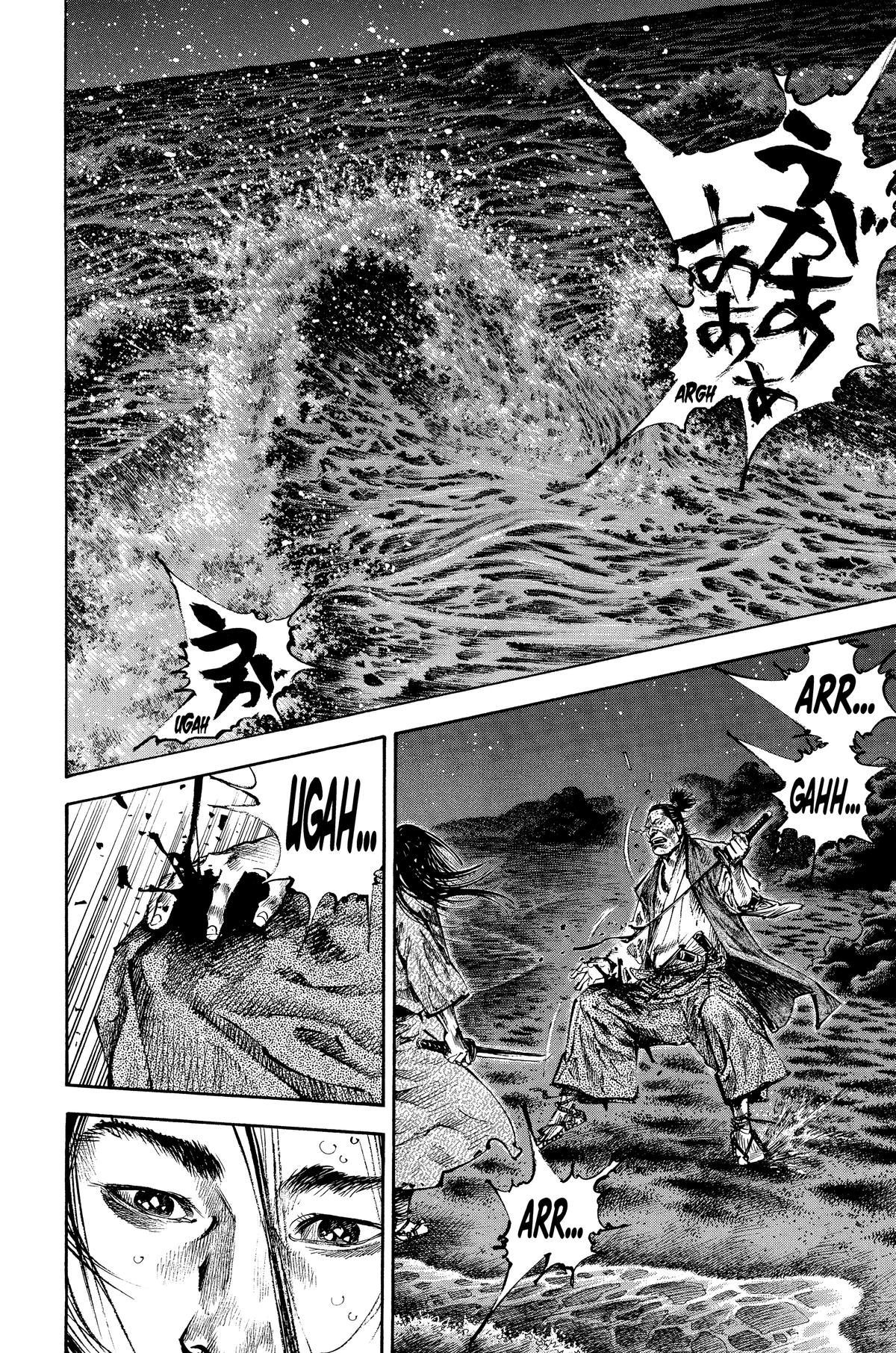
The battle takes place on a beach, and as the swords clash Inoue frequently adopts the visual metaphor of waves crashing nearby, these drawn to display power, yet also extremely graceful. The strength of the waves is eventually tied to Kojirō’s own, and what could seem a forced cliché is efficiently implemented. A stronger bond has been established between Kojirō and his sword, and yet a point Inoue makes is represented by the sword being discarded.
An occasional volume to date has featured a colour chapter opening, but this has three. They’re painted in bright watercolour, the technique almost defining the lack of detail when compared to Inoue’s dense black and white ink work. Intended as a treat, they’re actually disappointing as the bright colour lacks the tone so strongly defining Vagabond.
Having spent his entire life at the shore in the company of Kanemaki Jisai, Kojirō takes his leave in the company of Kanemaki’s former student Itō Ittōsai. He’s tested himself against the outside world and bettered it, and to mark the occasion Ittōsai creates a provocative banner reading “invincible swordsman under the heavens Sasaki Kojirō”. It’s an oddly trivial moment in a definitely spiritual series, and yet befitting Kojirō’s newfound arrogance. It’s attracted a challenge by the final pages, and that leads into Vol. 18. Alternatively both form part of the sixth VizBig combined edition.