Review by Ian Keogh
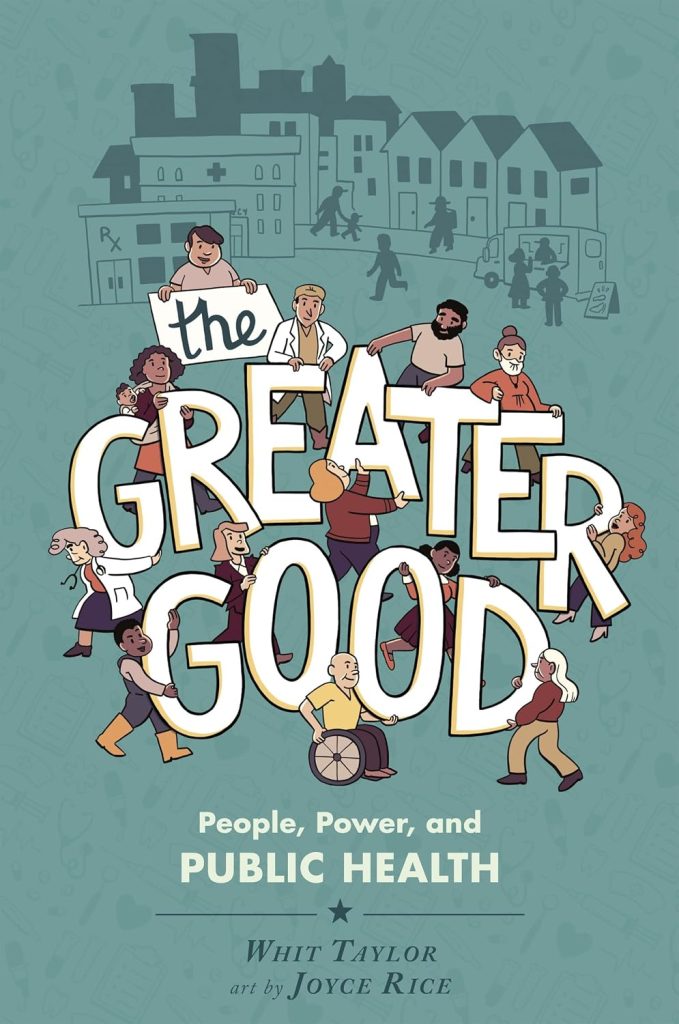
The Greater Good begins by author Whit Taylor laying out clearly what elements her examination of public health will include, and which will be bypassed, so avoiding health insurance and medicine. For the latter there’s the excellent Medicine: A Graphic History.
It may be considered that public health is a dry topic, perhaps not the everyday reading you’re looking for. There’s an awareness of this on Taylor’s part, and so her opening chapter is in effect a procedural investigation into a mass murderer. You’ll become utterly absorbed in John Snow’s attempts to isolate the source of cholera, a killer disease in the 19th century. One man’s dedication and persistence eventually changed the world in the face of entrenched administrative ignorance and indifference, a sadly common theme in successive chapters.
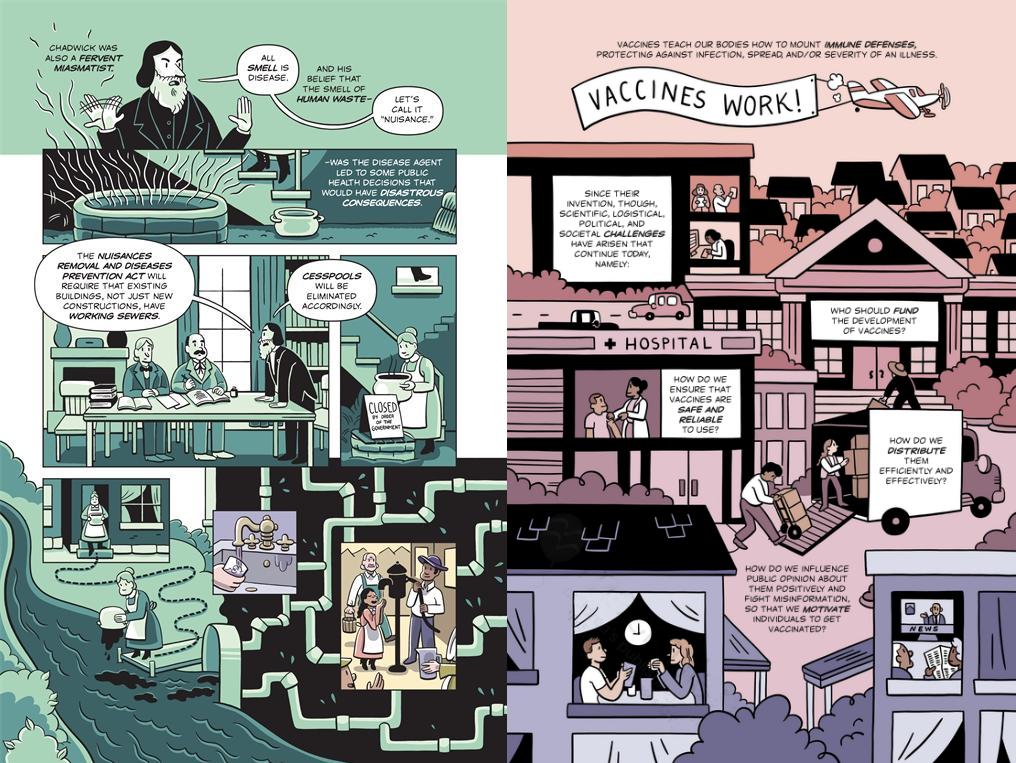
Snow’s quest is the template for what follows, with similarly immersive explanations. Most chapters include a strong personal story with which to identify, such as the unfortunate Mary Mallon, crusading Harvey Washington Wiley and housewife turned campaigner Lois Gibbs. In one of the few chapters lacking a personal focus Taylor addresses the current state of US medical incoherence regarding the value of inoculation, while time and again it’s related how vested interests attempt to stall legislation that would save lives. A common theme in American resistance is the lie of the poor being responsible for their own poverty.
A complex subject requires clarity from the cartooning, which Joyce Rice duly supplies, but she slips in some interesting page designs and has a compact way of compressing great amounts of information into a single illustration.
As Taylor moves forward toward the modern era, the concentration is increasingly on US health policies, with some surprising revelations about unethical conduct. Sadly, for the book’s second half, and indeed Americans, that’s an increasing theme. Chapters on environmental health, tobacco and car safety have repeated patterns of powerful industries lacking any concern about people’s wellbeing if impacting on profit. Unforgivably, the cost of fighting what companies know to be true through the courts is repeatedly seen as the preferred option, irrespective of the cost in human lives. They all end in victories for common sense, but only after fights lasting decades without any personal accountability.
The Greater Good opts for contracting the World Health Organisation to ‘WHO’ rather than ‘W.H.O.’. As traditional upper case lettering is used throughout you may find yourselves momentarily attributing the eradication of smallpox to the 1960s and 1970s rock band. Strangely, though, that would fit an incredibly well researched, yet anecdotal and readable investigation of a vital topic. Comics have long been viewed as powerful educational tools, and The Greater Good exemplifies the reasoning.