Review by Ian Keogh
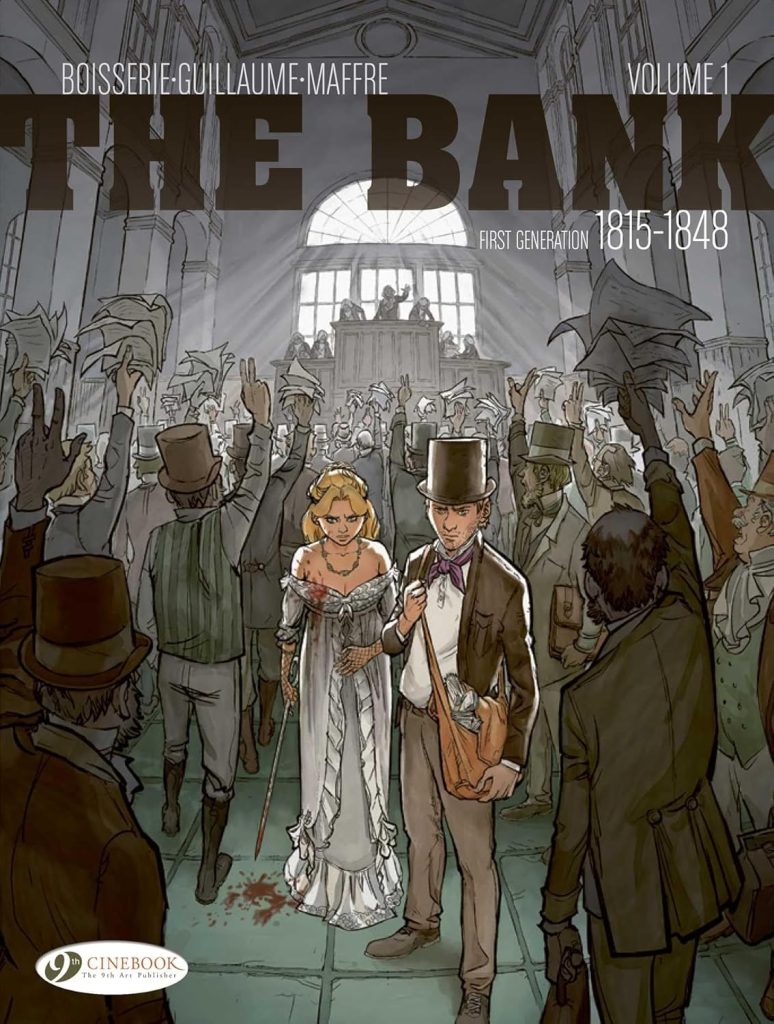
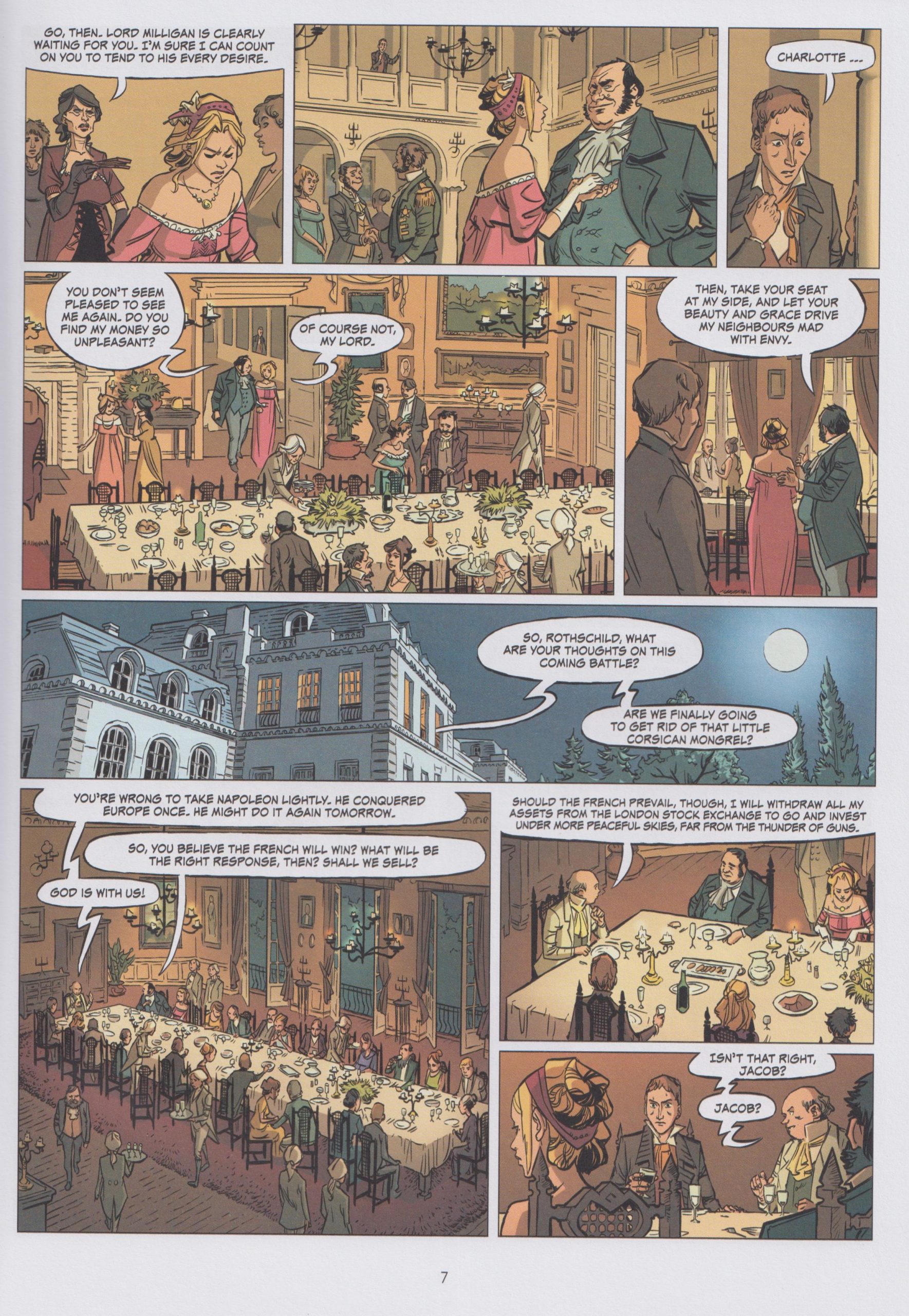
In summer 1815 Britain and other European nations have to deal with Napoleon in France. His resurgent threat has led to many French exiles living in London, among them teenage brother and sister Christian and Charlotte de Saint Hubert. The British establishment’s welcome, though, doesn’t extend to their being treated as the minor nobility they are. With their parents killed, Charlotte is a prostitute, exclusively hired out to the grossly offensive Lord Milligan, and Christian works as a groundskeeper to banker Nathan Rothschild. It pays for squalid, shared single room accommodation. A glimmer of hope for them is the infatuation Rothschild’s younger brother Jacob has for Charlotte, but her employer keeps them apart.
The sweeping historical saga has proved a popular genre in Franco-Belgian comics for decades, echoing the novels of Dumas and Zola, yet there are no equivalents in American comics, which is puzzling. The translated version of The Bank slots neatly into that gap. Co-writers Pierre Boisserie and Philippe Guillaume began their collaboration with Dantès, a stock market thriller with echoes of The Great Gatsby, and continue to mine the finance world with a generational saga of conflict, here set at the beginnings of stock trading as it’s now known.
That’s just the background, with the de Saint Hubert siblings placed in situations where they’re looking up at society from below, but involved in historically documented events, explained in Guillaume’s extensive notes at the end. As noted in Jean Dufaux’s introduction, the writing is clever for constantly shifting opinions about characters.
Artist Julien Maffre hadn’t worked on a major series before, but you’d not know that from his confident, detail-filled pages. The story is brought to life in a style straddling cartooning and realism, with the former applying to the cast, while their surroundings are impeccably recreated. It’s important that opulence and deprivation are contrasted, as they supply the motivation for much that happens, and Maffre brings this out.
A key sequence exploits Rothschild making a vast fortune on the stock exchange. Even two hundred years later it’s unclear how he was a step ahead, but the writers make use of one of several myths circulating about the incident. Others are discussed in the text material.
Cinebook set twelve as the minimum recommended age for The Waterloo Insider, but that reflects values in France differing from those elsewhere. While there’s no explicit content, there is near-nudity, and unsavoury subjects feature strongly, so some parental guidance is advised.
As much as anything, at this stage The Bank is founded on feelings of entitlement and the single-mindedness required to achieve what is believed due. It’s a fresh and page-turning approach, and continues in Volume 2: The Émigrés’ Billion.