Review by Ian Keogh
The relevant Star Trek series is identified in the title, but there have been so many incarnations of the Doctor your first inclination might be to wonder which is teamed with the Next Gen crew. It’s the Matt Smith version of the Doctor, with the Cybermen and Borg joining forces being the threat that brings them together, but that’s not the entire story…
Actually, Star Trek fans may feel rather shortchanged at the start, as while the opening chapter defines the threat and the setting as Star Trek’s universe, familiar characters are in short supply as the remainder is essentially an adventure for the Doctor and companions in Ancient Egypt. As primary writers Scott and David Tipton are better known for their Star Trek material, perhaps they’re just stretching their wings before the main course. Likewise, the Doctor’s fans won’t see him much in a Next Generation mystery occupying the second chapter
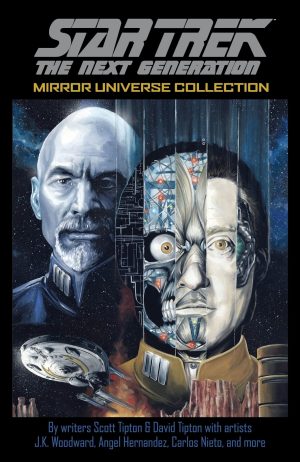
Initial artist J.K. Woodward is largely an impressionistic painter, but very good with likenesses of most if allowing for some expressions being a little too fixed due to being copied. This becomes a major problem in a cartoon sequence illustrated by the Sharp Brothers. From the fourth chapter onward, though, and into Volume 2, Woodward paints over Gordon Purcell’s pencils. What’s supplied here is the settling in period and it’s a little rough around the edges.
The plot is stronger than the art, with the writers defining all characters in line with their TV personalities. Naturally enough, there’s a level of distrust aboard the Enterprise for a fair while after the Doctor’s surprise arrival, but his genial insistence and knowledge of what a threat the Cybermen are along with Guinan’s acceptance of him win most over.
There is reference to events of the Star Trek TV show, but largely in the manner of easter eggs, with the one major exception only manifesting right at the end prompting the cliffhanger conclusion. Everything necessary is explained other than “with Tony Lee” credit on the writing. As a British writer, perhaps he was consulted on dialogue, as it rings true.
An awful lot of this first volume is set-up, the Doctor attempting to convince a dubious Picard of his genuine good intentions. It means this is heavy on conversation and low on action, and that’s not going to be to all tastes. A book combining all eight chapters would surely have been more desirable.