Review by Ian Keogh
Jordan Mechner has childhood memories of his grandfather typing an autobiography running to a thousand pages, and in 2015 he’s converting it to wordpress permitting family members elsewhere to access it and comment on it. At the same time he’s considering a move to France for a couple of years as a French company is interested in issuing an updated version of his video game Prince of Persia. The two are connected as Mechner’s grandfather and his father as a young child, left Europe to flee the Nazis.
Replay is a combination of autobiography, travelogue, reportage and historical circumstance with past and present subtly connected. It’s two separate beach holidays in different years or Mechner’s grandfather in 1938 whittling his belongings down to the bare minimum in preparing to leave Vienna, while in 2015 his wife wants him to discard a lifetime’s accumulation stored in boxes. The latter is a mundane problem common to many relationships, but time and again Mechner manages to highlight the remarkable, often distressingly so. His grandfather considered himself Austrian, but after the Austro-Hungarian Empire picked the wrong side in World War I it was split into separate nations, and the town where Adolf Mechner was born now lay within Romania. That made a difference as he was now considered a Romanian, and while Austrian refugees from Nazism were welcome in 1938, only a very limited quota of Romanians were granted US visas. As we’ll discover, though, Dr. Mechner is a remarkable man.
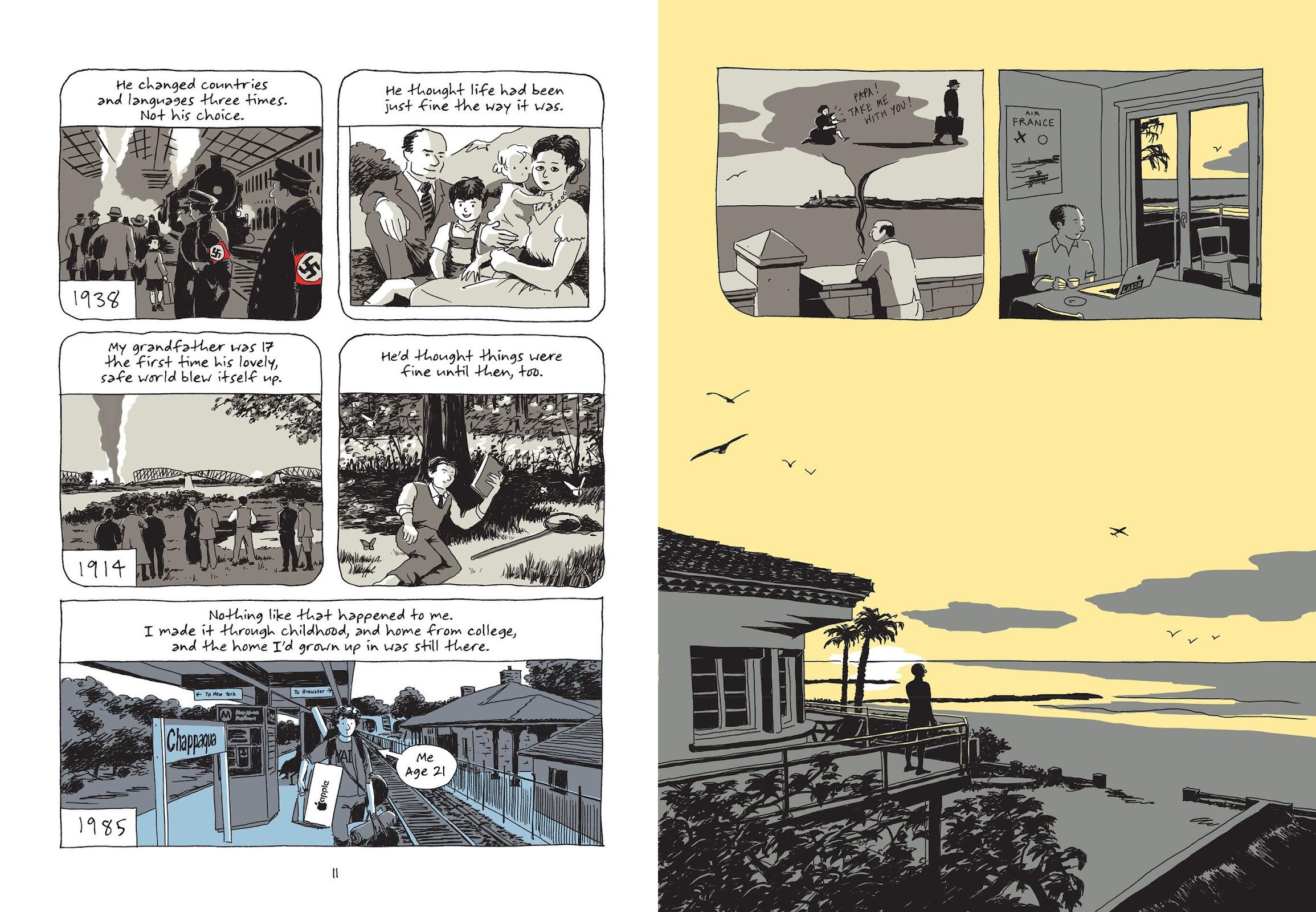
Jumping back and forth between decades is the storytelling method of choice, and the alternating time periods are separated by the simple method of being coloured differently. Red features for the Nazi era, pale yellow is the present, and blue Mechner’s childhood. It’s surprising how effective that is in creating memorable images such as the sunset on the sample art. Mechner details the painstaking process for his early game art, but Replay prioritises simplicity, loose figures and backgrounds yet also with attention to detail, such as the end of World War I being represented by the later infamous Compiègne Forest railway carriages.
It gradually becomes apparent that conflict isn’t restricted to the past. It’s a story only told from one side, but Mechner’s wife comes across as hard work, and as he’s trying to piece together his ancestry some aspects of the present require attention. There’s also Adolf’s World War I experiences to be related, which are remarkable for revealing some grim realities of war, and via his daughter’s history teacher reminders that some attitudes never fade. Jewish practices are also detailed in past and present, underlining the importance of a continued culture.
Nuance is a regular feature. There’s a man now likely to be remembered for little more than his vanity, but Mechner’s thought about connecting different times impresses throughout. While this is primarily a family history, those interested in Mechner’s games aren’t neglected, and anyone thinking of following his career should pay special attention to his top ten tips.
This is a remarkable story, and someone wanted the Mechner line to continue as so many times luck or coincidence intervenes. Replay is fascinating, constantly readable, and, in places very sad, yet never a misery memoir. Life prevails.