Review by Frank Plowright
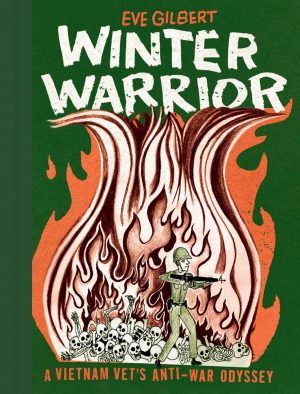
My Year in Vietnam presents three stories by Eve Gilbert, two of which she’s written and drawn, while the far longer title story is illustrations accompanying a first person narrative from George Ryan.
In 1967 Ryan knew very little about the Vietnam war and the reasons for it, but quickly figured out how to avoid the military draft. When he’s eventually taken to training he flouts rules, so is shipped to the war itself, where street smarts enabled him to recognise the walking casualties on base. He progresses from base to combat, and survives to tell his story.
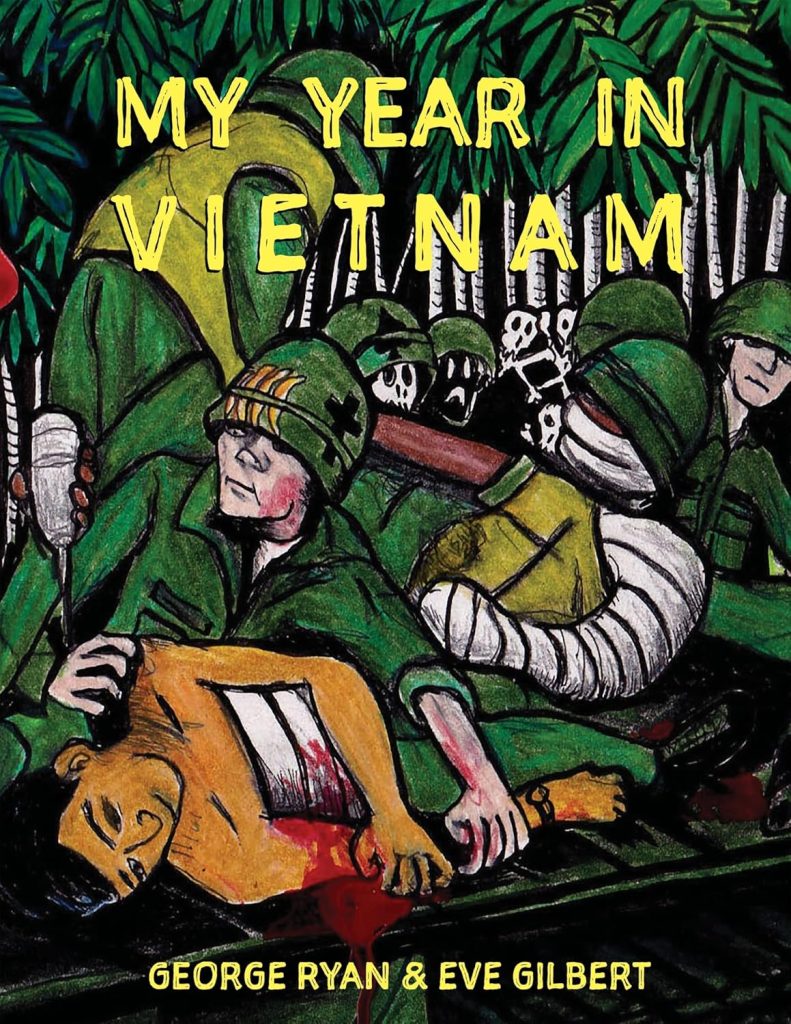
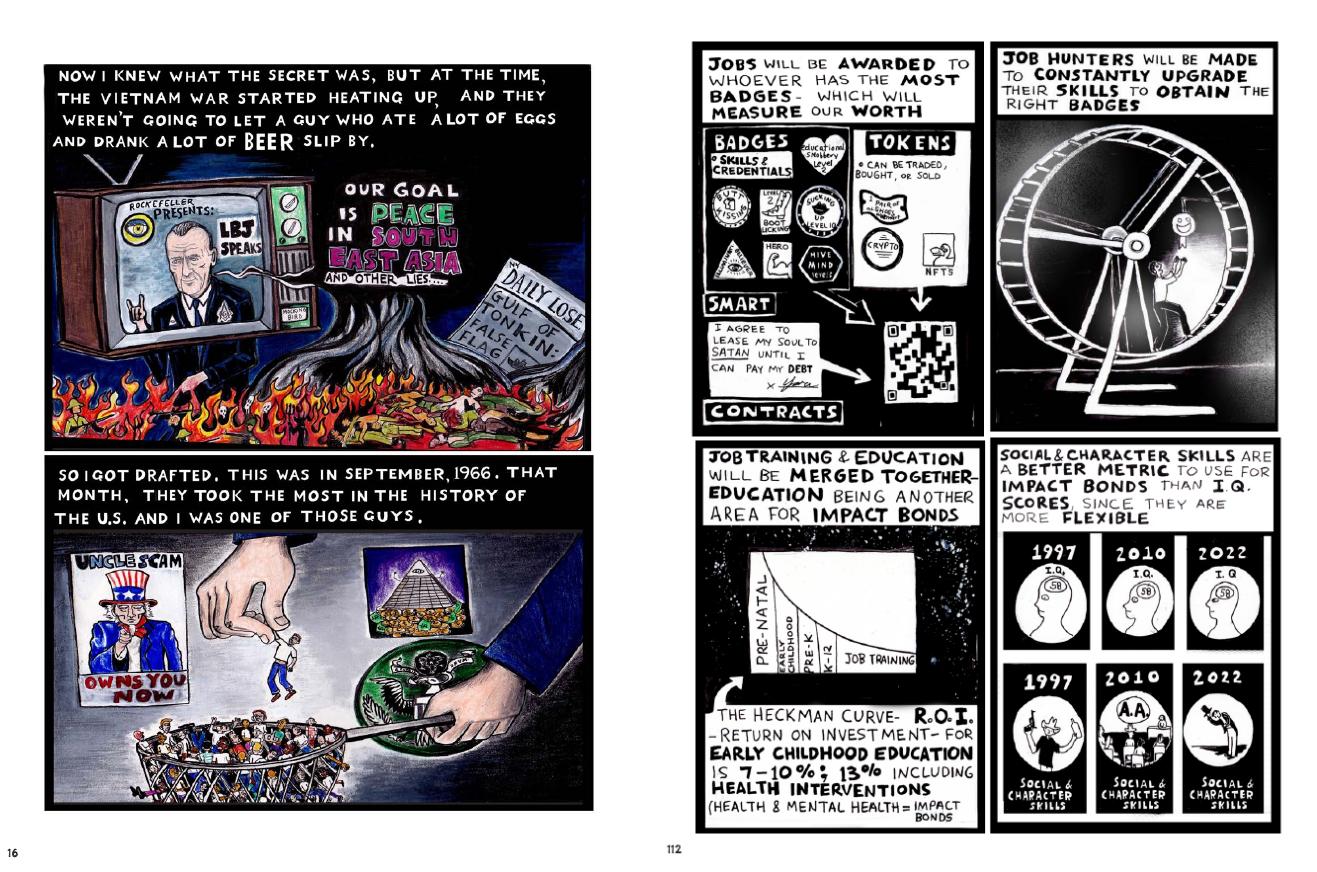
Gilbert’s naive art at first seems to lack polish with it’s misproportioned people and strange perspectives, but what quickly falls into place is her talent for a powerful image encapsulating a feeling or a moment. She frequently supplies thoughtful visual symbolism as per the sample art and appreciation of that leads to a fondness for the accompanying combat illustrations of the type schoolboys drew on their jotters throughout the mid-20th century. It’s a strange way of bringing home the terrors faced by the ordinary kid sent to Vietnam as cannon fodder, but the naive reflection of Reynolds’ attitude of the time eventually becomes a strength. However, it makes for an off-putting cover as immersion is needed to convey the reality.
Reynolds applies the knowledge of hindsight to his narrative, and a horror of what he relates is how atrocities become accepted as commonplace. His view is contrary to many accounts draped in unquestioning ‘patriotism’ for believing US troops had no business being in Vietnam. He also reveals the extent of corruption, jeeps being exchanged for a crate of beer being one example. It’s the type of story no-one wants to hear at the time, but the truth has a way of emerging.
The effects of a year in a combat zone also have a way of emerging and Reynolds details what a slow process it can be. It all adds up to a powerful memoir that’s also a very important warning in gung-ho times for the USA.
Gilbert’s two solo stories have a more obvious social and political agenda, and are drawn in the representational manner used by Darryl Cunningham for similar extrapolations (see recommendations), although his are more refined. The first concerns how we as a society are sleepwalking into a world where data gathered in the name of personal security is likely to be marketed, while society’s security is being used as the excuse for ever more invasive observation and analysis technology. While starting out as a reasonable explanation of what most people either don’t see or ignore, it devolves into wilder speculation, throwing out possibilities galore without any sources beyond a first panel crediting research by Alison McDowell published on wrenchinthegears.com. It’s interesting, frightening and possible, but is it inevitable?
‘Operation Popeye’ deals with weather control, mentioned as first occurring during the Vietnam war. Sources are credited here, but stretch back to 1898, and the seven from the 21st century include an article quoting an Iranian general claiming Israel is stealing clouds. This is all very entertaining, but in vanishing down a rabbit hole ignores the obvious. If widespread or even localised weather control was feasible in the early 1970s it would be massively commercialised by now, as vested interests value money above all else.
The shame of the Gilbert’s solo material is the lack of credibility reflecting on Reynolds’ experiences.