
Review by Ian Keogh
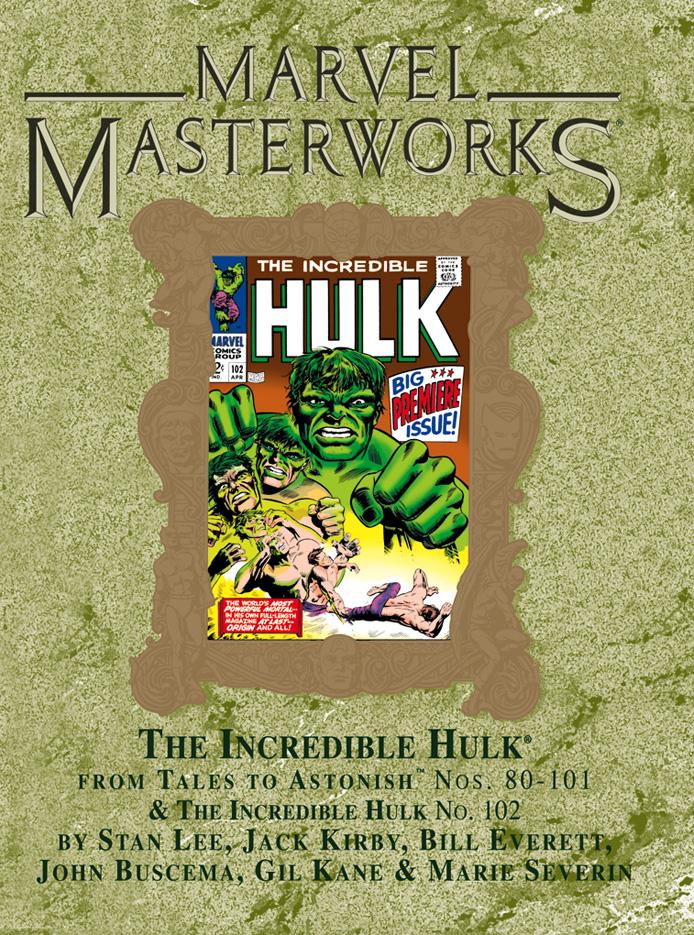
This third Masterworks volume concludes the Hulk being restricted to ten page episodes, ending with his restoration to his own title, that run continuing in Volume 4.
Volume 2 concluded with a game changer on the part of Stan Lee. Believing the Hulk to be dead, Rick Jones has revealed to several people that Bruce Banner was transformed into the rampaging behemoth when rescuing him from the effects of a gamma bomb detonation. It’s a disclosure that doesn’t head back into the bottle, and colours much of what happens immediately afterwards. However, Lee’s masterstroke is removing the Hulk from the area around the remote military base where most of his solo adventures have taken place and propelling him back into the wider world.
Artistically this a higher quality outing than previously, opening with the appealing combination of Bill Everett pencilling over Jack Kirby’s layouts and ending with Marie Severin’s polish (sample spread left). In between we have some of John Buscema’s earliest Marvel work and Gil Kane (sample spread right) whose Hulk is appealingly stylised. However’s there’s little credit due for recurring villain Boomerang’s preposterous costume, either its initial Kirby/Everett version or the Buscema redesign.
While there are interesting developments and Lee keeps the soap opera bubbling convincingly, he also takes his mind off the ball and forgets plots he sets in motion. The Secret Empire rather fizzle out, and the Stranger’s infallible command that the Hulk destroy the world provides a convenient cliffhanger and indirectly leads to the creation of the Abomination, whereupon the problem is forgotten.
The best sequence here sends the Hulk to the world controlled by the High Evolutionary. Variations on his experimentation on turning animals into humanoid forms has been a Marvel staple for decades, but this first twist on The Island of Dr. Moreau by Lee and Severin still supplies hubris and pathos. Unfortunately it’s followed by a clunker as Lee introduces the barely credibly Living Lightning organisation taking over Thunderbolt Ross’ military base.
The Hulk subsequently meets later Defenders colleagues the Silver Surfer and Sub-Mariner for the first time and slugfests inevitably ensue, while Lee having Loki bring the Hulk to Asgard has its moments, Severin excelling on all.
Gary Friedrich becomes the first writer other than Lee to produce a Hulk story, but his following up on the Hulk’s visit to Asgard is ordinary despite Severin’s efforts.
Until this collection it’s a rare Hulk solo story that’s not been located in the Arizona military base or the surrounding desert, so Lee pushing the Hulk into other areas certainly broadens horizons, but the better moments are outweighed by much that’s very ordinary.
All this content is alternatively available in the oversized Hulk Omnibus, or in Epic Collection The Hulk Must Die In black and white it’s spread over Essential Incredible Hulk Vol. 1 and Essential Incredible Hulk Vol. 2. In the smaller Mighty Marvel Masterworks format these stories occupy Vol. 3: Less Than Monster, More Than Man, and Vol. 4: Let There Be Battle (which features two extra comedy stories).