
Review by Karl Verhoven
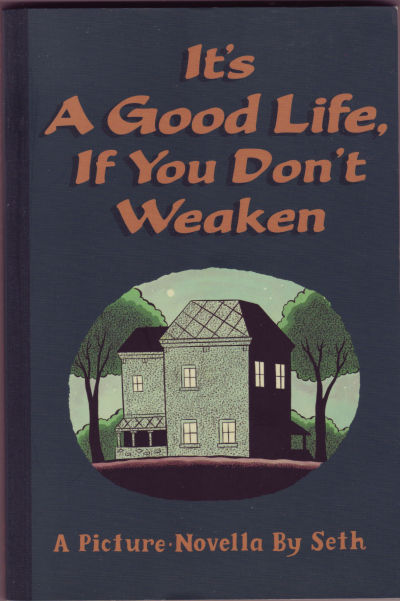
It’s a Good Life if you Don’t Weaken is an interesting experiment in several ways, presented as autobiographical, yet possibly entirely fictional and even after all these years still the best example of the unreliable narrator in comics. It worked so well when originally serialised in the 1990s because Seth had already established his autobiographical avatar in other strips, an artist obsessed with the styles of the past, particularly the creators of classic newspaper strips and cartoons.
To reinforce this persona Seth opens with an almost dull run through of an unremarkable couple of days, checking out second-hand bookshops and visiting his mother and brother. The following day he’s reflecting on a failed relationship in the company of friend and fellow cartoonist Chester Brown, considering a judgemental nature. It’s well-observed and deliberate tedium establishing a reality before departing from it as Seth relishes his discovery of Kalo, a New Yorker cartoonist he’d never previously come across.
In the pre-internet era the artifice was a far simpler proposition. An early comment by Brown notes a similarity between Kalo’s style and Seth’s own, thus paving the way for the subsequent appearance of Kalo cartoons. The hook is the establishment of obscurity. Seth can only locate the single cartoon in the New Yorker, and very few elsewhere, so who was Kalo? In reality, he’s a fictional alias.
A search for him is partially an excuse for Seth to offload anecdotes about other cartoonists and those they associated with. “He stuck his head out of the office and yelled ‘Moby Dick – the man or the whale?’”, is one about New Yorker editor Harold Ross, and there are few conversations Seth can’t somehow turn back to comics. As it continues Seth begins a new relationship amid plenty of musing about why the present is so unsatisfactory. The magpie appropriation of the past that suits him (style and workmanship) leads to reflection about whether It’s a Good Life if you Don’t Weaken is construction of a satirical personality or whether Seth’s glasses genuinely have rose-tinted lenses.
Distracting exceptionally well from all this navel-gazing is the one solidly attractive aspect of the past always associated with Seth. His art has such an confidently easy line and he relishes classical architecture, urban scenery and pastoral surroundings, which are used as moments of reflection or to shift from one scene to the next. Even during conversations there’s a mise-en-scène employed via shading and background in unusual ways. A coffee shop conversation with Brown includes a card game and switches focus to the elderly man on the neighbouring table listening in.
The questions of Seth’s obsession with the past and his inability to come to terms with progress are engagingly, although sadly only briefly challenged by new girlfriend Ruth as Seth’s search for Kalo brings him back to his own past, and the merits of cartooning as a career. If not entirely self-caricature It’s a Good Life if you Don’t Weaken can be read as a shimmeringly self-aware presentation.
Extremely highly regarded when originally published, this introspective work might now be seen as too self-obsessed. High-minded and aesthetic justification is contrasted with intolerance and poor behaviour, and the ending is almost dismissive. The cartooning, though, remains timeless.