
Review by Frank Plowright
It’s not as if Inio Asano’s other works don’t emphasise the downbeat, but Goodnight Punpun’s bleak coming of age story over seven volumes is Asano’s darkest tale to date. So, despite page after page of exquisitely drawn children seemingly enjoying themselves, don’t begin this series expecting a cheery, uplifting read. It’s brilliant in presenting depression, but unrelentingly miserable.
Punpun is on the verge of puberty when two life-changing events occur. The first is actually more important than the second, although it doesn’t seem that way at the time. Aiko Tanaka is a new transfer student and Punpun falls in love with her almost immediately. This coincides with his always aggressive father violently beating his mother leaving her hospitalised and Punpun’s somewhat dissolute Uncle Yuichi coming to live with him. As he becomes closer to Aiko, Punpun is also bombarded with conflicting messages, both from pornography and the comments his classmates make about girls, which he presumes to be honest and based on experience. He’s also confused about religion, talking to a god who constantly fobs him off, amusingly Asano’s own shopped-in picture grinning maniacally.
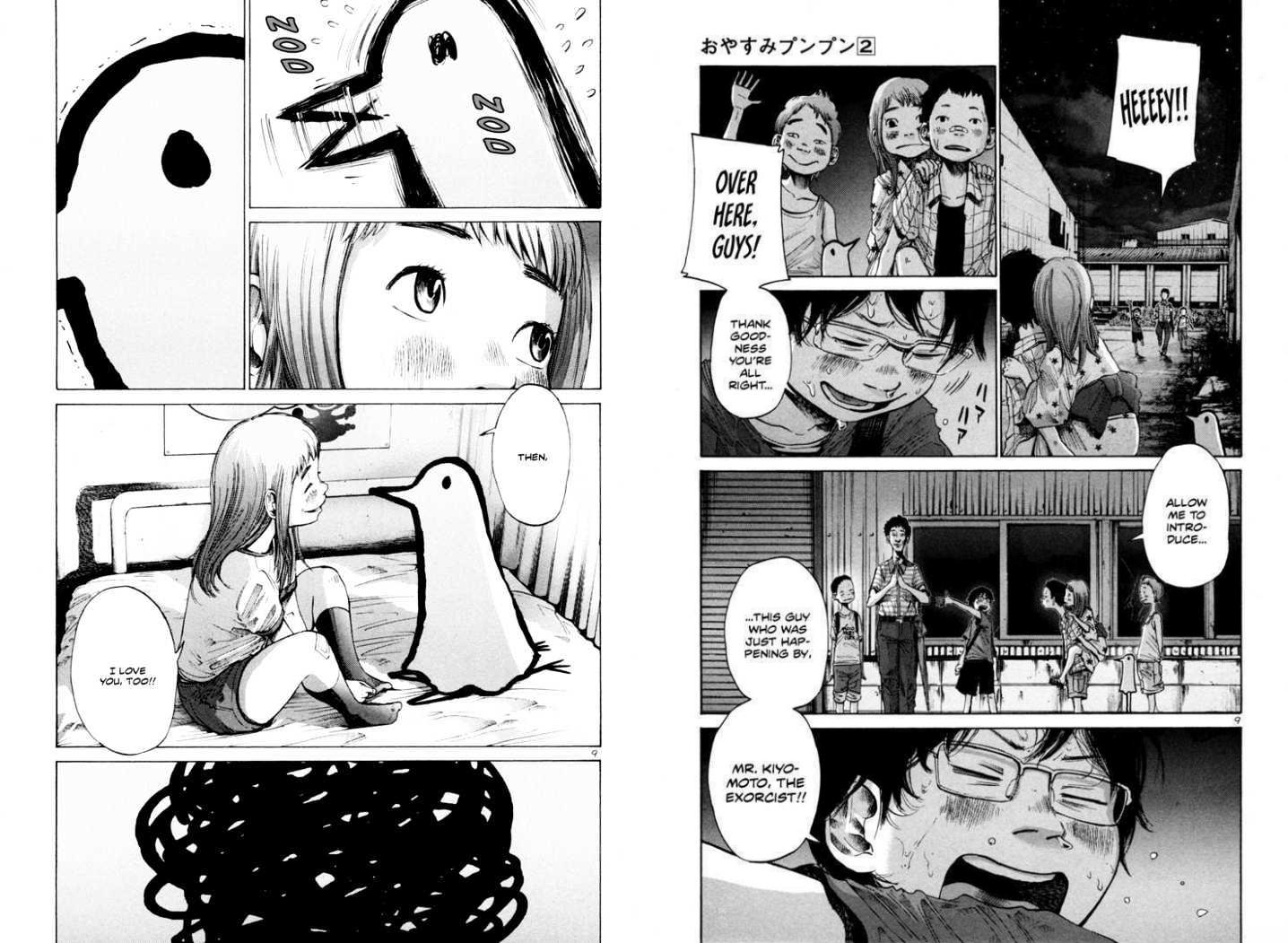
Ensuring readers both understand and feel sorry for Punpun is Asano’s creative priority as he acutely transmits the uncertainty and alienation some youngsters experience. He heightens this by keeping Punpun anonymous throughout. All Asano’s works feature incredibly detailed locations, but the realism here has the added effect of reflecting Punpun’s feelings of being out of place, accentuated by Asano’s visual metaphor of depicting him as a dashed off simple sketch of a bird.
The key coming of age sequence has Punpun and his classmates taking a trip across town to an abandoned factory where much goes wrong. Asano sets this up very artfully, and it leads to Punpun’s life flashing before his eyes, the never-fulfilled dreams of his father emphasised. It’s contrasted with his own current aim, that of finding enough money to take Aiko to visit her uncle who lives several hundred miles away. Cleverly, as with many aspects of Punpun’s life, when he needs to make a decision there’s a reinforcement of the negative possibilities.
Although the final chapter is one of the bleakest in the book, it’s also a glimmer of hope as for the first time Punpun sees through deceit, however well meant, and realises the adults in his life aren’t the best influences. It’s typical of the nuanced characterisation, yet simultaneously offers the possibility of further failure, because if one thing’s been established it’s that Punpun is prone to over-thinking life.
Despite being almost universally praised, there’s the feeling that Goodnight Punpun isn’t going to be for everyone. It’s uncomfortable and brilliant in expressing the alienation felt by some children, but the confident and aggressive will perhaps see a whiner or a victim. Those who Asano touches, though, will be deeply affected and head straight to Goodnight Punpun 2.


