Review by Frank Plowright
The IDW Classic Collection series combines graphic novels earlier released in a bulky, value for money format. The only downside is for art lovers, as the reduced price is viable due to the pocket format.
As the cover portrait shows, what’s on offer here are three stories based on the 1960s Star Trek cast, with one adaptation and two original stories. It’s the adaptation that’s the quality item.
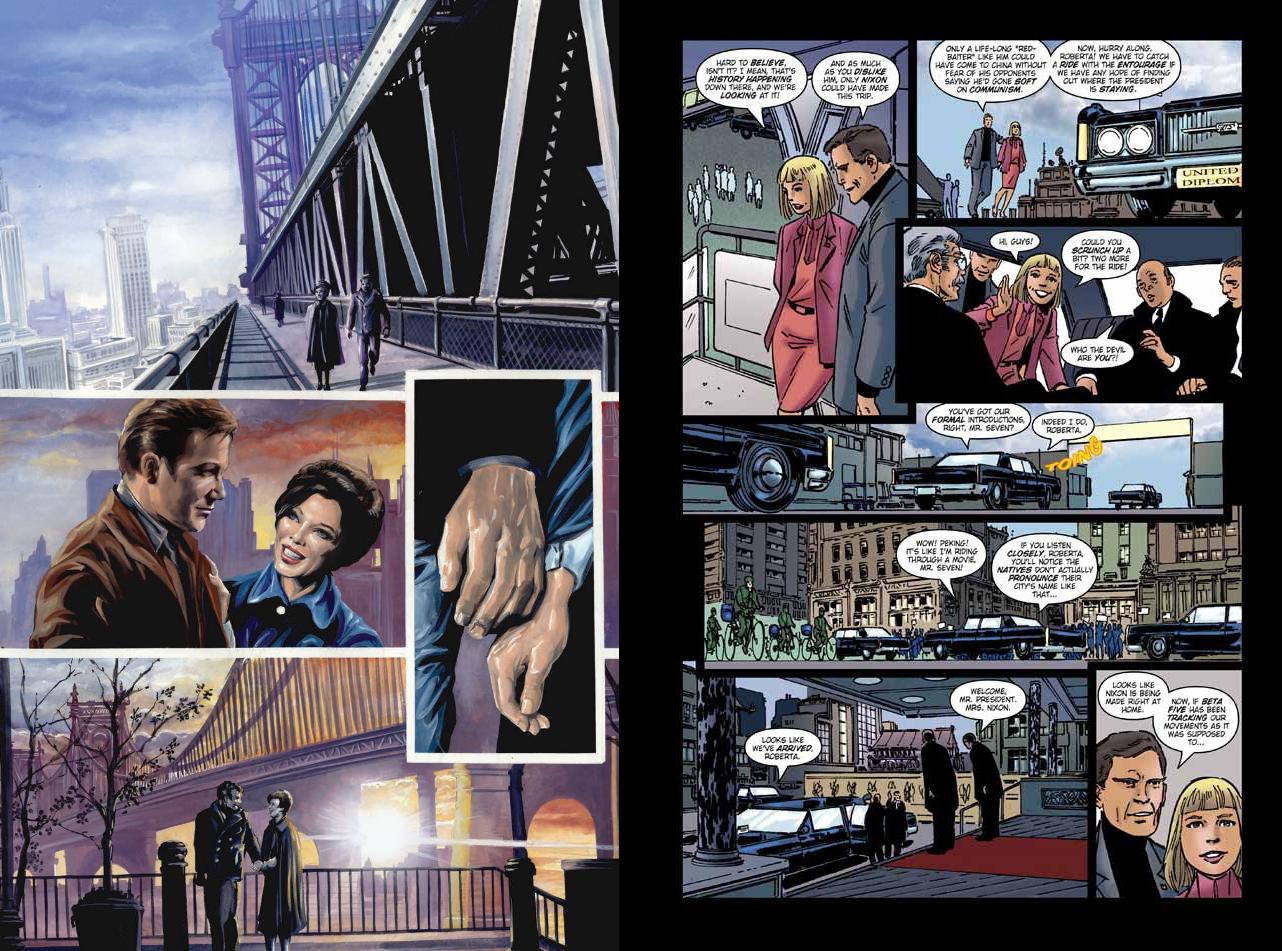
Famed SF author Harlan Ellison was never shy about making his feelings known, and he believed his original script for the Star Trek TV episode ‘City on the Edge of Forever’ was stronger than what was eventually screened. This was despite the episode being considered a series highlight. The Writing team of David and Scott Tipton break down Ellison’s script for adaptation and the stunning photorealistic art of J.K. Woodward brings cast and locations to life. The heart of the story remains James Kirk falling for Edith Keeler, whose fate is predetermined, but the trappings are inventively different from the TV show. A drug dealing Enterprise crew member prompts the trip to the 1920s, not an addled Doctor McCoy, and the drama plays out smoothly and heartbreakingly.
What was originally released as Klingons: Blood Will Tell, also focuses on TV episodes, with the starting point being retelling those stories, but from the viewpoint of the Klingons. Enjoyment is dependent on how fascinating any reader finds the Klingon warrior culture and its intricacies of honour and service. The Tiptons build on the Klingons race lacking kindness and excising compassion, and along the way provide an explanation of why the Klingons of the 1980s Star Trek look nothing like the Klingons of the 1960s. However, the original idea doesn’t sustain five chapters, and David Messina’s art, with Elena Casagrande credited for assistance, is workmanlike rather than startling.
The same applies to John Byrne’s Assignment: Earth, which focuses on Gary Seven, a character who managed to mystify the Enterprise crew in a TV episode bearing the same title. He’s been sent back from the future to 1968 in order to protect the timeline, and was intended by producer Gene Rodenberry as a separate show, but when that didn’t manifest Seven was merged into Star Trek continuity. Byrne supplies missions for Seven and his assistant Roberta Lincoln, able to transform into a cat. They’re decently plotted and drawn thrillers, but not of the type that stick in the memory.
City on the Edge of Forever was only issued as an expensive hardcover, so its appearance in an affordable format is welcome and makes Edges of the Final Frontier an attractive purchase, but you’re not seeing Woodward’s art at its best.