Review by Frank Plowright
From an early age Ben Hatke was impressed by G.K. Chesterton’s thoughts on getting home. Chsterton noted one method being never to leave, while the other is to circumnavigate the globe until returning to the same spot. It’s an idea that’s knocked around Hatke’s head for years, and he eventually began to wonder if it was now possible to travel around the entire world in eighty days using only surface transportation. Home/World is the story of that trip.
Travelogues are personal and so while the investment needed isn’t as strenuous as taking the trip, the guide needs to connect as open-minded and interesting, and Hatke proves an amiable host. The leisurely preparations and accompanying concerns form a prelude, introducing the concept of ghosts of travellers past (withe the caveat that some still live). Although the aim is to complete the journey to a deadline, this is no headlong rush, and an astute friend points out Hatke is taking a series of day trips in effect.
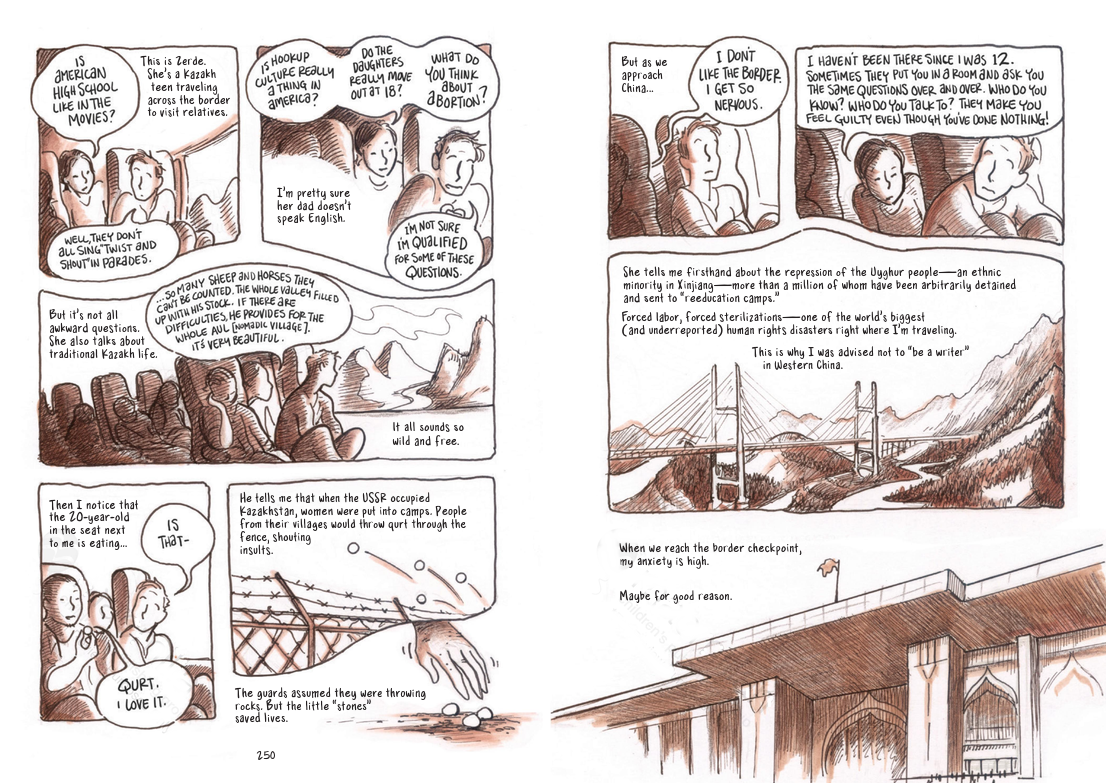
Europe as seen through American eyes is generally interesting, if not always sympathetic, but Hatke’s heart is cosmopolitan, making for an appreciative sense of wonder. As he notes, though, Europe is the easy part of the journey, and while London, Paris and Florence are admired and beautifully sketched, they’re also places where friends live, meaning language is no problem. It’s when Hatke moves beyond that the realisation of living in privilege hits. In Istanbul all trains are booked, crossing by land into Azerbaijan carries a two week jail sentence if caught, and Chinese authorities are to be respected. Illustration, though, is a universal communicator, and delicately detailed sketches produced along the way are useful on several occasions.
In addition to the ghosts of other travellers, Hatke’s haunted by a personal ghost, and the book’s most touching scene involves reconciliation at sea. It exemplifies us never knowing when deep feelings will be released.
Once beyond Europe Hatke learns that extensive travel requires patience and adaptability, and the sense of scale is transmitted. Kazakhstan, for instance, is little known beyond the Borat film, yet it’s one of the ten largest countries in the world with the unique cultures and obstacles that brings. Crucially, Hatke is open to experience, willing to try local delicacies and to rough it when necessary. He makes astute observations, connecting Hiroshima to the US July 4th celebrations, and while other travellers might skimp across the USA when back in their homeland, Hatke is able to recognise elements of US society as fundamentally weird, and that some sights are worth seeing, so the interest continues.
At the end Hatke underplays his achievement. How many of us would do what he did? Very few, so accompany him and let him open your eyes.