Review by Ian Keogh
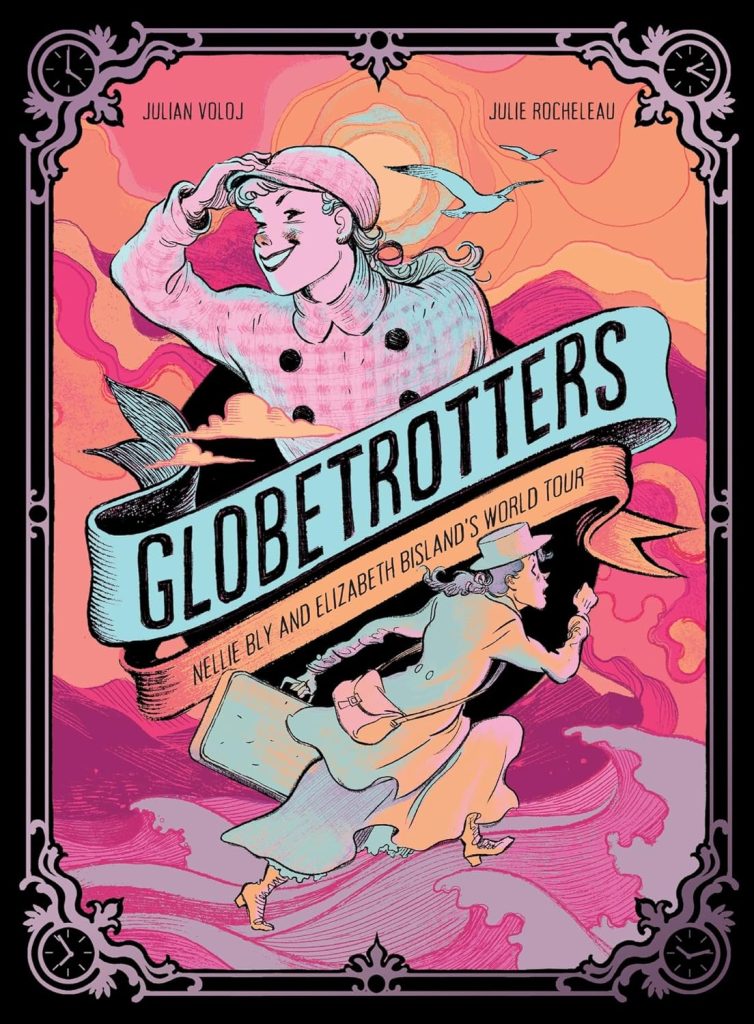
From all available historical records Nellie Bly seems to have been a force of nature, an exceptionally talented person as both journalist and businesswoman and she’s someone whose achievements ought to be more widely known. Julian Voloj and Julie Rocheleau begin Globetrotters defining exactly why with but one of the remarkable incidents of her life. It’s well told, intended to shock and surprise anyone unaware of the story.
The Bly name was actually an alias for Elizabeth Cochran, assumed because it was considered inappropriate for women to be journalists in the late 1800s. Following the events of the prologue, she suggested her next report take its lead from Jules Verne’s novel Around the World in Eighty Days, believing she could complete the journey in fewer days. She persuaded newspaper publisher Joseph Pulitzer to fund the trip, and it was well publicised before her departure. Even greater publicity was generated by another newspaper sponsoring Elizabeth Bisland to undertake the same task.
Both Bisland and Bly subsequently documented their journeys, so there’s reference for Voloj to sift through, and his frequent choice is to highlight moments of what would now be considered unacceptable behaviour. Their trades alone marked Bisland and Bly as relatively unique, and there’s no shortage of comments about what’s considered appropriate or not for women. Importantly, as they travel, Voloj doesn’t just supply a ticklist of locations, an itinerary and major incidents, but brings the trips to life via introducing people encountered and places visited. He also underlines what a major event it was, followed around the world and making celebrities of both women, although for a long time Bly was unaware she was involved in a race against someone else as well as time. Both participants are conveyed as lacking pretensions and their journeys, in different directions, are interspersed.
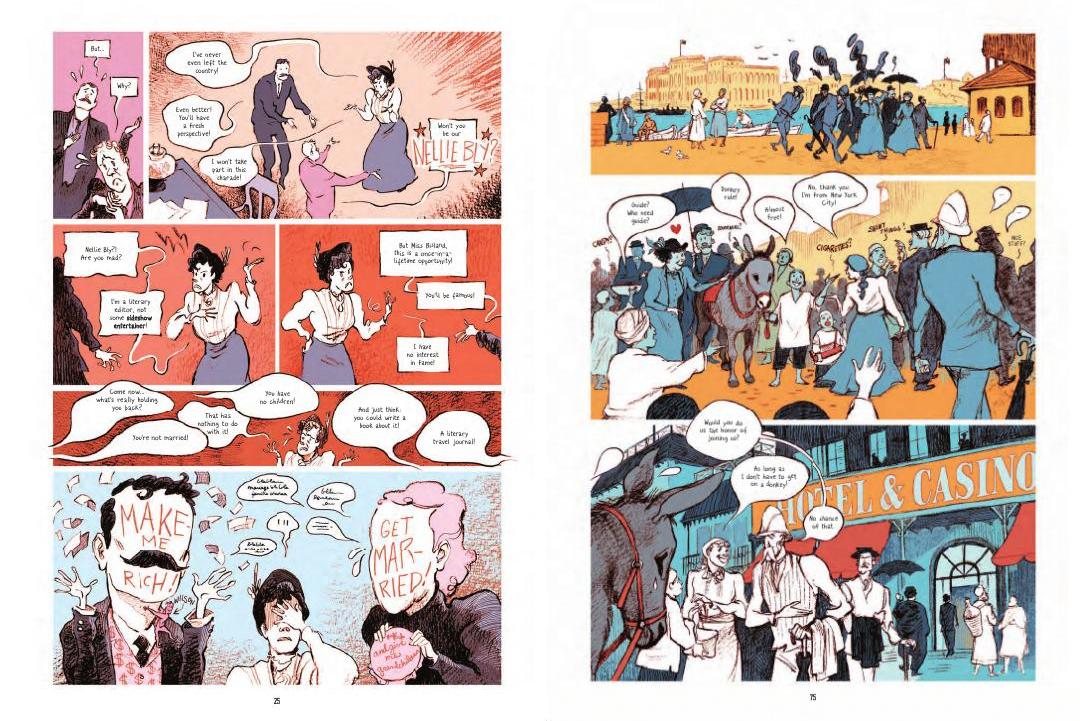
Rocheleau’s art is a loose cartoon version of old newspaper engraving, with plenty of lines conveying background detail. With so few people knowing what the protagonists looked like, Rocheleau is able to present them in the clothing of the era, yet as simple and expressive without likenesses required. Specialist techniques are the cut from one protagonist to the other ending with a quiet scene and then jumping to a shock, or the representational spread. Additionally, Rocheleau’s great at conveying the hustle and bustle of the cities visited rather than taking the shorthand approach of concentrating on landmarks, and if she feels it necessary she’ll present beautifully decorative pictures, be they of artwork or insects.
Anyone who loves a factoid is going to be delighted with Voloj’s inclusion of many. Tenderloin districts, Noh plays and catamarans are explained over a few pages and many more occur, generally in stopovers required in the days when foreign travel was restricted to trains and steam ships. He also ensures that when both women visit the same place, different experiences are related.
With Race Across the World now a TV show, and flights the preferred mode of travel there might be a blasé attitude toward what both Bisland and Bly achieved, but Globetrotters brings home the joys and trials of such a trip in the 1890s. It also accelerates the tension of a race in the final stages and pleasingly provides information about both women’s lives after their travels.
Abrams also publish The Incredible Nellie Bly, covering her entire career, but this is by some distance the better graphic novel.