Review by Win Wiacek
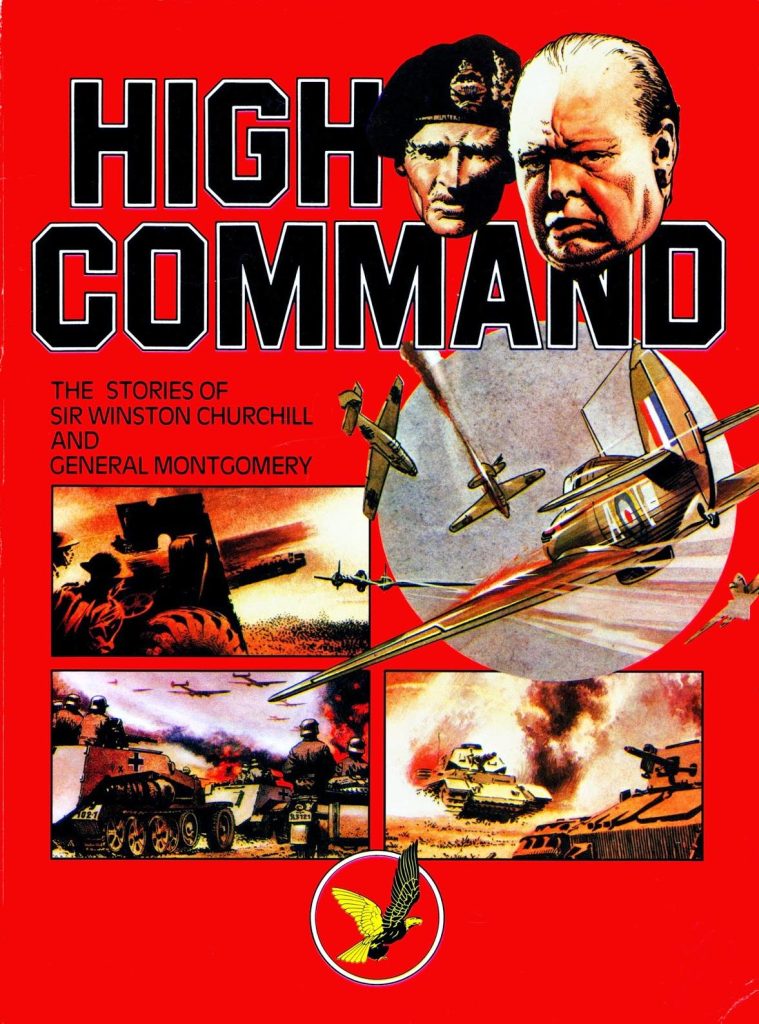
Launched in 1950, Eagle remains a highspot of British comics. From its glorious Reithian heyday (“Educate, Elucidate and Entertain”) came a brace of brief biographical serials devoted to two men crucial to the war that had imperilled the readership’s forebears, and these were collected into a classy album by Dragons Dream in 1981.
The first half was reprinted in 2014 as a slim, scarcely seen paperback and hardcover album from Uniform. The Happy Warrior: The Life Story of Sir Winston Churchill as Told Through the Eagle Comic of the 1950’s comes with a scholarly commentary from Richard M. Langworth CBE, but we’re long overdue for the combined volume to resurface.
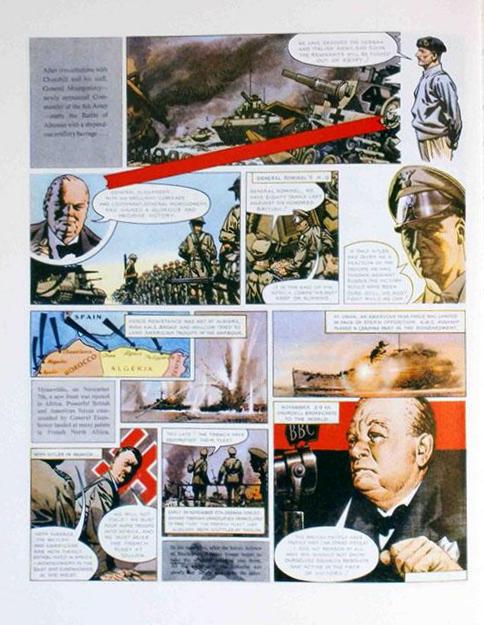
If you can, find the High Command edition, but in whatever form you can devour the life stories of Sir Winston Churchill and Montgomery of Alamein. Both were scripted by Clifford Makins, the former serialised on Eagle’s prestigious back cover between October 1957 to September 1958 and the latter between March and July 1962 in two page spreads.
The prestigious full-page back cover feature was Frank Bellamy’s first full colour strip. He followed up with Monty, delivering twice the punch and more revelatory design in two-page colour spreads that utterly spellbound readers, whether they were war fans or not.
Churchill himself approved the early strips. He was rumoured to have been consulted before the artist Frank Bellamy began the experimental layouts that elevated him from a highly skilled representational draughtsman into the trailblazing innovator. The tireless experimenter also began the explorations of the use of local and expressionistic colour palettes.
The Churchill story follows the great man from his early days at Eton through military service in Cuba as a war correspondent, and into politics. Although a large proportion deals with World War II – and in a spectacular, tense and thrilling manner – the subtler skill Bellamy displays in depicting the transition of dynamic, handsome man of action into burly political heavyweight over the weeks is impressive and astonishing. It should be mentioned, though, that this collection doesn’t reproduce the climactic, triumphal last page, a portrait that is half-pin-up, half summation and all hagiography.
Bernard Law Montgomery’s graphic biography benefited from Bellamy’s burgeoning expertise in two ways. Firstly, the page count was doubled, and the artist capitalised on this by producing groundbreaking double page spreads that worked across gutters (the white spaces that divides the pictures). This allowed him to craft even more startling page and panel designs. Secondly, Bellamy had now become extremely proficient in both staging the script and creating mood with colour. This strip is pictorial poetry in motion.
Makins doesn’t hang about either. Taking only three episodes to get from school days in Hammersmith, through army service in India and promotion to Brigade Major by the end of the Great War, Monty’s WWII achievements are given full play. It allows Bellamy to create an awesome display of action-packed war comics over the remaining fifteen double-paged episodes. There really hasn’t been anything to match this level of quality and sophistication in combat comics before or since.
If you strain you might detect a tinge of post-war triumphalism in the scripts, but these accounts are generally historically accurate and phenomenally stirring to look at. If you love comic art you should hunt these down, or at least pray that somebody, somewhere has the sense to reprint this work.