Review by Frank Plowright
A massive wall separates reality from the unknown beyond, spectacularly drawn by Ethan Van Sciver over the opening pages. It’s monitored by the New Gods, and Godhead is set in motion when the wall is partially breached by a being warning that the assorted ring-bearers of different shades have unknowingly loosed the ultimate power. The New Gods have fought a millennia long war against Darkseid, and this ultimate power might be the end of him, so Highfather needs seven rings from various shades of Lantern. It’s intimately tied to the complications of Green Lantern’s universe, so if that makes no sense, perhaps Godhead isn’t the crossover for you.
Even readers with a passing knowledge of the Green Lanterns and their purpose might find Godhead hard going as it combines chapters from five regular series, and then adds assorted New Gods to the mix for a massive cast. Additionally, it processes the ongoing concerns of the four series, builds on earlier crossover Lights Out, and there’s been a continuity reboot so Hal Jordan wasn’t previously aware of the New Gods.
Take all that on board, and Godhead does what it sets out to do. It’s a fast-moving, unpredictable action thriller with enough room to focus on what assorted characters are going through, although brief glimpses into some ongoing subplots lack substance here. The original story ran through titles associated with Green Lantern, but the New Gods receive equal billing here, and the continuing return to focus on their activities lifts Godhead above a standard crossover. They also believe they’re acting in the best interests of the universe, and they’re a fascinating bunch of characters from the aloof Metron to the thuggish Uggha and his distinctive hammer.
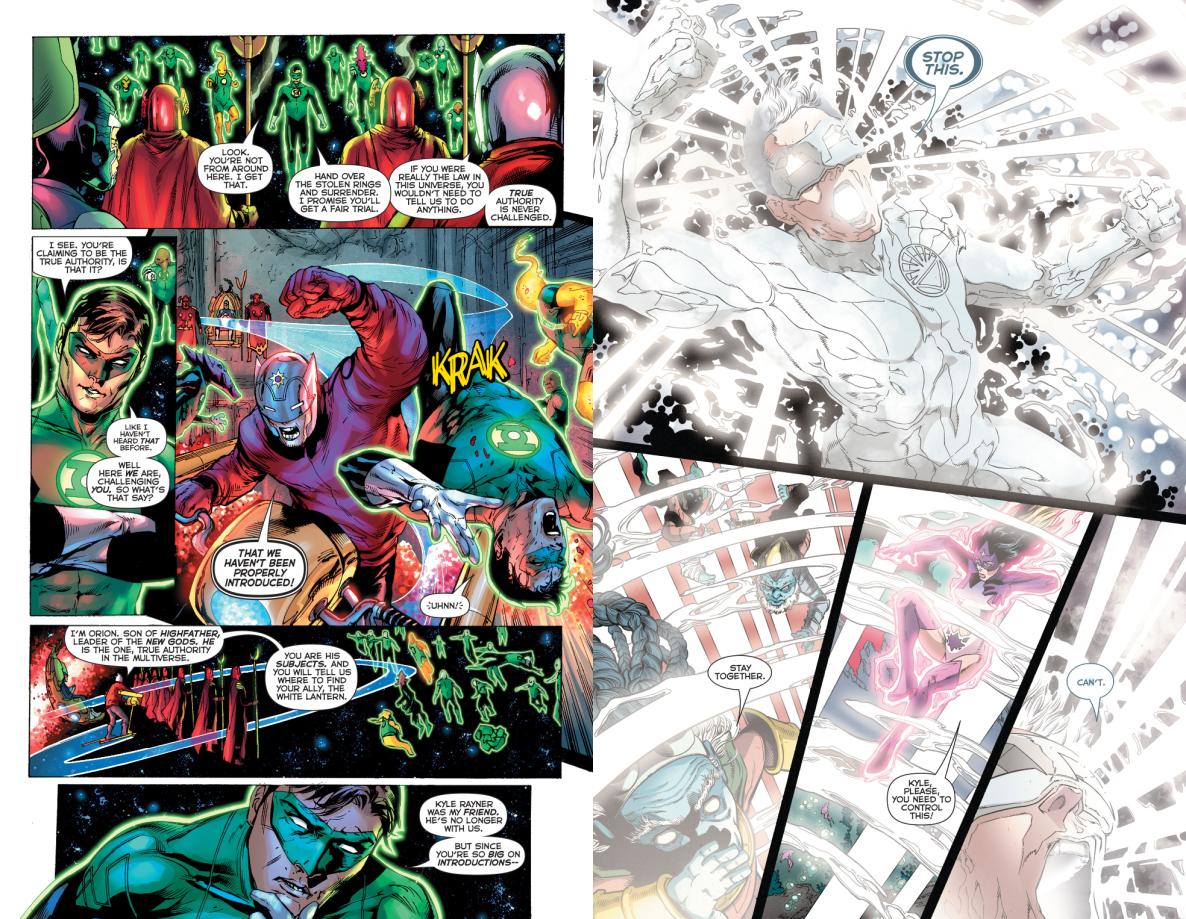
While the artists switch from chapter to chapter, they all supply imaginative action, differentiate a vast cast and don’t shy from packing the panels with them, and give a noble stature to the primary figures. The sample art combines pages from Billy Tan and Brad Walker early in the story, but it could just as easily be Bernard Chang and Martin Coccolo or Francis Portella and Dale Eaglesham. A couple of artists fall below the general level of visual imagination on display, but have a crucial level of competence. They’re all helped by an eye-catching stylistic technique with the colour, with the occasional panel on a page rendered in black, white and red.
A downside of involving so many characters in different locations is that it can take too long to return the spotlight to someone, as happens with Hal Jordan a couple of times. Some writers also have trouble reining in the writer’s instinct, so fewer words would have greater impact in places. The major weakness, though, is messing with a character whose previous incarnation embodied honour and justice. Having them become another power-hungry tyrant certainly surprises, but it’s cheap and idle plotting. That’s balanced against a thriller overall in which Charles Soule writes Sinestro with an arrogant swagger, while Robert Venditti has a spectacular ending planned.
Assorted chapters can also be found in volumes of Green Lantern, Green Lantern Corps, New Guardians, Red Lanterns and Sinestro, where out of context they make little sense. Here they run smoothly together.