Review by Ian Keogh
In 1937 Japan invaded China and the Korean peninsula, and committed atrocities wherever they arrived. One of their appalling habits was abducting Chinese and Korean women for sexual slavery among the military, calling them “comfort women”, a discredited term, but one widely understood, so used in Grass. Many who survived the experience never saw their homes again, and as they aged and needed care, nursing homes were set up in Korea for the women who suffered. It’s where author Keum Suk Gendry-kim met Lee Ok-sun, whose story forms most of Grass.
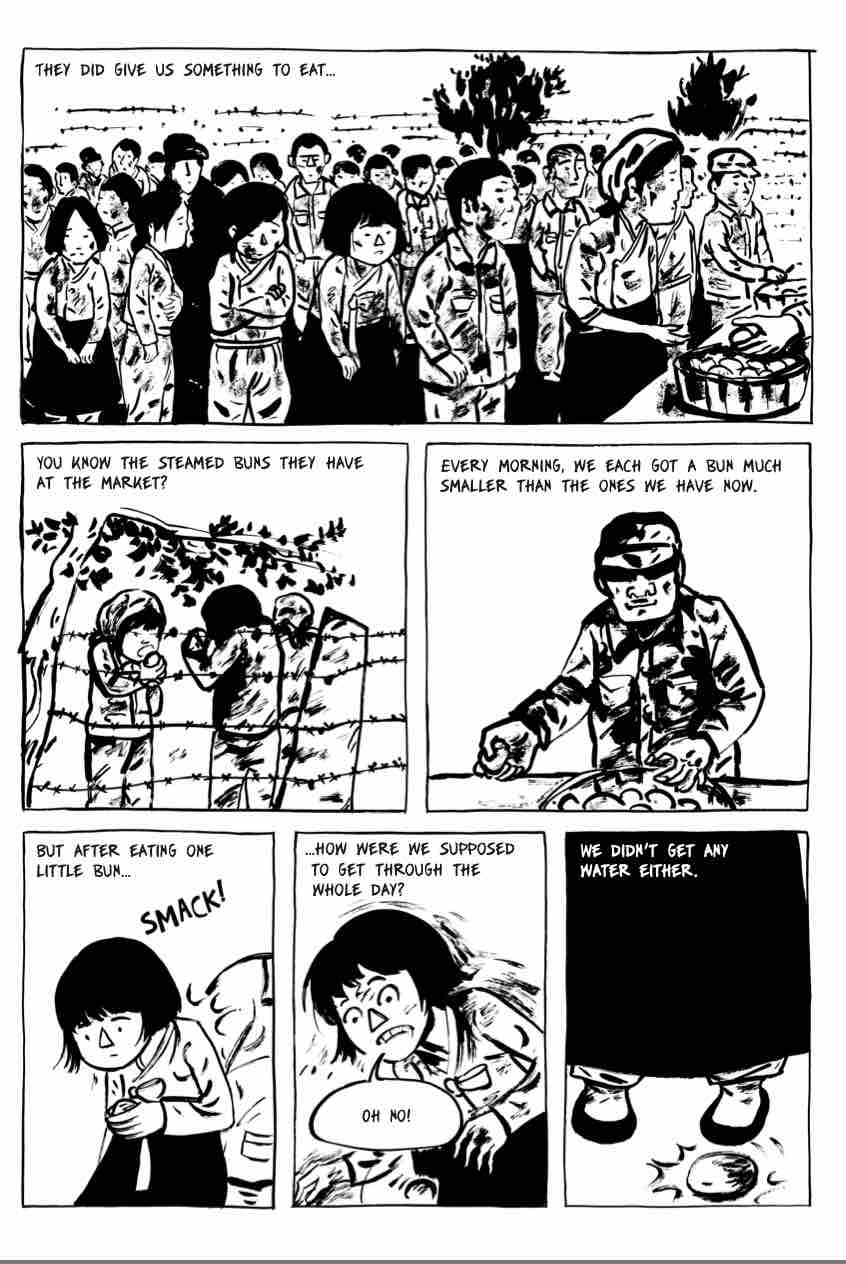
As horrifying as the abduction and rape was, it wasn’t as if Ok-sun’s life was easy beforehand. Her father was ill, so her mother had to take work wherever it could be found, and in order for that to happen Ok-sun needed to look after her baby brother and do the household chores. There were still days when no-one ate. Out of desperation she was sold to the owner of a city noodle bar, and then onwards to a tavern. She was abducted and taken to a work camp at fifteen, along with some girls even younger, and not long afterwards was first raped.
From the start Gendry-kim adopts a sketchy style of black ink that adapts well to anything that needs to be drawn from childhood antics to darker times. There’s a delicacy to the people despite the simplicity, and care taken to show the clothes worn, down to the creases in them. Some Japanese are seen and identified, but abusing soldiers are always faceless and dark scenery is constantly used as the transition from one scene to the next.
At no point is anything in a grim memoir ever sensationalised, and the women in the camp are always drawn as grubby and emaciated. Sometimes Ok-sun is shown relating her story, and this is accompanied by emotionally strong portraits of an older woman recalling her terrible circumstances. The knowledge of age is used to underline false promises believed at the time, such as the possibility of a return home.
The stories of others are also incorporated, some of whose lives were even more tragic than Ok-sun’s. Just reading about their experiences is hard, so having to live through them is beyond our comprehension.
Gendry-kim has Ok-sun tell her own story, and there’s a surprisingly dispassionate tone to it, leading to speculation about whether this is Gendry-kim’s policy of maintaining some dignity, as it’s difficult to imagine someone reliving events without breaking down. And it’s not as if the abuse ended with the conclusion of World War II. That put an end to the rape camps, but day to day survival remained an issue, and the unluckiest of the victims then ran into Soviet soldiers equally lacking in humanity. Ok-sun was more fortunate than that, but her story doesn’t become any happier.
As unforgivable as what the Japanese did was the stigma Korean society later accorded their victims, as if the abducted young girls were somehow responsible for their own decisions, and Ok-sun’s story ends on a tragic note.
Anyone requiring trigger warnings before their TV shows should go nowhere near Grass. It details the worst excesses of people holding power and unaccountable, brutality accompanying rape. While that was happening, in the wider world the Japanese were attempting to eradicate Korean culture. The title is explained right at the end, a rather forced metaphor about the resilience of grass able to replenish after being trampled underfoot, but it’s the only wrong note in this harrowing memoir.