Review by Frank Plowright
The first the comics world took notice of Carol Lay was with Good Girls, a serialised anthology featuring assorted imaginative pastiches of romance comics. These strips were weird, sharply observed and funny, and yet even among the sparkling originality one feature stood out.
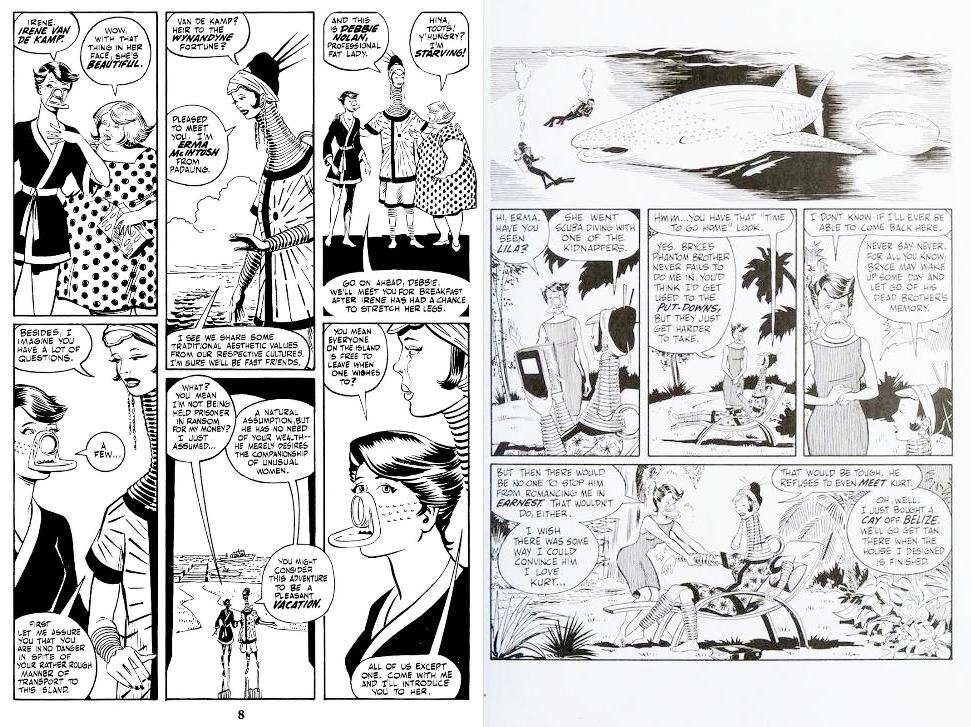
As explained in what was originally intended as a throwaway standalone story introducing Irene Van Der Camp, an American baby was orphaned in an un-named African country when baboons murdered her parents, and adopted by the Bongodian tribe. Brought up amongst them, she willingly underwent facial modification techniques to meet their traditional standards of beauty, having her bottom lip extended to hold a plate in her mouth, scarification, and her top lip extended over her nose. In a sequence pastiching Tarzan of the Apes, she’s eventually located and returns to the USA as an heiress, but from a society where she’s accepted to one where her image repulses people.
Lay writes this origin as if a sincere account, albeit in the lachrymose style of romance comics, and the joke sustaining the remainder of the story is that despite her fortune she can only attract a blind boyfriend, Kurt. In the end even he rejects her. Despite the attractive art, it’s bleak humour, yet what prevents it also being somewhat distasteful is Irene valuing her differences.
Subsequent 1980s instalments dropped the romance pastiche to focus on Irene’s personality and a series of increasingly absurdist adventures, yet the dark humour remains, with the selfish Kurt generally the victim of slapstick jokes based on his blindness. The original material’s wild drama ends by reverting to romance tropes for the sake of a convenient ending, but this collection continues with one previously unpublished story and one commissioned for the publication.
In the brief ‘Nobody’s Home’ a now pregnant Irene returns to the Bongodians for the first time since her departure. It’s funny, and also a clever meditation on how money corrupts. ‘About Face’ moves time forward and deals with Irene’s teenage daughter also wanting facial modifications, while returning the cast from previous episodes. It’s more of the same, which is that bittersweet feeling of getting what’s wanted, but also surprise that Lay isn’t moving beyond, which may seem a trivial complaint.
In all the years since Irene’s first appearance there has never been another leading character remotely like her or facing her challenges. These are funny stories with a genuine heart to them, beautifully drawn, displaying from the very start of her career Lay was an imaginative and utterly unique talent.