Review by Frank Plowright
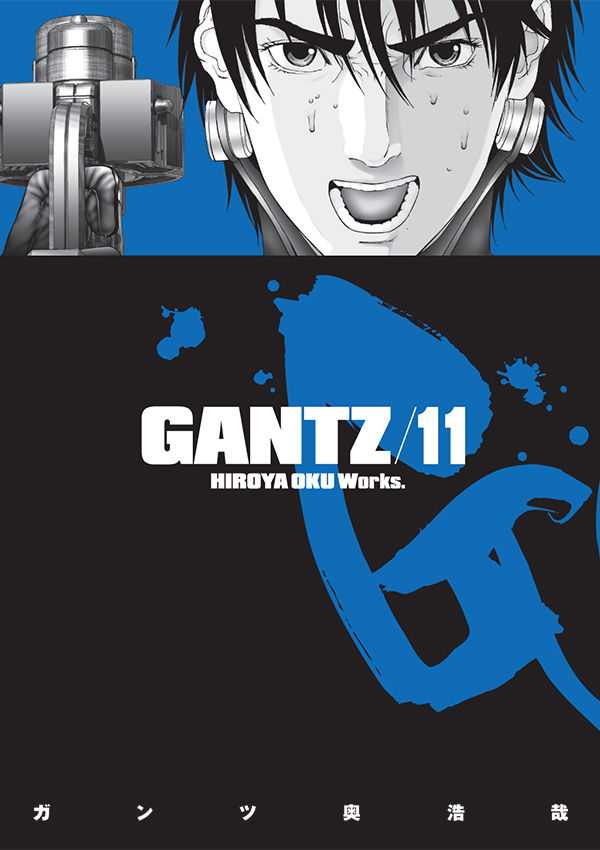
Hang on! What’s happening here? After ten volumes in red, the cover’s blue! There is no greater significance than design. It happens again with Gantz 21 onward featuring a primarily white cover.
Gantz 10 worked toward a clever ending calling into question much of what had been previously revealed, and Hiroya Oku’s not in any great hurry to delve into the details. Instead he scrolls back to the puzzle of Izumi, his addiction to a blog about hunting aliens, and his suspicions of Kei being involved. It’s clarified why Izumi is so driven and Oku imaginatively introduces another terrifying situation outwith the world of hunting aliens, leaving Kei alone aware of something and leading to a brilliantly awkward interview scene.
However, it rapidly becomes tame in the light of what Oku follows it with. He’s set up what already has the potential to be something bad, and instead delivers something even worse, appalling in fact. It’s counterpointed by Kei not being able to do anything, and the tension of his knowing his girlfriend Tae is likely to be at the epicentre of events. Oku shows she is, and ramps up the suspense via what she sees. As events reach their worst, it’s revealed that actually very little of the previous volume was in fact a dream, and all the characters with whom time was spent have a role to play here. It’s very smartly handled.
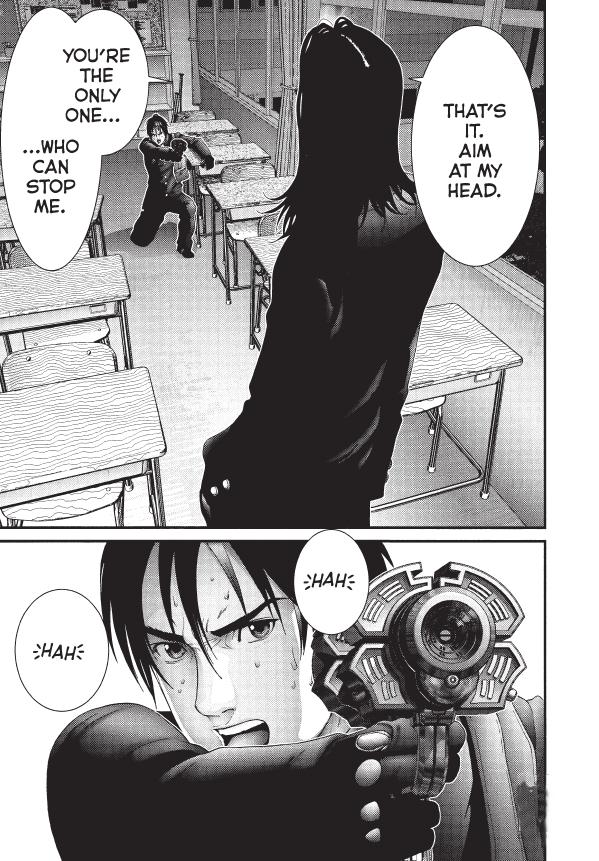
The effort Oku puts into the art is astounding. Much of the story takes place in a crowded area of Tokyo and Oku doesn’t slacken off for a moment in drawing the locations in detail and filling them with hundreds of people. This isn’t just on a couple of pages to set the scene, but on page after page as events unfold.
This is as good a volume of Gantz as there’s been, all the more amazing for the main premise having almost no bearing. However, as incredible as everything is, though, Oku’s still separating his chapters with pin-up illustrations of naked women, which is distasteful and disrespectful. It also makes one consider how slim the personalities of the women in the series have been to date, which is possibly down to the way Oku views them. The fallout is in Gantz 12, with which this is combined in the fourth Omnibus.