Review by Ian Keogh
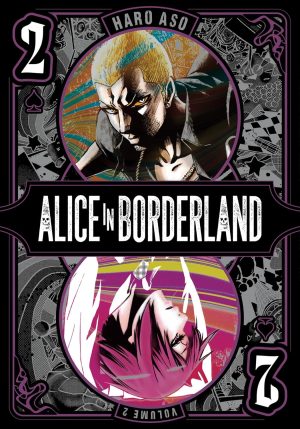
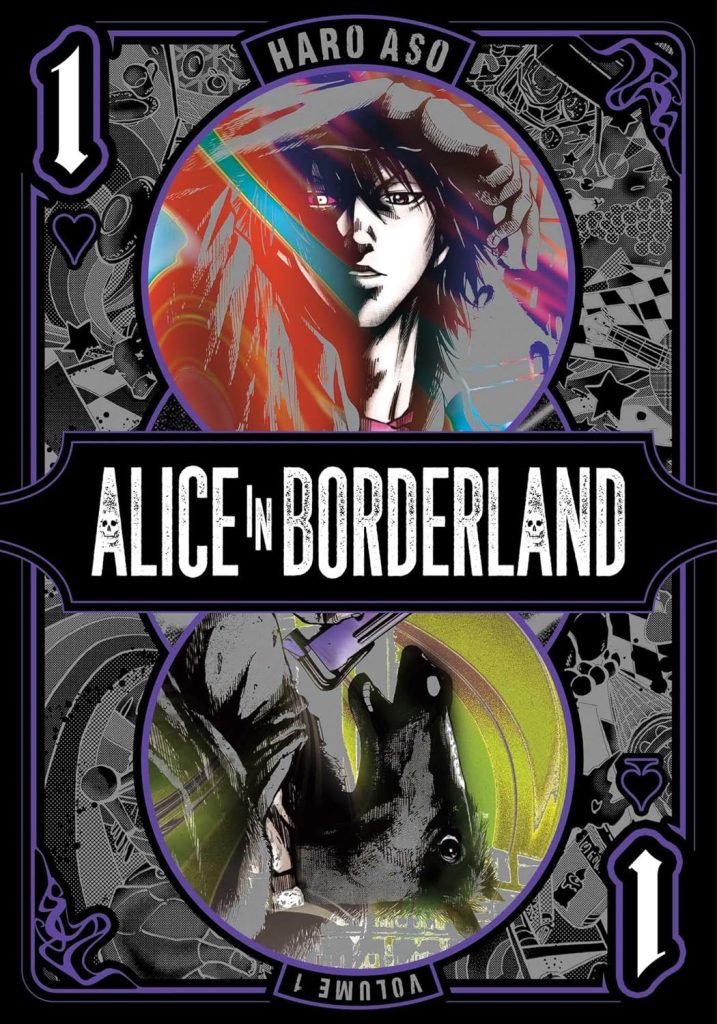
Viz’s Signature editions combine what was originally published as two books in Japan, in the case of Haro Aso’s Alice in Borderland reducing the total number of volumes to nine. It’s a type of action thriller the Japanese are very fond of, where a group of people are transported into an alien environment and are set possibly fatal missions, having to figure out the rules as they go along. The concept is original enough to have spawned a TV adaptation, but while there are connections, especially with the cast, Aso’s original version follows a different path.
In this case the initial victims are childhood friends Ryohei Arisu and Choda Segawa, along with a slightly older former schoolmate Daikichi Kaiube. Arisu is the narrative voice, at 18 disenchanted with school and his parents constantly comparing him with his academic brother. During an unguarded moment he lets slip that he feels he’d be more at home in a zombie killing game than reality, so does that make him responsible for what next happens?
All three wake up in what they presume to be the future of a largely deserted city and are drawn to a funfair area where they meet Saori Shibuki, who has some idea of what’s going on and what it takes to survive. What was originally the first volume runs through an allocated task, the necessities of survival and the dangers awaiting non-compliance. Winning the task earns rewards and prolongs life, although not for very long.
The cast is broadened for the second task, including people who’ve learned from surviving earlier games, and who’re able to supply a little more information as to what’s happening. One of them refers to where they are as Borderland, making for the rather contrived English language title. There is, as yet, no Alice, and the opening chapter title is ‘Arisu in Borderland’, so why not that? Of course it could be Arisu isn’t always intended to be the narrative voice. However, it turns out that while he might not have wished where he’s ended up, he observes and has an analytical mind able to assess what’s going on and conceive possible solutions.
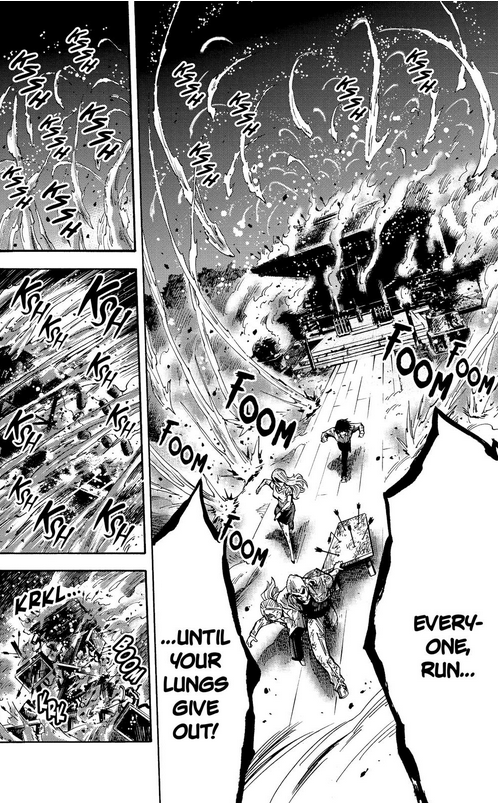
For what becomes an action thriller Aso spends a little too much time introducing characters and circumstances, especially as he later proves he can achieve the same far more rapidly. However, once he hits the sweet spot there’s barely a page wasted. The challenges are inventive, the threats visually stimulating, and Aso’s unafraid to resort to diagrams to aid understanding. His art’s stylised, but broadly realistic cartooning good at distinguishing character.
Volume 2 continues to add to the cast and delivers more complex challenges.