
Review by Karl Verhoven
Finder isn’t a series that offers its secrets willingly. It’s highly imaginative science-fiction, but in the form of extrapolating a society rather than action thrills, and as such resembles more esoteric French SF graphic novels than the likes of Star Wars. Persistence pays off and skim-reading doesn’t. The devil is in the detail.
Anvard is a massive domed city, once great, but now decaying, and where humans interact with humanoid animals and robots, and TV broadcasts form a near-universal presence. It’s introduced via the return of Jaeger Ayers, quickly revealed as rather the rogue, and more later revealed as the Finder of the title. It’s a talent allied to a form of belief, and Jaeger’s help can be violent and not always accompanied by kindness, as personal isolation is also attached to the belief and that denies friendships. Overall, he’s astutely summed up by former lover Emma’s comment that “you always come in looking like something an emergency room couldn’t handle, but when I wash you off it’s never as bad as I imagined”. There’s a reason for that also.
While Jaeger’s the main character, Carla Speed McNeil’s focus is broad. She’s as interested in Night of the Hunter’s plot, the problems of growing roses and the nature of true predators, but she’ll move from something relatively trivial to tragedy with the turn of a page. It makes for a meandering, but never dull journey provided you’re of the mind to follow. That journey’s punctuated with constantly interesting ideas, some trivial and throwaway and others explored with greater depth, such as the exchange of information for painful memories. However, McNeil doesn’t plot in the conventional way, introducing concepts of later importance, to her an idea has its own value and doesn’t need to recur.
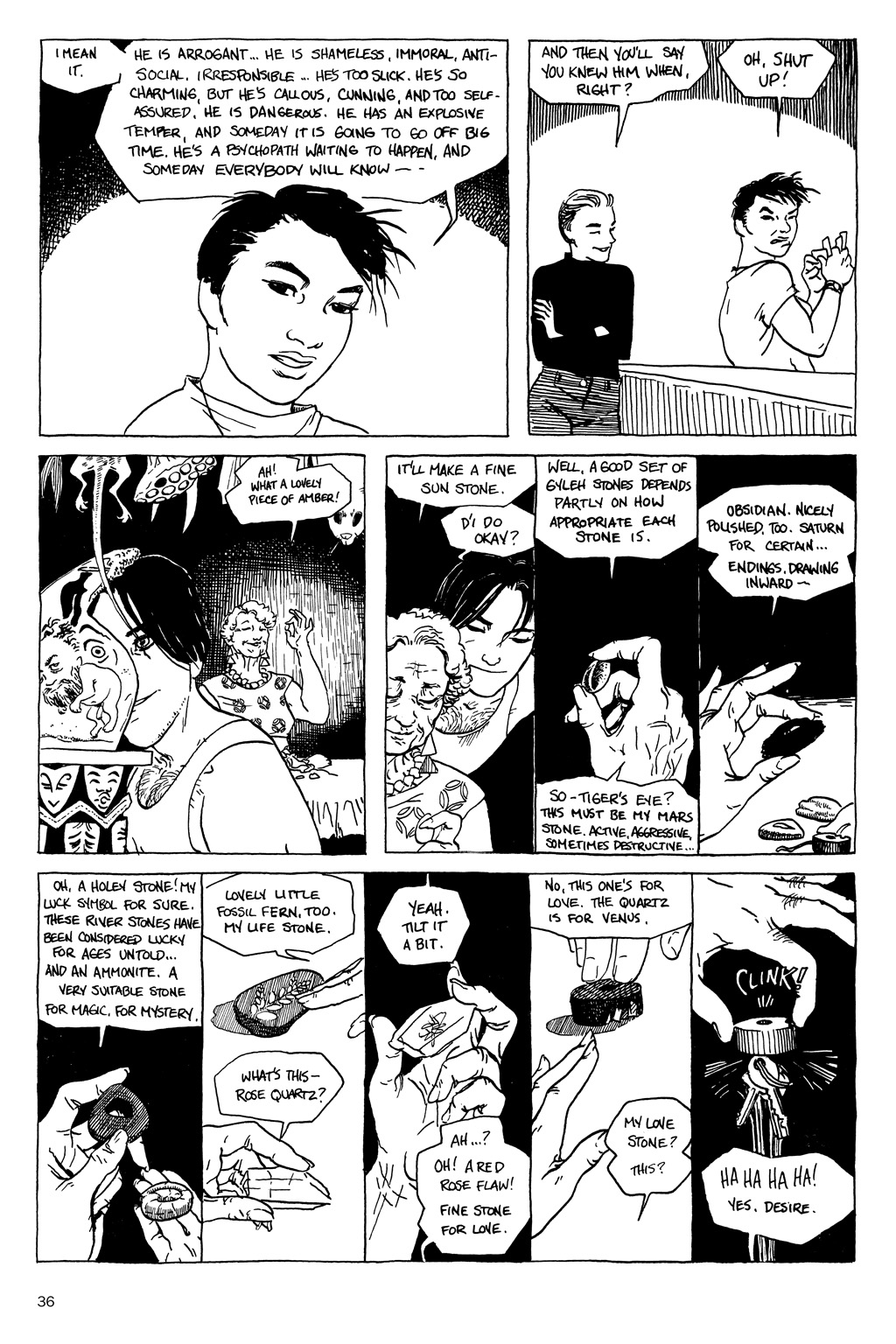
The art is simple, and in places a little flat, but it services the plot well enough, deals with the character moments and there’s imagination to the way events are presented. It improves as McNeil becomes more comfortable. On a few occasions the visuals don’t seem to make much sense, but that’s what the extensive footnotes are for, providing background details enriching the entire story.
Once you start in on the footnotes it’s easy to become distracted by them, but everything necessary is there in the comic pages. Well sometimes.
Perhaps in reverence to the concept, McNeil is the complete magpie when it comes to the smaller details, which are found anywhere and everywhere from distorted song lyrics to slightly altered names. What will surprise most, though, is the devious plotting. It takes a few chapters for it to drop, but not everyone is what they seem, some are very resourceful indeed, and just because we’re not shown someone doing something doesn’t mean they can’t do it. It’s also worth bearing in mind that everyone has their demons, and McNeil tunes into a few those as well.
This introduction to a new world begins slowly, but gradually becomes compelling. You’re constantly going to have to think about what’s happening and the density is immersive, but it’s very, very rewarding.
Things continue in Sin Eater Volume Two, or both books are combined in the first Finder Library.


