Review by Karl Verhoven
After just three previous volumes it’s already a certainty that there can be no expectation whatsoever about what any new Finder story might concern. While set on the same world, the two volumes of Sin Eater and King of the Cats were hardly similar, offering different objectives and considerations. A frisson of anticipation ought to greet every returning reader on seeing the title page quote of “my book and art shall never part”, all the better for being imprinted on a hand. Is it creator Carla Speed McNeil’s statement or something more?
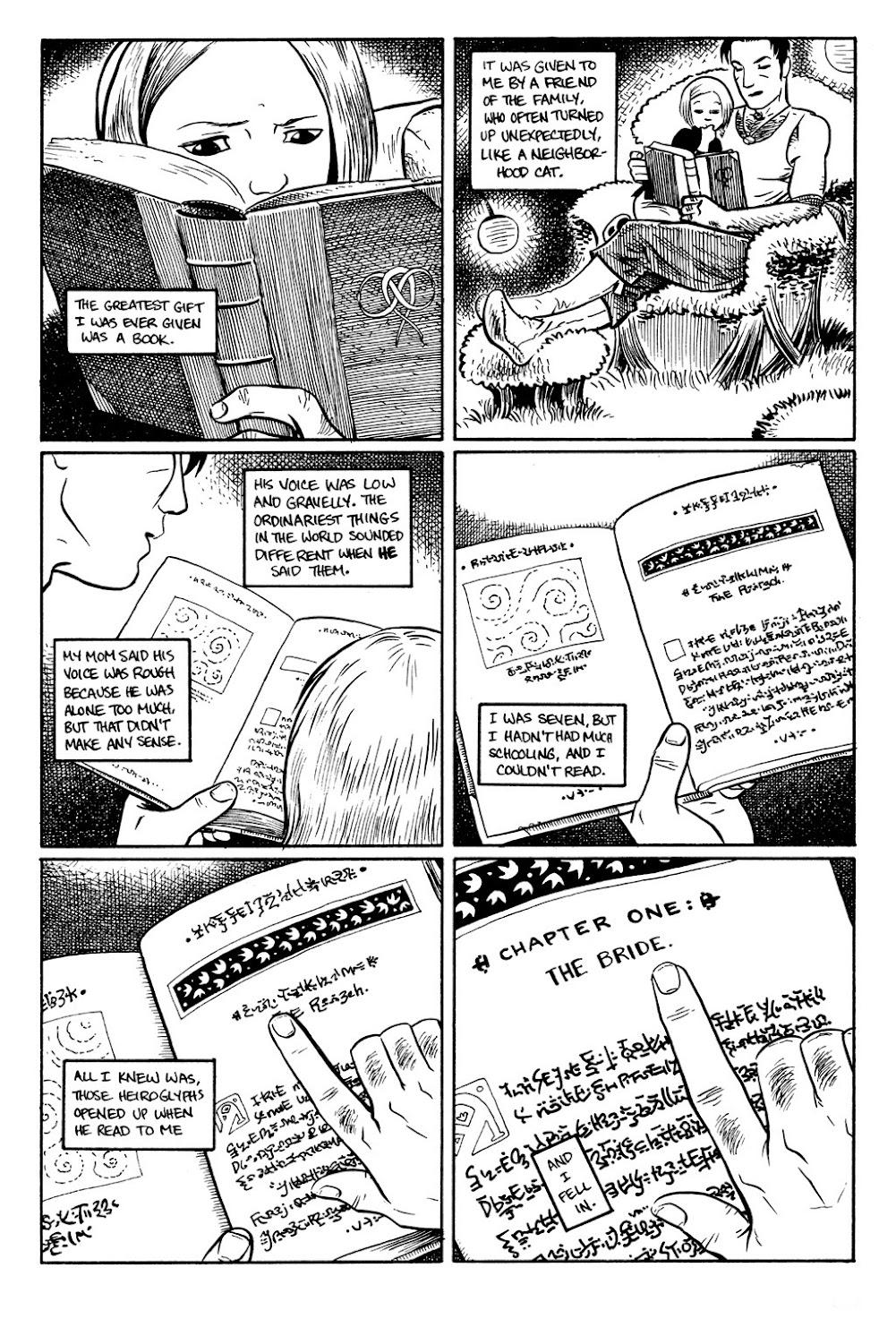
We do at least begin with familiar characters, Jaeger visiting Emma Lockhart and her now incapable husband. Talisman barely concerns them, though, instead concentrating on their young daughter Marcie who wants to master magic despite having none within her. She finds reading difficult, yet somehow the words open up when Jaeger reads to her, an enormously impressive use of the Finder’s talents on McNeil’s part. Talisman is told from Marcie’s viewpoint, McNeil slipping in amusing moments concerning a child’s lack of understanding alongside her determination.
Marcie can’t read, and people don’t have enough time to read to her, but there’s a book in the house serving as a constant delight. The level of immersion supplied by McNeil is represented by her creating her own deliberately unimaginative section of the children’s book so loved by Marcie. Much of Talisman concerns Marcie’s love of what in her society is a redundant means of communication, and for a story written around the millennium McNeil proves prescient about the way society is moving. Marcie is contrasted with Emma jacking cables directly into her brain to gather information, disturbingly presented as completely normal. Also aired is a variation on the comment about voracious readers knowing everything and understanding nothing.
McNeil’s art is detailed and imaginative, but with the occasional shortcoming of misproportioned people. There’s nevertheless an immediacy, and when reprinted in the Finder Library she resisted the temptation to fix the minor errors in what was then old work.
The clever allusions to Talisman are many from the opening reference to magic predicting the comfort Marcie later finds in books to the constant stream of what’s accepted as normal in society, yet perhaps merits greater questioning. The author surely speaks directly in reinforcing artistic creation isn’t some automatic gift that naturally fills pages, panels or canvases, but something requiring nurture, practise and eventually craft.
Rewarding, humane and understanding, Talisman is a quieter and more personal story than previous books, but has the same conceptual density and questioning attitude. A pleasing touch is that when Dark Horse issued a hardcover reprint the trade dress was the same design as the book that so infatuates Marcie.