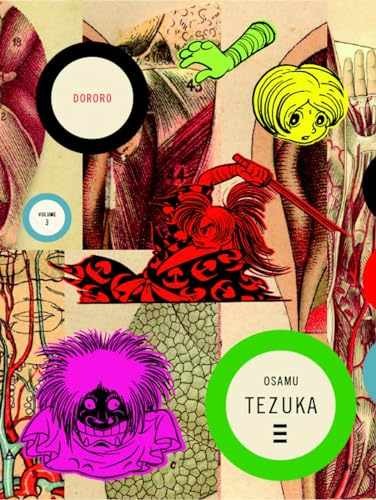

Review by Ian Keogh
While they’ve been separated on occasion, orphaned kid Dororo and Hyakkimaru a killer of demons have been travelling together from the start of the series, yet here they’re apart for extended periods. It was seen in Volume 2 that Dororo’s back features a tattooed map, explaining a supernatural resistance to bathing. It reveals the location of loot stolen and hidden by Dororo’s bandit father and to open this volume Dororo is abducted by former underlings who want that map.
As a series Dororo has been episodic, but with this final volume Osamu Tezuka ties up the few plot threads he’s used as staging points, although never in the way that’s expected. Much of the early chapters are set not so much on an island as on a rocky outcrop in the sea. A fantastic new character is introduced, and Tezuka seems very taken with Shiranui and his pet sharks. Although he’s a villain, Tezuka presents Shiranui in heroic poses and gives him solo scenes, so there’s a good likelihood he was remodelled when Tezuka began his Triton newspaper strip later in 1969.
Shiranui’s not the only artistic highlight. There are some phenomenal battle pages here, Tezuka delivering mounted armoured soldiers and never shortchanging on spectacle. There’s a scene where the focus is a wounded and dying horse, yet in a small panel Tezuka still supplies a full battle going on in the background. As ever, Dororo is drawn as a force of nature, and the assorted demons are creative inspiration, with a surly turtle a highlight.
Tezuka’s imagination shines so often in other respects, a great example being an occasion where Hyakkimaru restoring another body part stolen by a demon puts him at a disadvantage. A surprise about Dororo awaits at the end, although it’s been foreshadowed for sharper readers
As before, there’s some unpleasantness acceptable in Japanese children’s comics that wouldn’t be seen in their English language equivalents, an example being a warlord deliberately riding his horse over a pregnant woman begging for mercy. Allowing for his style of cartooning, Tezuka draws this reasonably explicitly, and few other items mean this can’t be categorised as suitable for all ages, but it’s certainly not an adventure young adult readers would consider too childish.
Used copies of all three Dororo volumes are still available, but the volume of choice is surely the entire story collected as the Dororo Omnibus Edition.