
Review by Ian Keogh
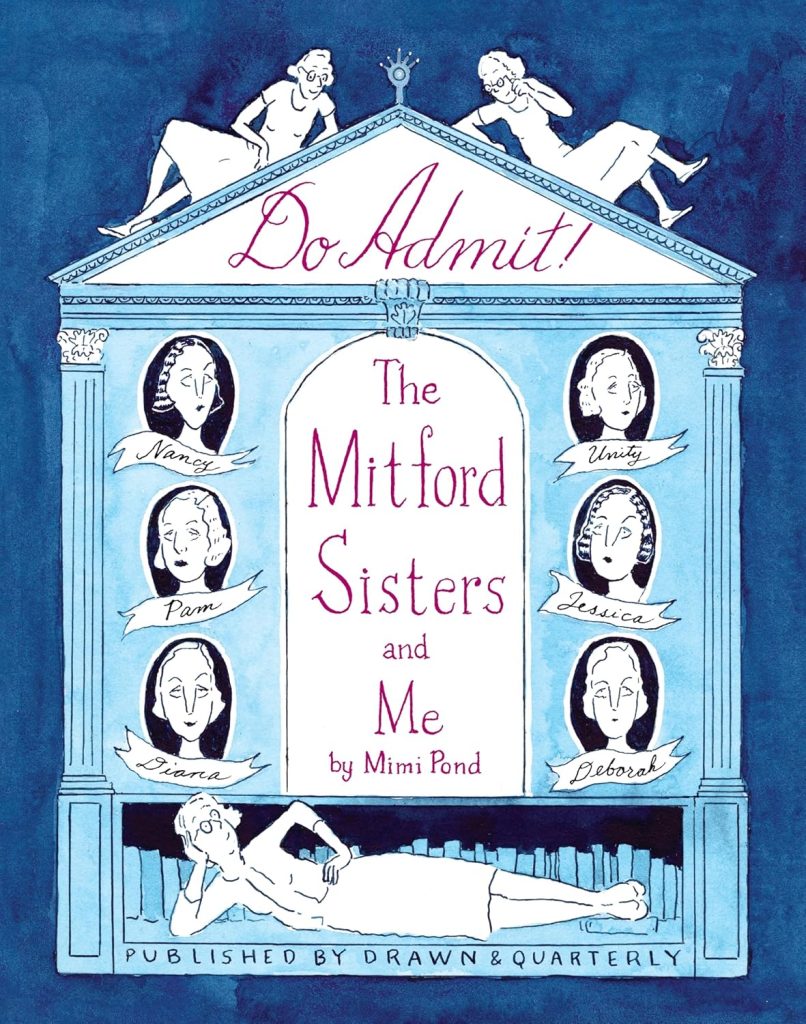
Their prime was almost a century ago in the 1930s, yet the allure of the six Mitford sisters continues to transcend time, fed by biographies, TV shows and films, the extent of which is apparent from the massive bibliography Mimi Pond lists. Born into the British upper classes, as minor nobility the Mitfords had opportunities restricted to only a small percentage of the population, yet despite their similar upbringing they grew to have conflicting careers and opinions. Almost all, though, at different points and in different countries found themselves at the crossroads of history.
Pond reflects this from the start in an exploration of times and places that she parallels with her own youth in the 1970s. She sifts through contradictory anecdotes from assorted writing, not least from the sisters themselves, each later with points to prove, to create a cohesive picture of why the Mitfords fascinate her. As a Californian child in the 1960s they represented a glamour and a history her hometown lacked, yet as an adult she takes an attitude as sardonic as theirs to what becomes a comprehensive, yet dazzlingly original biography. She gets under the skin of the British class system admirably well, detailing hypocrisy and entitlement based on trivia, and feeds in historical events, many of which are likely to be unknown to readers outside the UK, always with compact explanations.
Stylised art in black, white and Prussian blue is initially in traditional comics form, but imaginative decorative flourishes intrude, such as the factory conveyor belt line representing the graduates of British finishing schools. The illustrative instinct gradually takes over, with Pond prioritising iconography, visual allegory and metaphor, some pages resembling nothing as much as lurid 1950s film posters or book cover illustrations. Likenesses are simple and impressionistic, yet serve well as Pond takes the Mitfords through the 20th century, with the greater time spent from the 1930s to the 1960s. The default typeface is a form of handwriting, and illustrative writing features frequently to dramatic effect, also giving an endearingly handmade look.
A surprising aspect of Do Admit! is that despite the historical glamour of her subjects, Pond’s own interludes are equally compelling, if sporadic and from midway only manifesting as a brief cameo toward the end. An assessment of The Prime of Miss Jean Brodie (movie version) and the associated future of a school bully resonate.
Pond follows the pattern of most biographers by confining her account to the four most interesting of the sisters, with Deborah only ascending in the 1960s. Yet if avoiding descriptions of Pam’s farming life provides space for a parade of eccentric associates, lovers and friends, it’s a merited trade-off. The sisters are shown to have complicated relationships and weren’t shy of pointing fingers, with Nancy as a novelist having the most prominent venue, yet from what Pond reproduces, snobbery is rife in most. In later life self-mytholgising and point scoring is shown as almost industrial in scale, and Pond reveals the consistency of personal convictions, even if flying in the face of societal norms.
Some interludes veer off-topic, such as a diversion into John F. Kennedy’s death, but Pond brings out how four Mitfords were historically relevant in different decades, while Nancy’s writing career and succession of poor romantic choices acts a consistent narrative glue. Imaginative illustration combined with informed individual assessment makes Do Admit! immensely readable and it transmits as Pond greatly enjoying herself.