
Review by Frank Plowright
Linnet Ridgway is a wealthy socialite who’s just married Simon Doyle, not so long previously the boyfriend of her now former best friend Jacqueline de Bellefort. It was Jacqueline who introduced Simon and Linnet, and now displays her resentment by following them around the world. The latest piece of stalking is on a Nile cruise also being enjoyed by renowned Belgian detective Hercule Poirot, and Linnet approaches him for help in dissuading Jacqueline. When Poirot points out to Jacqueline she’s only prolonging her own agony she reveals she has a gun.
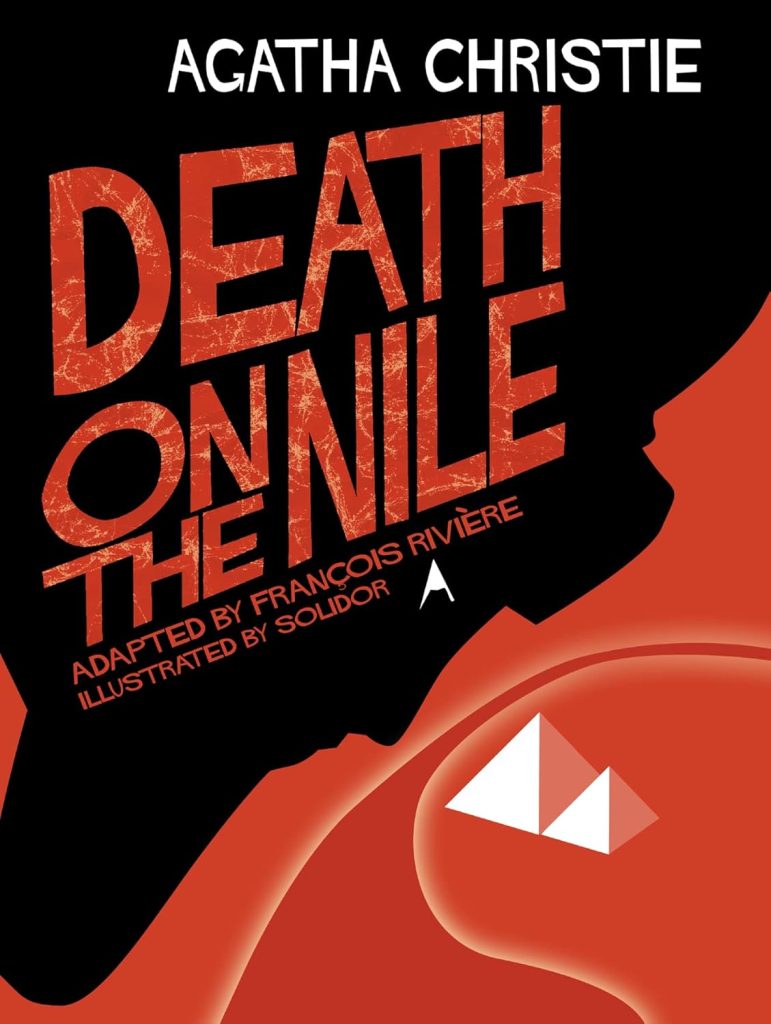
When Agatha Christie published Death on the Nile in 1937 Poirot was already an established favourite character with the reading public, and the setting for his latest murder mystery was deliberately exotic. Few of Christie’s readers could afford their own Nile cruise. Christie described exotica like Karnak and the Abu Simbel temple, but here artist Solidor (Jean François Miniac) brings those locations to life in his precise clear line style. He’d already had experience with decadence and Christie by adapting Murder on the Orient Express, and once you become used to his stylised people, the effort put into the illustrations is obvious. The one great artistic flaw is the colouring, now looking messy, clumsy and dated.
Even allowing for the adage of a picture representing a thousand words, Francois Rivière has his work cut out condensing the 250 or so pages of the original novel into 44 pages of comics. This does necessitate some contraction, but Rivière is very adept. Those who know the original story will realise what’s missing, but readers encountering it for the first time in this edition will be greeted with a densely packed, yet very readable mystery.
That follows Christie’s intention. The scene is set with one failed murder attempt before a successful one shortly afterwards, along with a robbery. The finger of suspicion point towards obvious suspects, yet have they been framed? In order to preserve the essence of the plot in 44 pages Rivière has to dispense with some characters altogether, so separating the eccentric innocent from the guilty isn’t quite the task it was in the novel. It will nevertheless be a smart reader who figures everything out before Poirot gathers everyone to begin his disclosures five pages before the end. Even then Christie has a final surprise in store.
Numerous film and TV dramatisations speak to Death on the Nile remaining one of Christie’s most enduring mysteries, and Rivière and Solidor’s transformation of it retains the essence in a new form.