Review by Frank Plowright
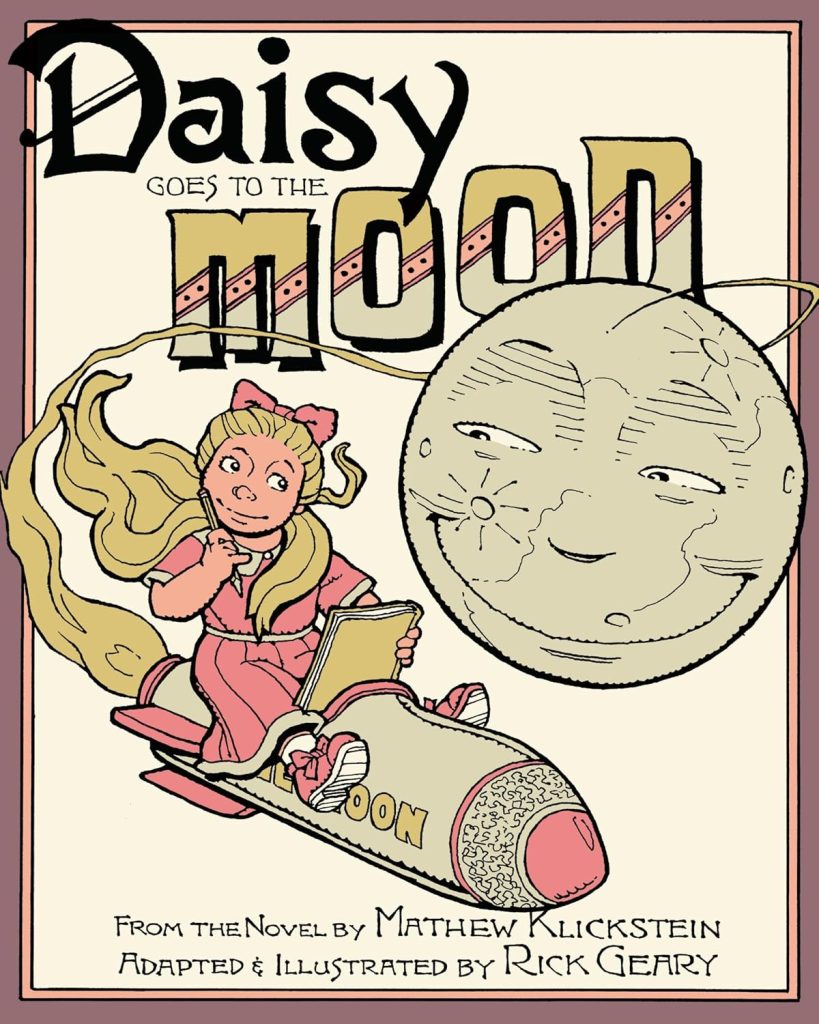
The stories Daisy Ashford wrote as a child in the 1880s and 1890s saw publication as curiosities after World War I, keeping her eccentric spelling intact and briefly making her a literary celebrity. Among those inspired by her was eventual screenwriter Mathew Klickstein who published a whimsical children’s story Daisy Goes to the Moon, adapted here with the collaboration of Rick Geary.
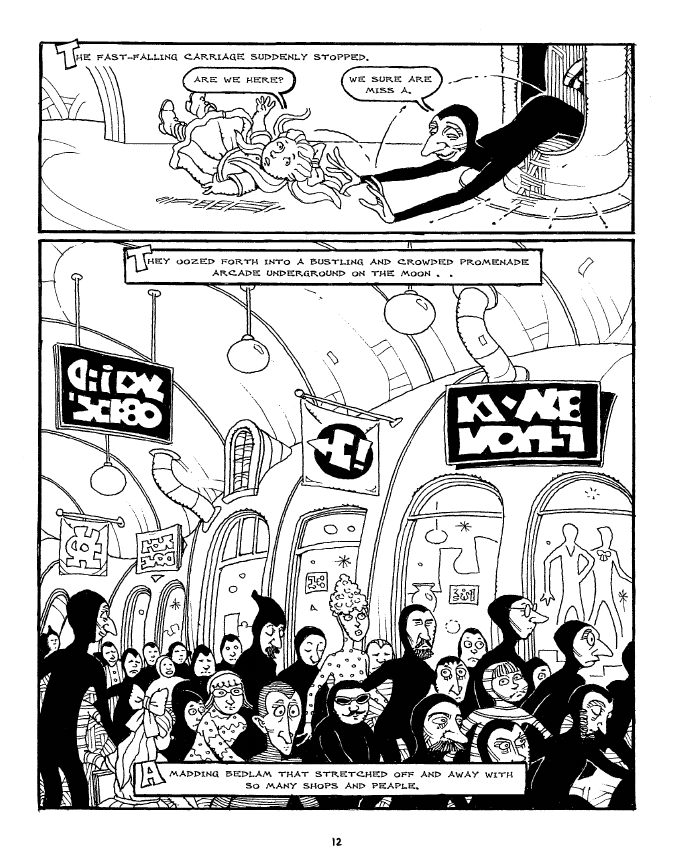
As the young Daisy Ashford sits in her garden one day writing a story, she’s surprised to see a spacecraft land and accepts an invitation to be taken to the Moon by Mr. Z. What seems from Earth to be a barren unpopulated rock actually hosts a thriving society beneath the surface. Daisy sometimes portrayed as petulant and selfish is unexpected, but consistent with a young child’s behaviour, and for the most part she’s incredibly accepting of strangeness, also a characteristic of children.
Klickstein imitates Ashford’s writing style as she details her experiences on the moon, complete with wrongly spelled words, and achieves the discursive childlike frame of mind that can switch from one subject to another without greatly caring about logic. The result is imaginative, but wearing as Klickstein switches from one subject to the next. We meet a man from the future with a television set, hear Daisy’s bedtime story and see her abducted by another alien.
The bulk of Rick Geary’s graphic novels are precise investigations of murders, but his earliest work celebrated the surreal and absurd, so the appeal of Klickstein’s story is obvious. He draws it with the same sincerity characterising his other work, as if it’s a documentary recording of events, and page after page looks delightful.
Unfortunately, though, while a clever pastiche, Klickstein’s story runs out of steam well before we reach the point where a different extrapolation of events is introduced, as written by Daisy’s sister. Daisy Goes to the Moon could also be considered an extended drug-fuelled hallucination. Klickstein’s recollection of the writing is of planning, with the second half being completed as a single caffeine-injected seven hour rush in a coffee shop. Perhaps sampling in small doses is the way forward.


