Review by Graham Johnstone
Gary Panter straddles the worlds of fine art, design and comics. Longtime publisher (of his comics), Fantagraphics, claim any new Panter publication is an event. Given that a six decade career has produced about as many books of comics, that’s a fair claim, justifying their oversized prestige editions, including 2021’s Crashpad.
Panter was initially inspired by Los Angeles’ ‘punk’ music scene. However, Crashpad takes inspiration from Hippie counter-culture, specifically the teenage Panter’s 1968 visit to a head shop, and exposure there to psychedelic art.
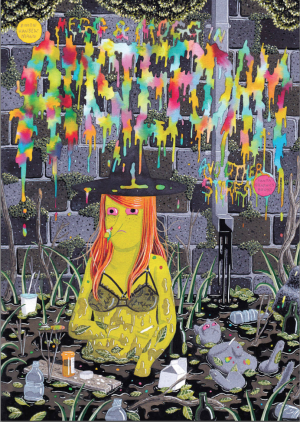
Crashpad is a love-letter to underground comix, and a septegenarian artist’s hymn to his youth. After some suitably psychedelic endpapers, Panter drops us straight into ‘Batlatis’ – the title evoking mythic lost utopia Atlantis, and ‘batty’ punk irreverence. This section (pictured, left) is a meditation on matters psychedelic, in the literal sense of “attempting to depict the inner world”. Non sequitur images depict tripping hippies, fairy tale figures, gurus, ‘funny’ (and not so funny) animals, and alchemical entities, all in imagined realms of mushrooms, mandalas, and Paisley pattern. Homages to underground comix styles and imagery, bolster this multi-dimensional depiction of psychedelia. Panter’s art installation mentioned in the publishers’ blurb, may be the source of this section.
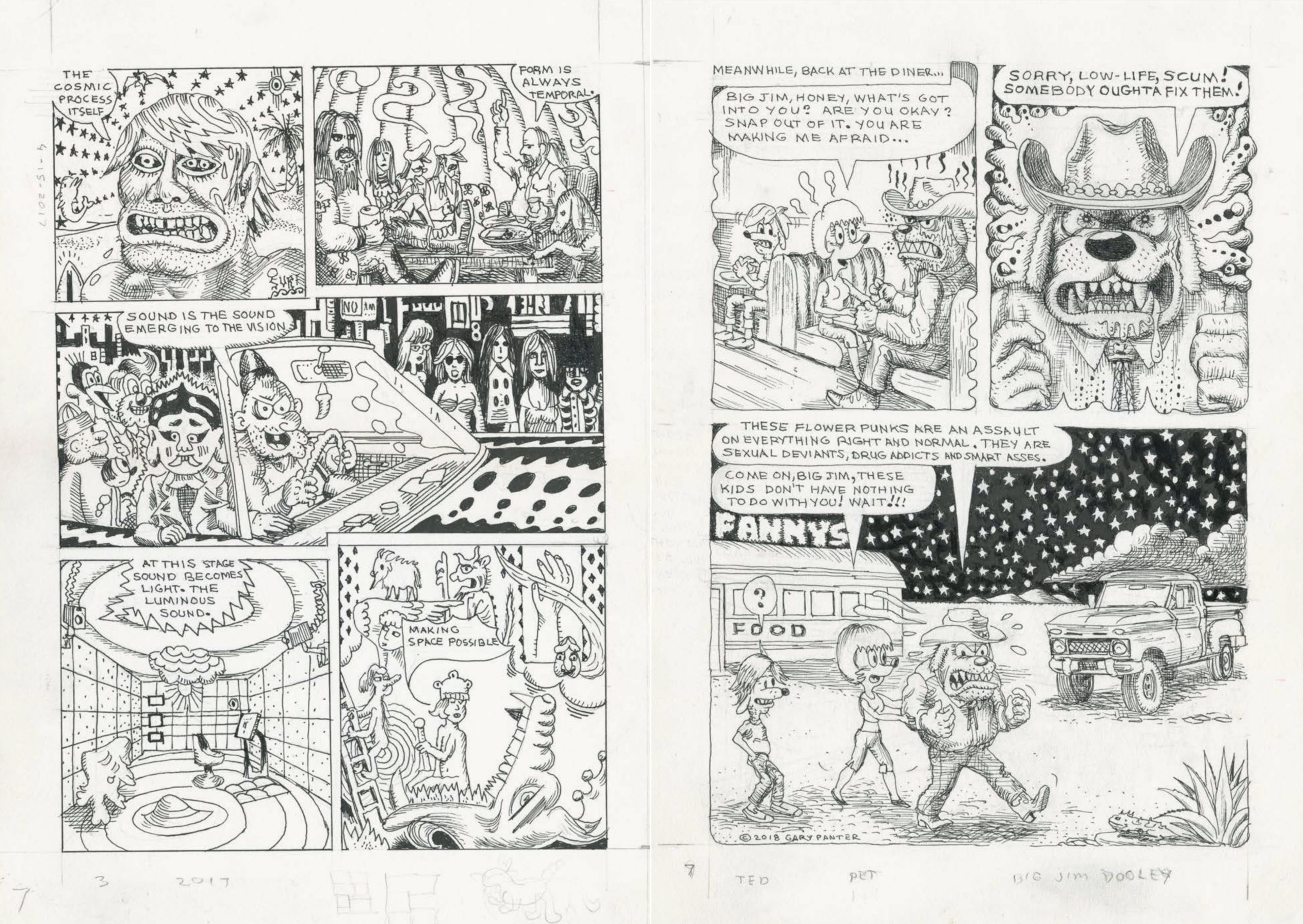
Three ‘Crashpad’ chapters develop the themes into more a linear comics narrative. Cartoon animal hippies (in a symbol-bedecked camper van), ponder their recent fix, and likelihood of their next one. That’s a minimal plot for the remaining 24 pages. However, it captures so much of the era as seen in its comix: itinerant living, a crashpad, people power, opportunists, the environment, bad vibes from ‘ticked off’ squares, trips and transcendence, possible alien abduction, and crucially, wondering what was real and what was the drugs. Panter’s striking art may overshadow his writing, but his balance of philosophical narration, and streetwise vernacular, vividly evokes the ‘scene’. There’s deep empathy here, even for the squares (pictured, right), resulting in an ending that’s positive without feeling phoney, while hilarious, humane, and wholly hippy.
Panter is a cartoon Picasso, a punk Jack Kirby. Look beyond the cultivated roughness and you’ll see distinctive, expressive characters, vivid imagery, striking compositions, and sheer love of putting pen to paper. Compared to his earlier lush brush-work, there are perhaps too many inexpressive pen lines. On previous book, Songy in Paradise that evoked period engravings, and here, perhaps, the obsessive rendering of comix-king Robert Crumb. Panter captures the transcendent imagery of his Dante adaptations, but without the forbidding textual density, making Crashpad a welcoming place to land.
True to its inspirations, Crashpad was published as a cheap pamphlet comic on newsprint. The oversized hardback edition includes the newsprint edition inserted into a sleeve within the hardcover “so that it can be removed and enjoyed on its own”. It’s a nice touch that also offers the art in contrasting forms. The newsprint version necessitates traditional ‘line art’, while the art paper of the hardback allows high resolution colour photographs of the black and white originals. Such ‘Artist Editions‘ are designed to reveal the artist’s hand at work, here complete with pencil guidelines, half-erased workings, imperfect ink-fills, and scrawled page numbers. This approach added little to, say, Jim Steranko’s pristine pages, but Panter’s work is a kind of meta illustration, a balancing act between representation and pure abstraction – his workings, well displayed here, are all part of the experience.
As a manifestation of psychedelia, Crashpad might be as good as anything else rolled into oversized papers…