
Review by Ian Keogh
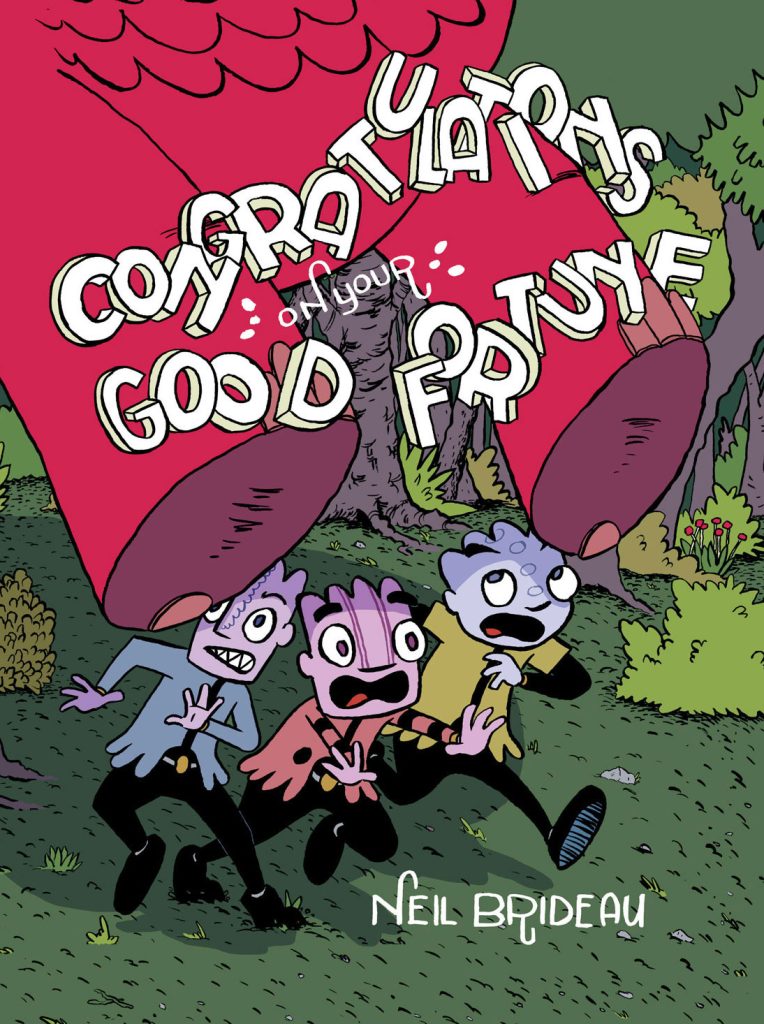
A small hidden kingdom flourishes in self-contained isolation. Legend has it that visiting aliens transformed the people 25 generations previously, responsible for bestowing a form of mental powers that manifest when children become adults. This occurs via the ascension ceremony where bonding occurs with a spirit, at which point their differently formed noses darken. Along with the rest of their class, three close friends Atchi, Eena and Fib are on the verge of ascension as Congratulations on Your Good Fortune begins. The title is a form of greeting used by the villagers.
There’s no discounting Neil Brideau’s ambition as Congratulations on Your Good Fortune is introduced as the first of a trilogy. Much background information is passed on before the story really begins, and while the three lead characters have personality as they learn, it might have been better to find a more compact way of supplying the necessary world building. Just at the point it seems the story’s about to spring into life after 110 pages, Brideau cuts to another history lesson differently presented, but repeating a fair amount of what’s been supplied already. There’s a slight alteration, but did we need both versions? Atchi could have just commented on the differences.
Brideau’s art is simple and functional rather than decorative. It supplies personality, but distinguishing features other than individual noses occur only very occasionally and there’s not enough variation of viewpoints for a plot very dependent on conversation and explanation. Different styles are used for an alternative presentation of village history, but only for a couple of pages at a time drawn by Kenan Rubenstein.
The society is one of rules to be obeyed with no explanation to youngsters, so Atchi becomes the key character, driven by a curiosity to test for himself in preference to believing everything he’s told. It leads to danger for the village, with Atchi copping the blame, but also opens a wider discussion about the society presented as surviving by everyone buying into the same faith in their administrators. A key discussion between Atchi and his father transmits well, the opposing views of both understood.
Readers might suspect that despite the detail, not everything is being revealed, and when toward the end we witness a meeting of the village council that suspicion is proved. Plenty of villagers are in on the deception, proving Atchi’s inclination not to take everything as told is correct. It’s the closing chapter ‘Defending Our Ascendancy’ that’s by far the strongest. Assorted themes previously introduced come together satisfyingly, and reinforce the idea that a society seemingly sustained by some considerable falsehoods is on the verge of falling apart. Confirmation will have to wait until the continuation in How We Are Who We Have Become.
That the strongest material ends Congratulations on Your Good Fortune is encouraging, but too much beforehand could have been contracted. This isn’t available via major online booksellers, but pick up a copy directly from the publisher here.