Review by Frank Plowright
Conan the Barbarian is by far the best known of Robert E. Howard’s creations, but writing for the pulp magazines of the 1930s he actually conceived many other characters. Jim Zub’s idea of uniting them came to fruition in subsequent work for Titan’s Conan publications, but The Serpent War is his conceptual starting point.
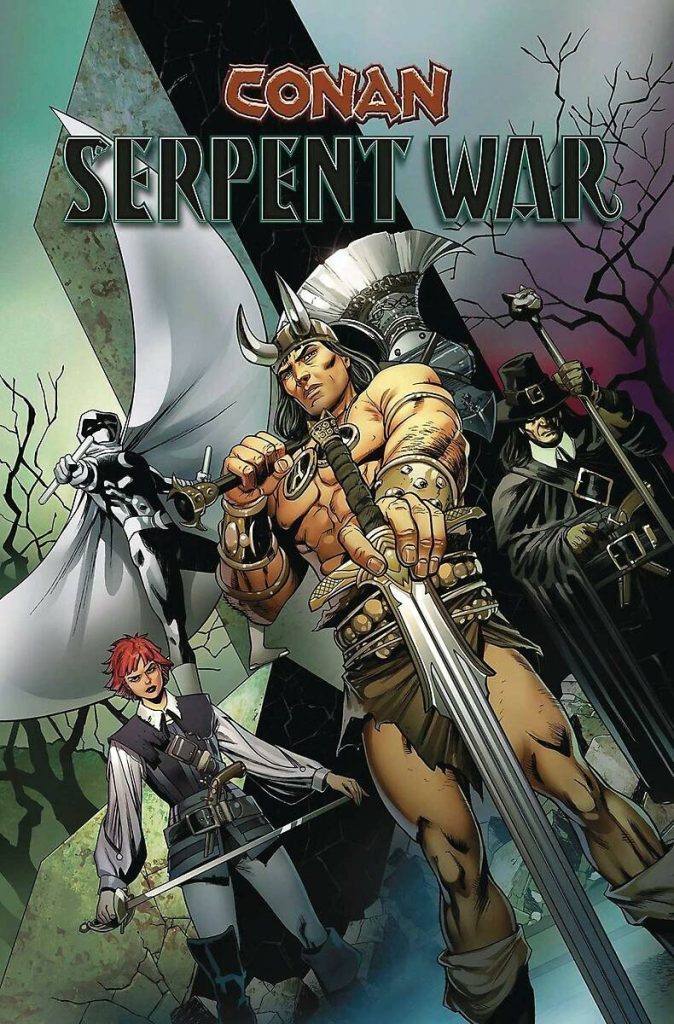
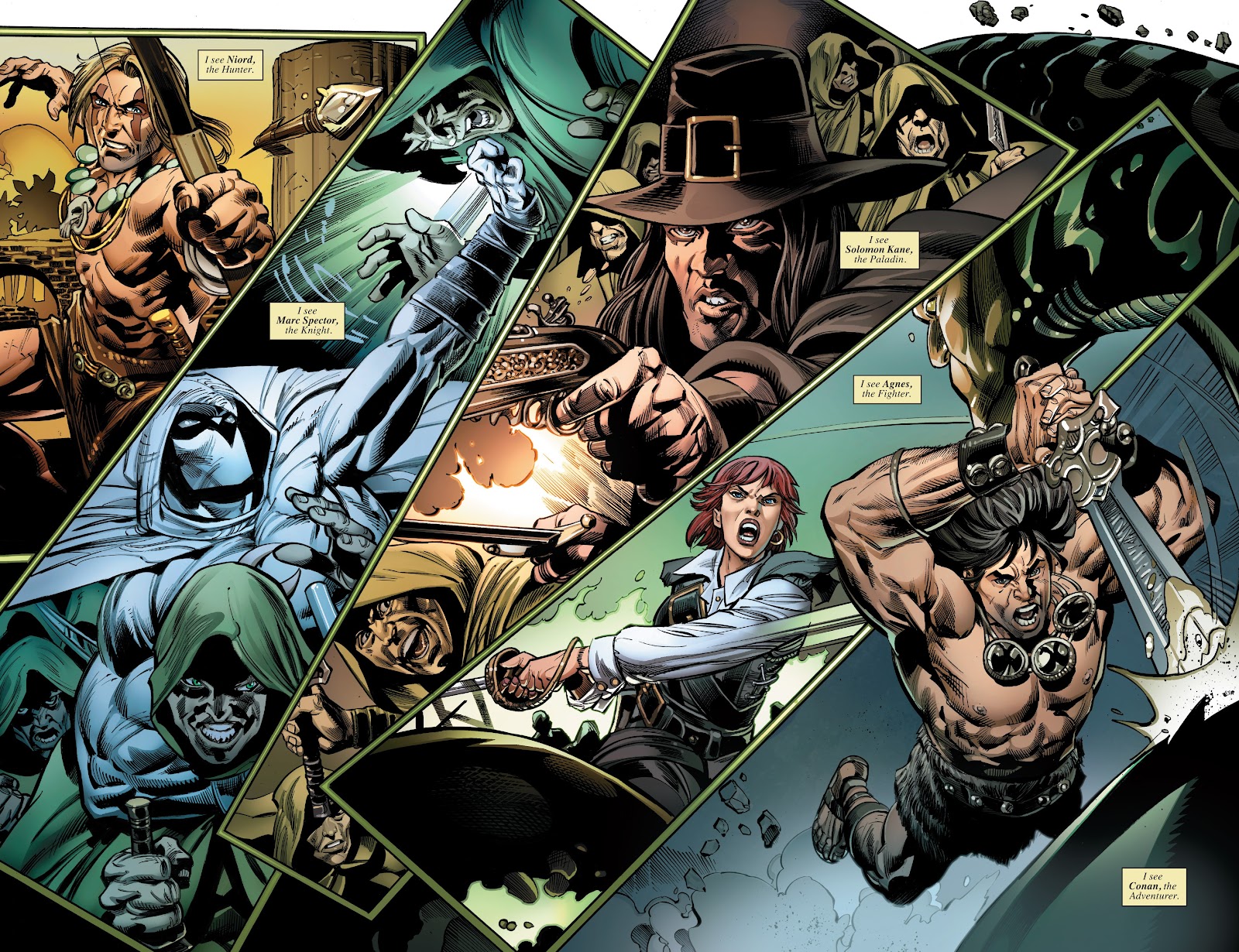
The story’s starting point is James Allison in Texas in 1936. He’s lived many lives over centuries by possessing the minds of warriors, and on his death bed he becomes aware of a threat requiring battlers across time. Where working for Marvel’s version of Conan might trump working elsewhere is access to the wider Marvel universe, so supernatural superhero Moon Knight becomes involved alongside Howard’s characters Solomon Kane, Dark Agnes and Conan. They’re a widely disparate bunch in attitude and motivation, and introducing them all makes the first chapter heavy going at times.
Snake god Set is seemingly the threat uniting our heroes, who’re paired in different eras, Kane with Moon Knight and Agnes with Conan and once past the awkward first chapter it all rushes along well enough, but never quite thrillingly, notwithstanding the artist changing with every new chapter. The sample spread is Scot Eaton’s work, but in order thereafter Stephen Segovia, Luca Pizzari and Ig Guara all produce distinguished action, with Vanesa R. Del Ray’s deliberately slightly blurred art common to each chapter for a few pages about Allison.
It’s clear to readers relatively soon that our heroes are being manipulated, but it takes the heroes themselves a while to cotton on. However, once they do it expands the plot to enable a scene of the Moon god Khonshu facing off against Set, adding weight to Moon Knight’s presence. Up until then it might as well have been Captain America accompanying Solomon Kane.
Because Zub has since united Howard’s characters more efficiently on other projects, The Serpent War very much reads as a dry run, and he’s smoother on Battle for the Black Stone.
The collection ends with a 1973 adaptation of Howard’s ‘The Valley of the Worm’, showing Allison in better health dreaming of the time he was Niord the Hunter. Scripters Gerry Conway and Roy Thomas pack the pages with Howard’s original text, rather than letting impressive artist Gil Kane tell the story. Whether or not originally intended by Howard, these days his story would be seen as promoting unpalatable colonial attitudes, and that weighs against the well considered action.