
Review by Lewis Savarese
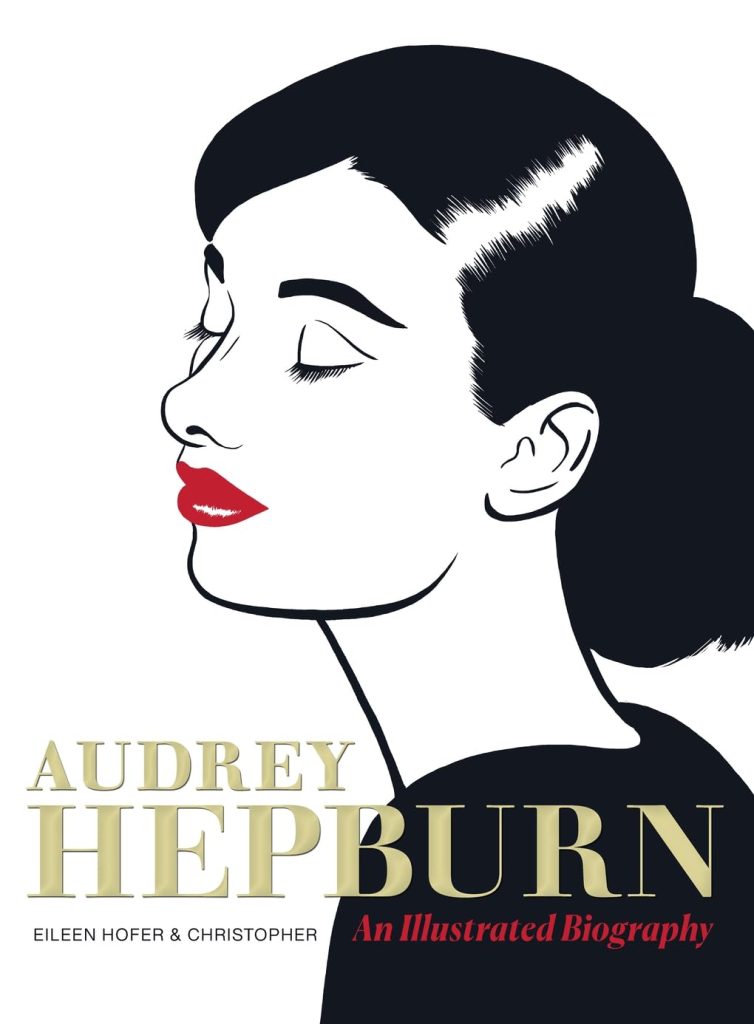
What can we glean from a graphic biography of Audrey Hepburn that we cannot from a prose one? Regarding Audrey Hepburn: An Illustrated Biography, the inverse of this question might elicit a more substantial response. Writer Eileen Hofer and the mononymous artist Christopher’s sluggish, chronological account of Hepburn’s life fails to capture the spirit and charm that endeared her to millions the world over.
Our introduction to Hepburn is simple, yet enigmatic: a splash page of Hepburn in her twilight years, elegantly dressed in black, seated on an antique chair, positioned against a stark white background. Addressing the reader, she says, “If I were to write a book about my life, it would start like this: I was born on May 4th, 1929, and I died three weeks later.” This ostensible fourth wall break is never repeated, nor do we see an aged Hepburn in this setting again. Worse, the answer to the riddle of her mortality (she came down with a case of whooping cough that stopped her from breathing) is casually dropped into a conversation at a picnic, some twenty pages later. This is indicative of Hofer’s struggle to weave Hepburn’s remarkable life into a cohesive narrative. Perhaps a consequence of choosing an exhaustive over a selective approach.
The book is divided into four chapters: “Winter” details Hepburn’s childhood including her life during the Nazi occupation of the Netherlands; “Spring” follows her early stage and screen career in post-war Europe; “Summer” chronicles Hepburn’s career as an actress on Broadway and Hollywood’s silver screen; “Fall” covers her retirement from acting and her humanitarian work with UNICEF until her death. “Winter” and “Summer” make up the bulk of the book with “Summer” being the lengthier section. Hepburn’s presence is not felt for much of “Winter,” instead her mother Baroness Ella van Heemstra and various family members are the focus. Hofer does not shy away from discussing van Heemstra’s early support for Adolf Hitler, but never shows Audrey reckoning with her mother’s fascist sympathies (something she purportedly did for the rest of her life). We do see Hepburn experience the horrors of Nazi occupation which leads her to aid the Dutch Resistance as a courier; formative moments in her life that influenced her work with UNICEF.
Hofer and Christopher know that Hepburn’s Hollywood career, which spanned 36 years from 1953’s Roman Holiday to 1989’s Always, is why most people will pick up this book. They also understand that depicting Hepburn in her many iconic costumes is another selling point. Throughout the book, Christopher incorporated splashes in which he draws an exquisitely dressed Hepburn the full height of a page, surrounded by a collage of images from a corresponding play or film. As appropriate as this quasi-lookbook visual motif is for a graphic biography of Audrey Hepburn, it is awkwardly deployed three times during the World War II portion, framing Hepburn amid Nazis, crying family members, and allied soldiers, respectively. Overall, Christopher’s art feels hampered by his tendency to reproduce movies stills and photographs. A panel duplicating a photo of Hepburn meeting President Ronald Reagan, with the exact same composition and framing, is a prime example.
The remaining content of the book explores her on and off set relationships with everyone from Humphrey Bogart to her husbands Mel Ferrer and Andrea Dotti. Many insights about set or family dynamics are revealed via clunky dialogue or sporadic text blocks. In the appendix, Hofer thanks Hepburn’s son Luca Dotti for his assistance including full access to the family archive. We can only wonder if this book might have been different without his “assistance.”