Review by Frank Plowright
It’s already long been proved that Hajime Isayama plots a creative story, so while Attack on Titan 20 appeared to have presented a decisive ending in favour of the Survey Corps, is it actually the case?
Yes, is the short answer, although a decisive ending doesn’t equate to a decisive win. Retreats mean key Titans remain a threat, yet an early flashback reveals something we hadn’t been told before the Survey Corps set out, which is now crucial and leads to a contested decision. It’s a clever injection of extra tension when the main threat has been removed, cutting to the heart of the question of whether luck in battle is more important than experience.
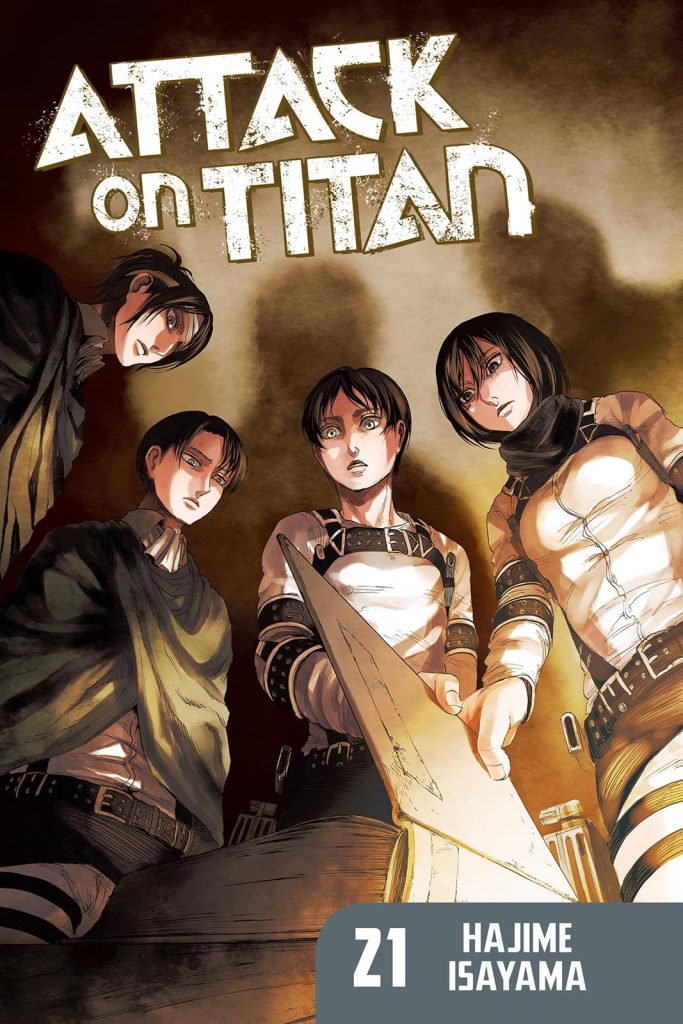
Eren Yeager’s transformations have been important throughout, but hanging over the entire series despite being rarely seen is his father Grisha. Right from the very beginning it’s been assumed that the basement of the Yeager home holds existential secrets, but until now it’s been in extremely dangerous occupied territory. Among other matters, Attack on Titan 21 reveals what’s in the basement, although not before Isayama’s played one final small joke.
The revelation is simple, but stunning, and redefines the entire background to Attack on Titan, opening a whole new set of possibilities. We again see Grisha confined to flashback, and learn of his youth and the society he grew up in. It doesn’t offer any great relief to the sense of repression, but the allegory is difficult to mistake, and supplementary information about the society’s rulers can be presumed. It’s a lot to take in, but brilliantly conceived in reshaping motivations and establishing a new threat. Where the series goes from here is anyone’s guess, but Grisha’s past continues into Attack on Titan 22.
This and the previous two volumes are combined in a larger format as Attack on Titan Omnibus 7.