Review by Frank Plowright
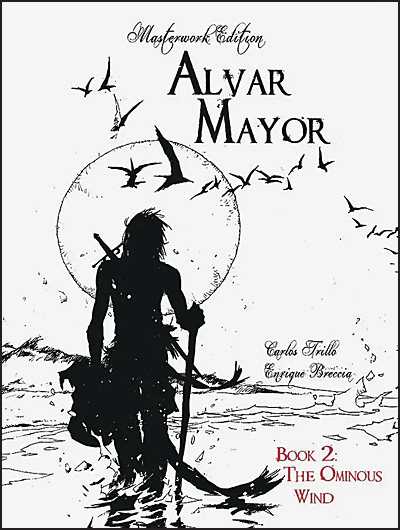
By this material Carlos Trillo and Enrique Breccia had been working on short stories starring 17th Century Adventurer Alvar Mayor for over a year, and were really hitting form. What began as historical adventure featuring a leading character with a conscience and no love for the greed of his fellow Spanish in South America gradually developed into something offering spiritual and supernatural experiences. Not that Mayor’s above searching for gold himself, just averse to slaughtering all-comers to obtain it.
As The Ominous Wind opens he’s accompanied on a treasure quest by the alluring Lucia and fellow adventurer Raven, their ship following directions to an alleged city of gold. That remains the thin thread tying together the stories until the title chapter is reached two-thirds of the way though. By then Mayor’s met pirates, a philosopher who’s walked the Earth for centuries, travelled to a city of dwarves, been given possible glimpses of his future, dealt with Lucia’s kidnappers and freed a pair of lovers trapped in unusual forms. A definite decision has been taken to deal with myths and fables alongside period adventure, and some of the results are startling.
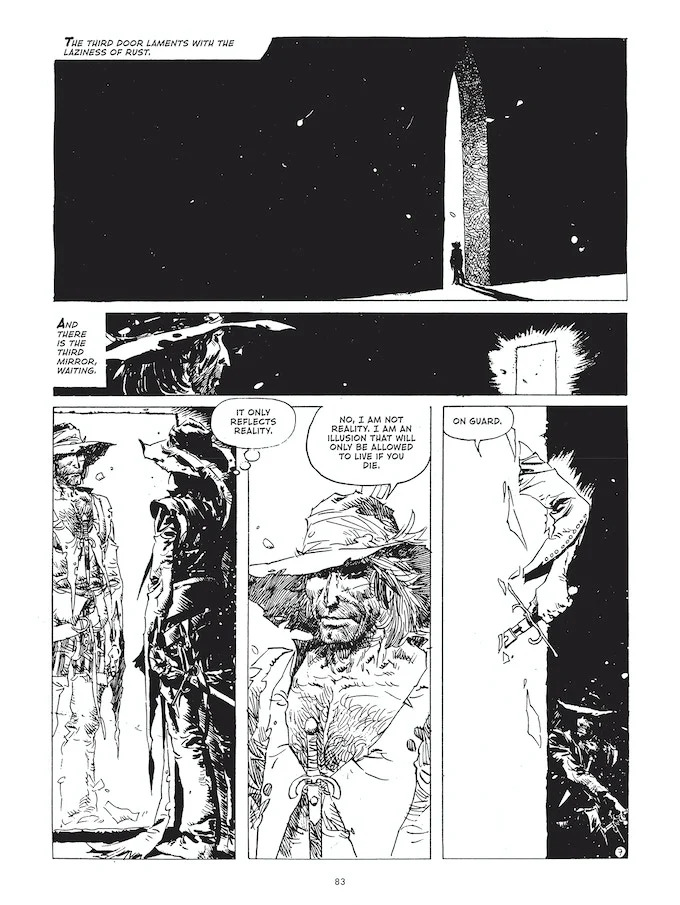
Trillo has opened his mind to the story possibilities, and Brecchia is becoming more attuned to what can be done visually. He’s increased the contrast between light and shade, draws flashbacks and visions with barely any shadow, and his ability to design distinctive characters astounds. Most of the men who feature are rogues and created accordingly, and while not all women have Mayor’s best interests at heart, every single one of them is a beauty. Mayor himself is a largely glowering presence, and can be drawn relatively simply or as incredibly fiddly adorned with clothing, sword and other accessories.
Book One: The Legend of El Dorado was severely hampered by poor translation. This is again the work of Vladimir Jovanovic, but there’s considerable improvement. It’s now only occasionally that attention is drawn to the translation via poor phrasing, and for the most part the stories now hold the awe and wonder intended.
The title chapter is a clearing of the decks and a re-setting of the feature. Although Lucia was influential toward the end of the first volume, until ‘The Ominous Wind’ her only significant purpose here is to be kidnapped, although in absentia she acts as a conscience for Mayor. Trillo takes the opportunity to refresh the series, but avoids predictability in doing so as both Lucia and Raven depart. Because they’ve been barely used in these stories their departure in practice makes little difference other than a statement on Trillo’s part that Mayor works best as a loner encountering new people every episode. That’s how he continues in The Three Deaths of Alvar Mayor.
The Ominious Wind features some magnificently imaginative stories, many with a supernatural tinge, and the quality rises further in future volumes. As this edition is already quite rare, it’s possibly best found as part of Alvar Mayor: The Complete Collection, a box set only available through publisher Epicenter Comics.