Review by Win Wiacek
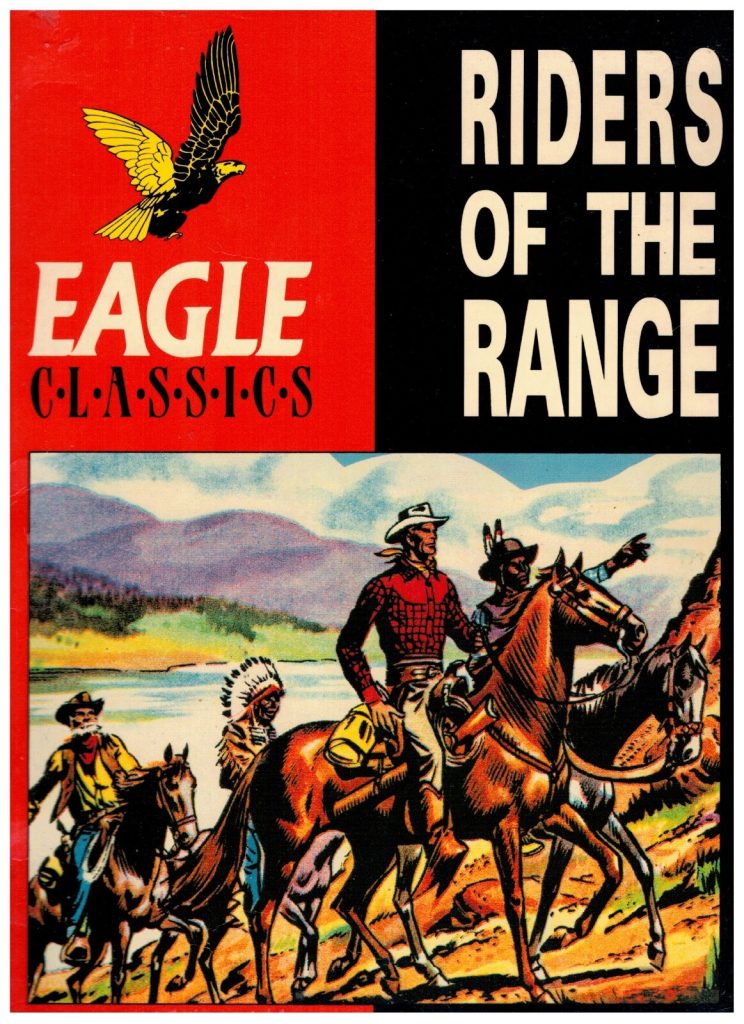
In the 1950s “Cowboys & Indians” ruled the hearts and minds of the public. We all underestimate radio today as the dominant entertainment medium ideal for creating spectacular scenarios and dreamscapes on a low budget, and the staid BBC managed a halfway decent western/music show. Written by producer/director Charles Chilton, Riders of the Range ran for six series between 1949 and 1953, and at the height of its popularity the serial show was adapted as a comic strip in Eagle.
Riders of the Range began as a full colour page in 1950 and ran until 1962, outlasting the radio show by almost a decade and becoming the longest running Western strip in British comics history. It only ever had three artists. The first was Jack Daniel, an almost abstract stylist who worked in bold, almost primitive lines, but whose colour palette was years ahead of his time. Crude and scratchy-seeming, his scenarios were subversive and subliminal in impact and made spectacular use of Hulton’s now-legendary photo-gravure print process, which modern repro techniques and digital systems still can’t come even close to recapturing.
Chilton had a deep and abiding fascination with the West and often wrote adventures interwoven with actual historical events, such as ‘The Cochise Affair’ reprinted here. This was the second adventure and had heroic Jeff Arnold and sidekick Luke branding cattle for their “6T6” ranch near the Arizona border when they stumble across a raided homestead. A distraught, wounded mother begs for help and reveals that “Indians” have stolen her little boy. Despite the terminology this hugely enjoyable lost gem is remarkably short on the kind of stuff that makes many Westerns of this era so unpalatable to modern readers.
Angus Scott took over from Daniel with ‘Border Bandits’, but was not a popular or comfortable fit. He departed after less than a year. With only a single page of his art included here, it’s perhaps fairest to move on to the artist most closely associated with the feature.
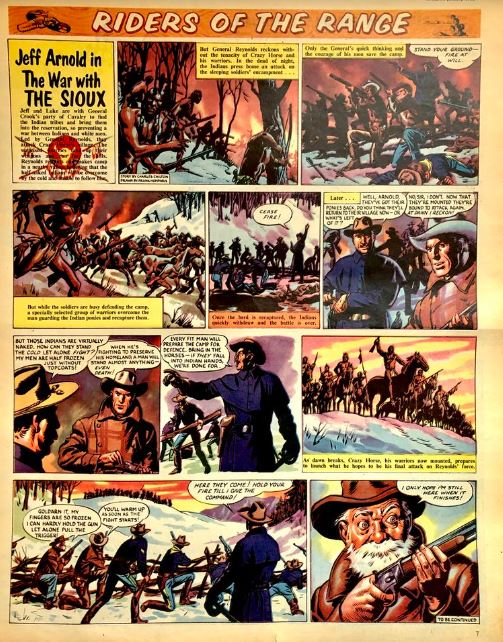
Frank Humphris was a godsend. His artwork was lush, vibrant and full-bodied. He was also as fascinated with the West as Chilton himself, bringing every inch of that passion to the tales. From July 1952 and for the next decade, Chilton and Humphris crafted a thrilling and even educational sagebrush saga fondly remembered to this day even if only by those of us somehow still breathing! His tenure is represented here by ‘The War with the Sioux’.
In 1875, gold was discovered in the Black Hills of Dakota and a resultant rush of prospectors resulted in the US Cavalry being dispatched to protect them from the incensed Native Americans again pushed out of their homelands. Jeff and Luke are hired as intermediaries and scouts, but are helpless as the situation worsens, and weekly-delivered events and incidents inevitably lead to the massacre at the Little Big Horn. There have been many tales woven into this epochal historical tragedy, but the patriotically-neutral, dispassionate creativity of two Brits united here to craft one of the most beautiful and memorable.
The day of the cowboys’ dominance has faded, but the power of great stories well told has not. This is a series and a book worthy of a more extensive revival – and fortunately still readily available in collector retail emporia in the real world and digital places. Let’s hope one day someone with the power to do something about it agrees. We’d all be winners then.