Review by Win Wiacek
The entire genre of “Jungle Girls” is one fraught with perils for modern readers. Barely clad, unattainable, (generally) white paragons of feminine pulchritude lording it over superstitious primitives is a trope now pretty hard to digest.
However, ways can be found to accommodate such crystallised or outdated attitudes, especially when reading from a suitably detached historical perspective and even more so when the art is crafted by a master storyteller like Bob Powell. After all, it’s not that big a jump from fictionalised 1950s forests to today’s filmic metropolises where leather armoured (generally white) Adonises with godlike power paternalistically watch over us, telling us lumpy, dumpy, ethnically mixed losers how to live and be happy.
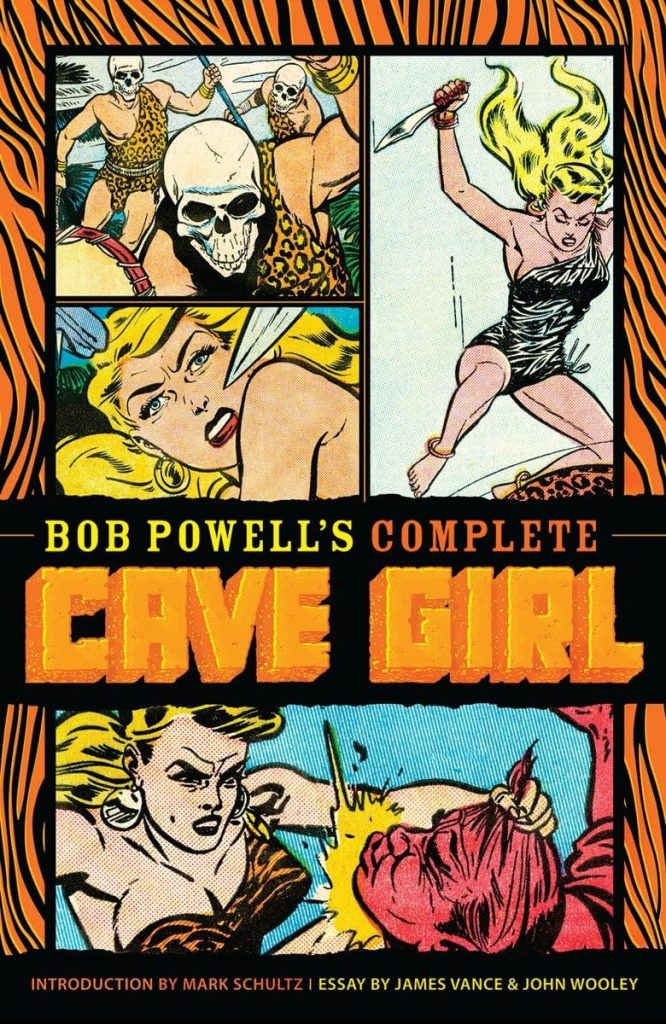
Cave Girl was one of the last entries of the surprisingly long-lived Jungle Queen genre and consequently looks relatively mild in comparison to other titles as regards suggestive or prurient titillation. Here the action-adventure side of the equation was always most heavily stressed, and readers of the time could see far more salacious material at every movie house if they needed to. And the pages were so damn well drawn…
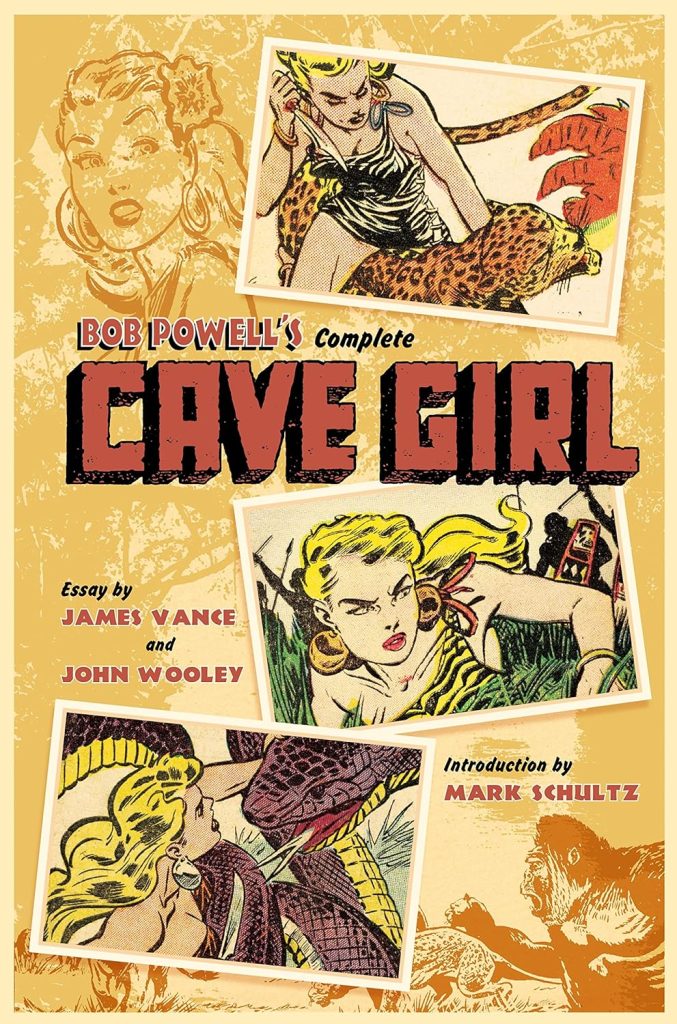
This captivating compilation gathers all Cave Girl’s appearances from assorted anthologies starting in 1953 and written by ubiquitous jobbing scripter Gardner F. Fox. He sets the stories in an Africa that never existed for action and adventure beyond compare with Cave Girl introduced in ‘Thun’da’, a primeval barbarian saga set in an antediluvian region of the Dark Continent where dinosaurs still live. In ‘The Ape God of Kor’ the mighty primitive encounters a blonde stranger who can speak to birds and beasts, and helps her escape the unwanted attentions of a bestial tyrant.
Early stories have the wild woman showing a maternalistic care for all creatures, protecting them from a greedy hunter, a debauched queen and a trio of sadistic killers from the civilised world. In ‘Death Comes Three Ways!’ we reach the troublesome introduction of demeaning comedy sidekick as pompous “pigmy” bumbler Bobo attaches himself to Cave Girl as her protector. Thankfully, his further appearances are few.
When the forest monarch sprang into her own title, Fox and Powell supplied an origin, showing a scientific expedition was wiped out, leaving little blonde toddler Carol Mantomer to fend for herself. Happily, the child was adopted by Kattu the wolf and grew tall and strong and mighty. Time honoured tables are turned when explorer Luke Hardin deduces Cave Girl’s true identity and convinces the wild child to come with him to Nairobi and claim her inheritance. Already appalled by the gadgets and morass of humanity, Carol’s decision to leave is cemented by her only living relative’s attempts to murder her for said inheritance.
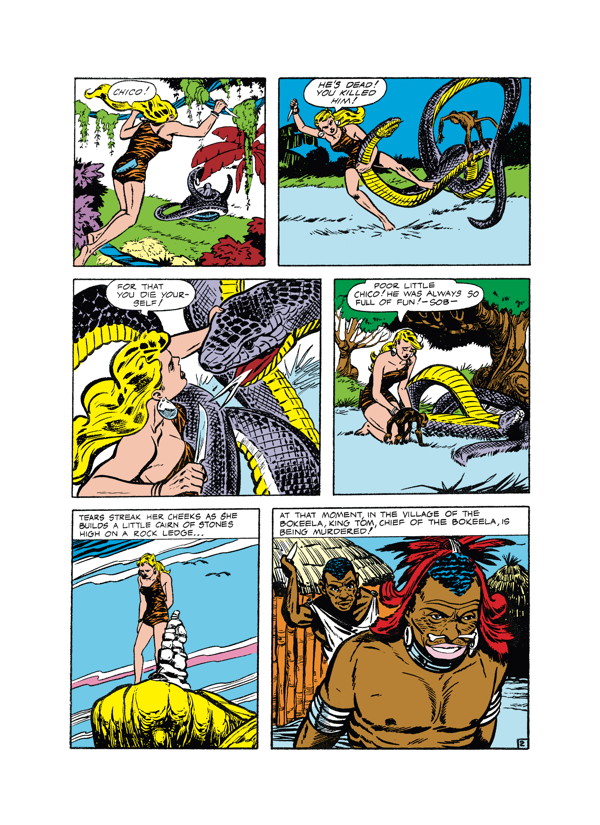
Even the usually astoundingly high-quality scripting of veteran Gardner Fox couldn’t do much with the formulaic strictures of this subgenre, but Powell’s illustration raises the tone. He reaches a creative zenith in 1954, his solid linework and enticing composition augmented by a burst of purely decorative design which makes ‘The Man Who Conquered Death’ a dramatic tour de force. When a series of murders and resurrections lead Cave Girl to a mad scientist who has found a time machine, she is transformed into an aged crone, but still possesses the force of will to beat the deranged meddler.
Whatever your political leanings or social condition, Cave Girl – taken strictly on her own merits – is beautifully rendered, and a terrific tribute to the talents of Powell and his team. If you love perfect comics storytelling, of its time, but transcending fashion or trendiness, this is a treasure waiting to be rediscovered.