Review by Graham Johnstone
Virginia Woolf’s novels are a century old, but her fictional biography of bisexual hero(ine) Orlando, still resonates today.
That presumably inspired this adaptation by Jules Scheele, continuing a theme from Queer – A Graphic History, and companion works. Though latterly known for illustrating such non-fiction, he’s also drawn and written fiction comics. For a first book-length project without a writing partner, an adaptation makes sense, but isn’t Woolf difficult?
Virginia Woolf is famous not only for her sexual progressiveness, but also her literary experimentation. 1925’s, admired Mrs Dalloway was a downbeat, day-in-the-life, stream of consciousness novel. Orlando, in time-frame and premise, could hardly be more different. Inspired by Woolf’s real-life lover, aristocratic author and libertine, Vita Sackville-West, it’s a romance in the senses both of ‘love story’, and ‘remote from everyday life’. Orlando moves through centuries, moves from page-boy to poet, extrovert to introvert, in and out of costumes, and from man to woman. So, compared to other Woolf novels, there’s a little more action, and a lot more visual inspiration, yet it’s a very narrated book, so potential challenge to adapt.
Scheele adapts all chapters, spanning the 16th to 20th centuries, and from verdant shires to sun-washed Constantinople. He features the friends, lovers, haters, and famous authors. However, much of Woolf’s artistry is in the narration – her lyrical phrasings, and ironic musings on the limitations of fiction and biography. For example, the bemoaned ‘lack of facts’ about (Orlando’s ambassadorship of) Constantinople might cheekily acknowledge Woolf’s ignorance. While, her narrator’s fragmentary account, (an uprising, torching of the Sultan’s palace, and Britain’s honouring of Orlando), hints at darker ‘diplomacy’. Scheele wisely retains this narration, aptly presented on scorched parchment, with some of Woolf’s words (‘damaged’ and ‘destroyed’) partially burnt away. Elsewhere, the narration is mouthed by characters and creatures, and in the striking opening sequence, the severed head of an ancestor’s foe, dodging Orlando’s sword. Scheele confidently adapts, and creatively expands, Woolf’s original.
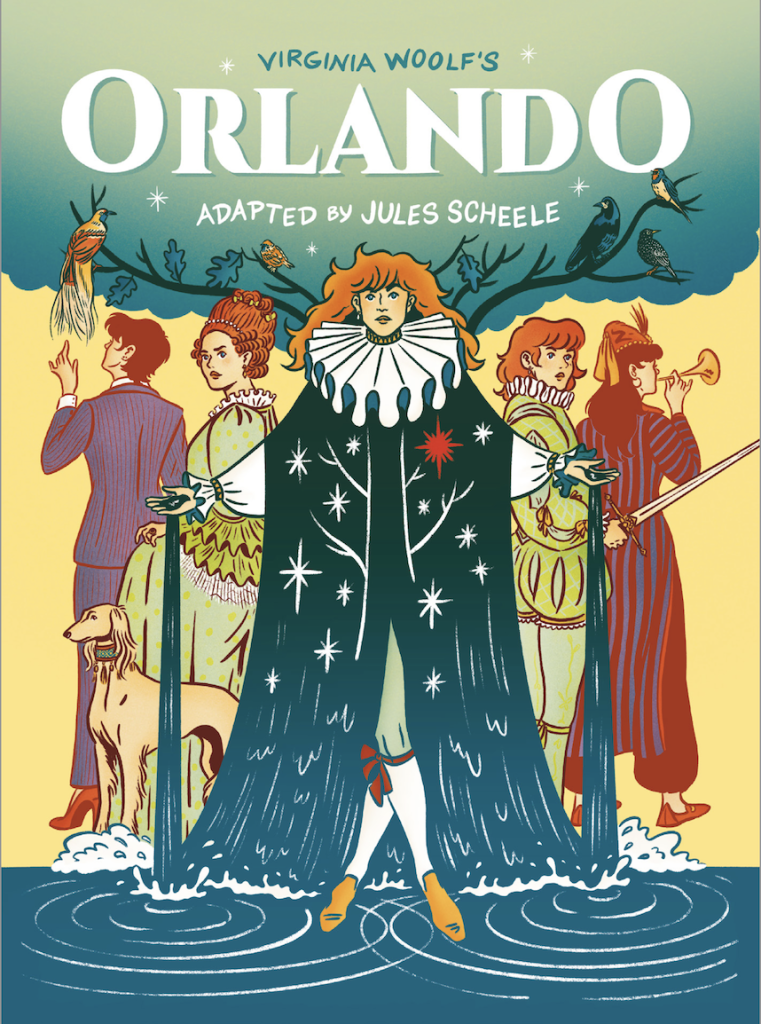
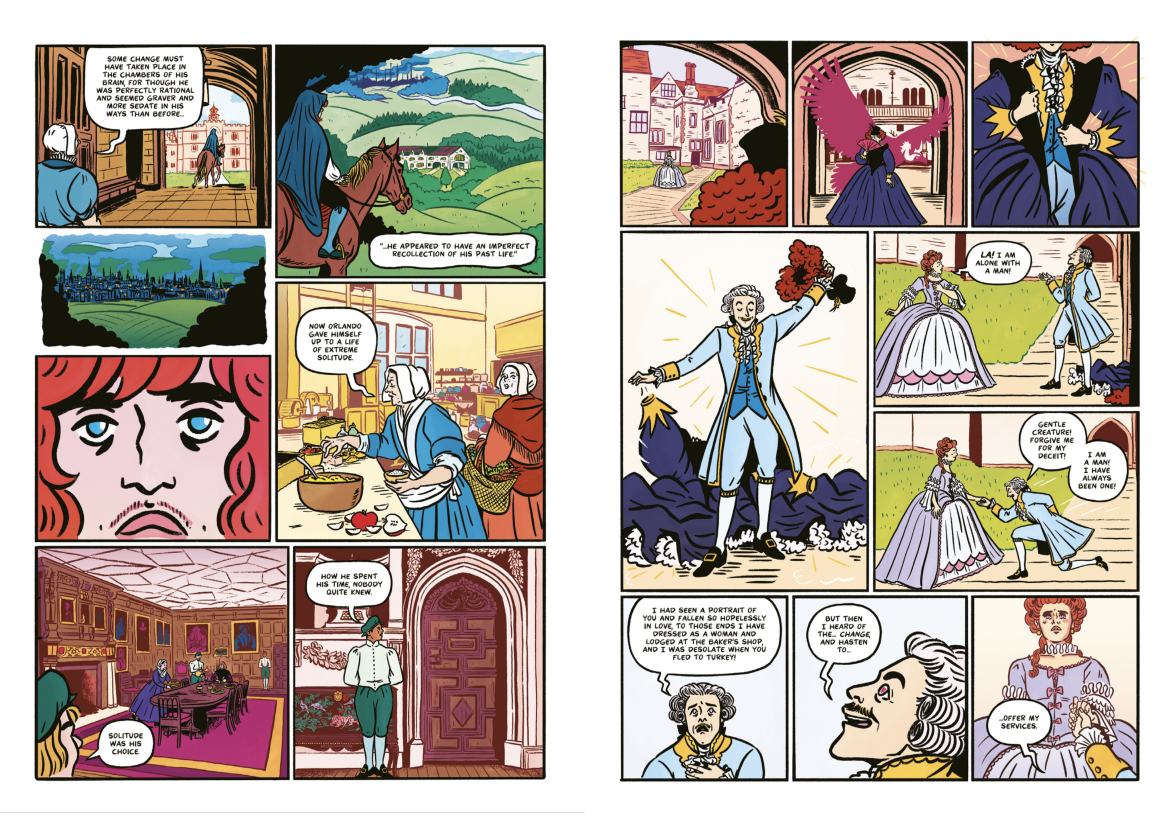
Scheele’s version, (‘art assisted’ by Garry Mac) also enchants visually, with distinctive characters, extravagant settings, and lush brushwork. He makes it seem effortless, but it’s built on craft and graft – like strong page design and scene-setting details. Scheele deftly orchestrates a variety of comics techniques, like montage, irregular and borderless panels, thought bubbles showing imaginings, and (for foreign speech) balloons with pictograms. There’s hardly a lacklustre page, though readers are unlikely to stop and study – they’ll be too immersed in Orlando’s’ story.
For a first major work in colour, it’s a triumph, instantly conjuring, in mahogany, crimson and emerald, all the opulence of Orlando’s mansion. Palettes adapt, though, cooling for ‘the great frost’, and warming for Constantinople. The line-art, too is often colourised, adding focus and depth, signifying imagined scenes, and amplifying visual appeal. Scheele’s colour, then, is both storytelling device, and optical delight.
Scheele’s queer consciousness sensitively updates Woolf’s, for example a montage of current anti-trans agendas, plausibly dropped into the ageless hero(ine’s) fever dream. The depiction of the gender non-conforming Shelmerdine, not as betwixt male and female, but a burly ‘bear’ adds a further level of contemporary diversity. Woolf typically alludes to sex acts, but Scheele can show naked flesh, conveying intimacy and passion, while deftly omitting the specific mechanics. That’s all a sensitive extension of Woolf’s joyously liberated original.
Scheele’s Orlando, then, is true to the content and spirit of this never-more-topical classic, and a creative original work. Open-minded readers will enjoy the party.
Woolf’s original contained images – ‘found’ artworks purporting to be her characters, suggesting she, above all, would be delighted with Scheele’s visual reimagining.