Review by Karl Verhoven
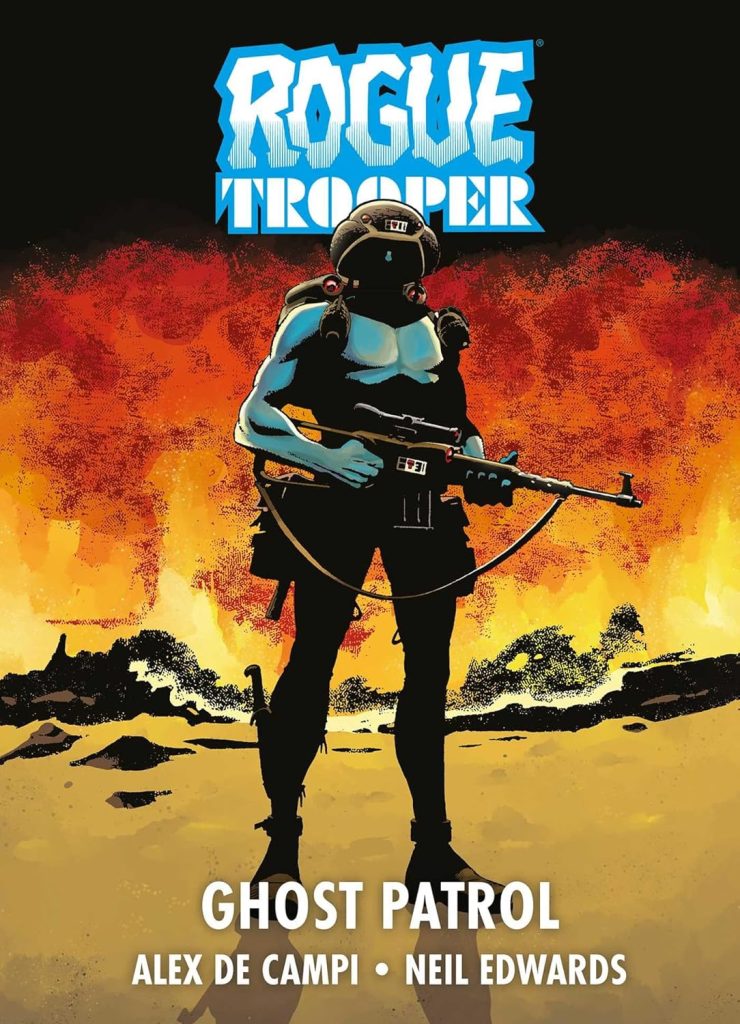
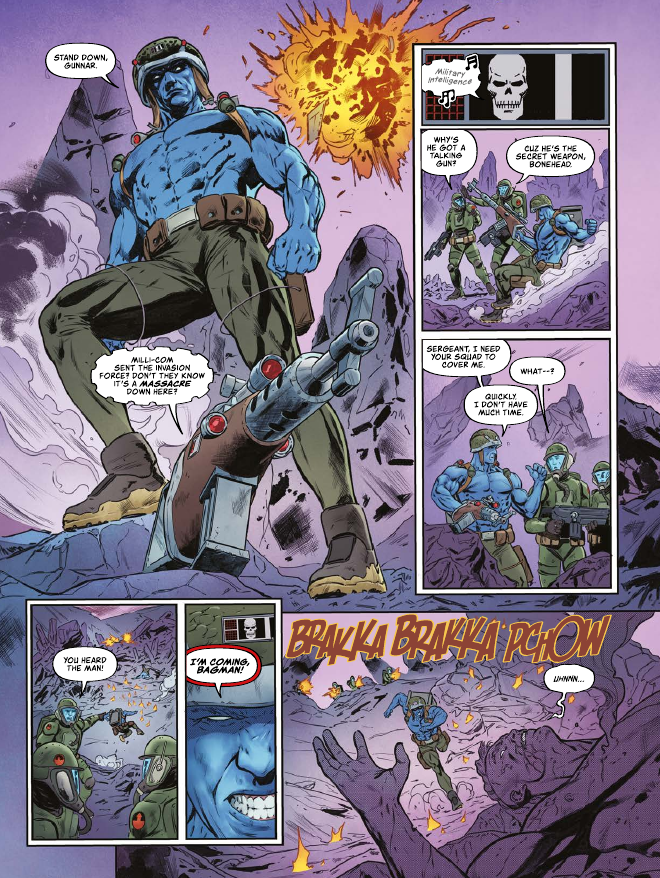
There have been plenty of Rogue Trooper stories over the years, but until now no-one’s thought to consider his earliest experiences, and that’s what Ghost Patrol does, at least in parts. Our first sight of Rogue is as he removes the personality chip from a dying fellow genetic infantryman and attaches it to his bag. Welcome Bagman. Rogue’s story thereafter played out in the original series as written by Gerry Finley-Day and now most readily available as Rogue Trooper: The Complete Collection.
Alex de Campi looks back at those early days via combat veteran Jock Mackinrow returning to Nu-Earth in search of a former comrade a decade after his last message was received. As if that wasn’t impetus enough, he’s told “Imagine a programme so secret, so full of experimental research, that only a single general knows its exact location”. We’re given flashbacks to Mackinrow’s past, and and his team eventually hook up with Rogue to discover there have been improvements in Nort technology.
De Campi rushes Rogue and Mackinrow from one crisis to the next in what’s an extremely episodic plot. In that way it’s true to the rambling nature of the original series, and the pot is sweetened via the inclusion of the series’ only good supporting characters Brass and Bland, although they’re just part of a weak episode that feeds into the meandering.
As noted in de Campi’s introduction, artist Neil Edwards has to create a different environment for practically every episode, and for a while does so in a generic style, although every story contains at least one impressive scene-setting image. However, beginning with a scene of the cast needing to head beneath the sea, Edwards ups his game and the art becomes more imaginative overall.
The undersea sequence is where the cast stop following clue to clue and inherit a greater purpose. It leads to a secret well dropped and fulfils the original premise of revealing the personalities on which the Rogue Trooper and his associates were based. De Campi doesn’t greatly use those associates, although when she does, Gunnar in particular makes strategic interventions.
Ghost Patrol captures the mood of the old Rogue Trooper, while also incorporating updated science, but it’s not memorable in the way other more recent outings for Rogue have been.